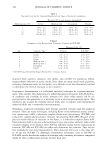
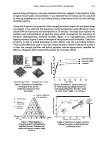
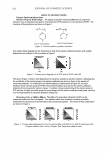
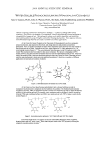
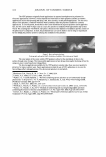
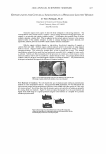
2006 ANNUAL SCIENTIFIC SEMINAR 435 WATER SOLUBLE PHOTOCROSSLINKING MATERIALS IN COSMETICS Amy S. Cannon, Ph.D., John C. Warner, Ph.D., Kei Saito, Sofia Trakhtenberg and Justin Whitfield Center for Green Chemistry, University of Massachusetts Lowell, 1 University Avenue, Lowell, MA 01854 amy_cannon@uml.edu Thymine containing polymers have been shown to undergo 2 + 2 photocross/inking under various conditions. This process is an example of"bioinspiration" where a physiologically relevant mechanism is extrapolated for commercial use. These polymeric systems can be used to immobilize and insolubilize watersoluble polymers by using UV light to control their rheological properties. These aqueou� non-toxic, environmentally benign materials are useful in a number of cosmetics applications. At the Center for Green Chemistry at the University of Massachusetts Lowell we extrapolate natural mechanisms, take inspiration from them, and design materials and products around these phenomena. There are plenty of examples in nature where inspiration can be derived. One such example is that of base pairs in our DNA Thymine in our DNA, when exposed to UV light, undergoes a 21t + 21t cross-linking reaction (Figure 1). 1 '2 The cross-linking of these base pairs in our DNA places a kink in the strand. This mechanism has been linked to skin cancer in humans. This process is damaging in DNA strands however, the photoreactivity of thymine has been used to benefit human health as well. It has been used in the medical field to treat the skin disease psoriasis and at the Center for Green Chemistry we have used the same mechanism to create non-toxic photoactive polymers, 3 which have a number of different applications in materials and cosmetic chemistry. 3i o�)---' )jt H3C;c-� ! o=f--o- � o=_,,,)-_,)::\ H, = �� � .. Figure 1. Photodimerization of thymine in a DNA strand. At the Center we have taken thymine and attached it into a styrene backbone in order to incorporate the photoreactive component into the backbone of a polymer. The thymine-based monomer (vinylbenzyl thymine, VBT) is copolymerized with a variety of co-monomers in order to obtain the desired solubility of the resulting polymer. For example, ionic monomers such as vinylbenzyl triethyl ammonium chloride (fEQ) and vinylphenylsulfonic acid (SSA) are copolymerized with VBT to make a water soluble system (Figure 2). Figure 2. Ionic photoreactive polymers. VBT:TEQ (left) and VBT:SSA (right) It has been found that E. Coli contains an enzyme called DNA photolyase which recognizes thymine dimers and will "unzip" them. 4 These same enzymes work in our VBT polymers, allowing for completely reusable polymer systems. 5 • 6

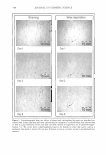
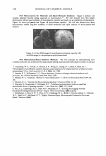
436 JOURNAL OF COSMETIC SCIENCE The VBT polymers originally found applications in aqueous based photoresist polymers for electronic applications. However, recent research has found uses for these polymer systems in cosmetic applications such as hair perming and dying7 and, more recently, in nail polish applications. The non-toxic nature of the polymers, combined with their water-solubility make the polymers suitable for cosmetic applications. In a recent patent, researchers at the Center found that the aqueous polymer can be applied to hair the hair can be held in shape (such as a curl), the polymer is irradiated with light and the hair is then rinsed. The resulting hair will hold the curl and is a function of the duration of irradiation and the content of the photoreactive component. In short, the permanent hair curl can be made to last as long as required just by fine-tuning the polymer system or altering the irradiation of the polymer. Figure 3. Hair curling technology Coating and curling hair (left) Irradiation (middle) After rinsing curl (right) The ionic nature of the water soluble VBT polymers allow for the attachment of dyes to the surface through ionic charges. This has possible applications in hair dying, allowing for the dying of hair by using non-toxic, water based ionic charged dyes. The diverse applications available for the VBT polymer systems make these non-toxic polymers attractive for many cosmetic uses. Future applications include the use of DNA photolyase to reverse the hair perming effect and applications of the photoresist polymers in nail polish. 1 Blackbum, G.M. Davies, R.J.H. J. Chem. Soc. C, 1966, 2239. 2 Lamola, A.A Mittal, J.P. Science, 1966, 154, 1560. 3 Warner, J.C. Lloyd-Kindstrand, L. "Thymine-containing styrene polymers as environmentally benign photoresists" in Biopolymers, Vol. 9, Matsumura, S. Steinbuechel, A, Eds. Wiley-VCH Verlag GmbH, Weinheim, Germany 2003, pp 165-174. 4 Sancar, A Chem. Rev. 2003, 103, 2203-2237. 5 Whitfield, J. Morelli, A Warner, J.C. Journal of Macromolecular Science A, 2005, 42(11), 1541-1546. 6 Warner, J.C. Morelli, A Ku, M.-C "Methods ofsolubilizing and recycling biodegradable polymers containing photoreactive moieties using irradiation" U.S. Pat. Appl. Publ. 2003, 4 pp US 2003224497 7 Cannon, AS. Raudys, J. Undurti, A Warner, J.C. "Photoreactive Polymers and Devices for use in Hair Treatments" PCT Int. Appl. 2004, 23pp WO 2004058187.
Purchased for the exclusive use of nofirst nolast (unknown)
From: SCC Media Library & Resource Center (library.scconline.org)