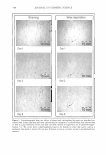
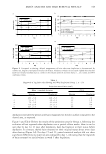
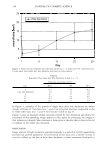
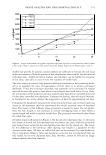
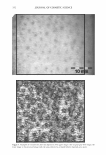
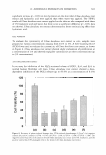
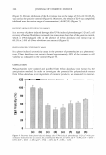
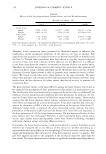
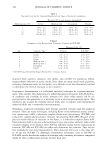
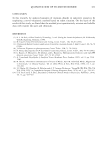
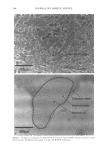
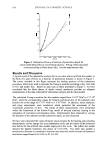
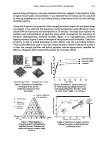
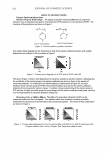
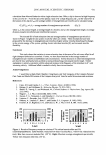
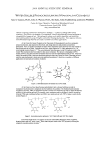
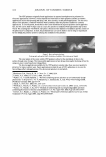
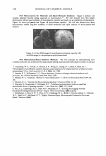
2006 ANNUAL SCIENTIFIC SEMINAR 423 UNDERSTANDING THE MICRO-PHYSICAL AND MECHANIC AL PROPERTIES OF THE HAIR CUTICLE VI A DAMAGE AN ALYSIS Manuel Gamez-Garcia, Ph.D. Ciba Specialty Chemicals Corporation) 540 White Plains Road) Tarrytown) NY 10591 Abstract: This paper presents a systematic analysis of various patterns of hair cuticle damage. The analysis suggests that as the hair grows from root to tip the cuticle envelope gradually ages by weathering and grooming stresses losing its natural visco-elasticity and its ability to dissipate shear, compression, and extension stresses. The results show that patterns of cuticle damage such as cuticle lifting. de-cementation, buckling, bulging, cracking, and breakage do not only occur by mechanical stresses imposed during combing, but also as the hair cuticle expands and contracts naturally during wetting and drying. The analysis also suggests that most types of cuticle damage occur because the weathering stresses induce physical-chemical changes in the cuticle protein structure. These changes appear to compromise the cuticle's protein ability to bind water and consequently affect negatively the cuticle visco-elastic behavior. The role of conditioners will be discussed Discussion and Analysis: Changes in the aesthetic properties of hair are of great concern to cosmetic formulators. Damage to the cuticle at the hair surface is the main cause for hair aesthetic properties degradation. In order to prevent this type of damage it is critical to understand the various mechanisms leading to cuticle damage during grooming practices. In this paper an analysis of patterns of cuticle damage is presented. The analysis shows that various common patterns of cuticle damage produced during grooming occur because the cuticle protein structure loses its natural softness and visco-elastic characteristics, thereby becoming gradually rigid and brittle. This rigidization of the cuticle occurs either because the cuticle cell components lose transiently or irreversibly their hydration water that acts as protein plasticizer, or because the protein structure is irreversibly changed. For instance, Fig. 1 a shows a SEM micro-graph of a severe pattern of cuticle buckling resulting from cyclical tension stresses on a hair fiber when stretched cyclically at low moisture conditions (IO % RH). This pattern of damage is fully reversible and results from a transient lack of water in the cuticle cells. As the cuticle cells are devoid of its natural plasticizer "water" there is a mismatch in the visco-elastic response of the various inner layers of a cuticle cell and the whole cuticle cell buckles under Poisson compression stresses ( 1 ). The proof that this type of damage is fully reversible is sho'Nn in Fig. I b, where the same hair fiber shown in Fig. 1 a can be seen after it has been allowed to absorb water. Observe in Fig. I b that after the proteins in the cuticle cells are hydrated, the latter are able to recover from their distorted buckled state into their normal shape. Note that the fiber depicted in Fig. I a, is the same as that one shown in Fig. I b, but before hydration. Fig. 2 shows, on the other hand, a form of irreversible damage that often occurs in hair when its cuticle surface is devoid of water and builds up enough static charge to produce a discharge. The electric charge is produced tribo-electrically on the cuticle surface by the

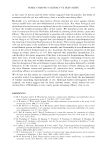
424 JOURNAL OF COSMETIC SCIENCE combing :friction on dry hair and accumulates as the hair surface lacks the electrical conductivity to dissipate the charge. This type of damage can actually be well reproduced in the laboratory by using a Tesla Coil to simulate the discharges on hair. Fig. 1 a and I b) Same hair fiber, first (1 a) with 100 extension cycles at I 5 % deformation at 10 % RH and then ( 1 b) after hydration with water for 15 minutes. Fig. 2) Surface of hair fiber showing bulges and craters produced by static "fly away" discharges References 1) M. Gamez-Garcia, "Cuticle De-cementation and Cuticle Buckling produced by Poisson Contraction on the Cuticular Envelope of Human Hair," J. Soc. Cosmet. Chem. 49,213-222,(1998)
Purchased for the exclusive use of nofirst nolast (unknown)
From: SCC Media Library & Resource Center (library.scconline.org)