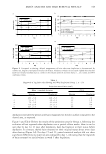
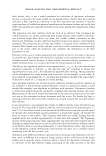
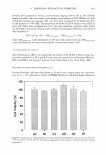
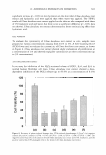
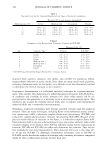
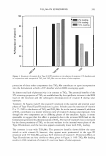
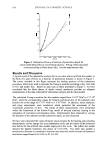
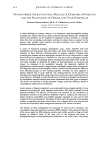
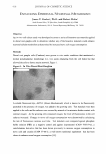
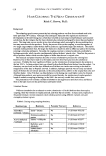
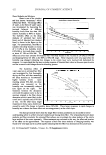
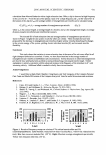
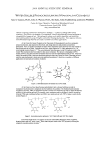
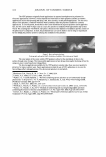
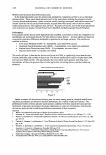
2006 ANNUAL SCIENTIFIC SEMINAR 425 AN INVESTIGATIONOF THE EFFECTS OF OR DER OF ADDITION ON THE MECHANISM OF INTERACTION OF POLYELECTROLYTE-SURFACT ANT SYSTEMS IN THE SEMI-DIWTE AND CONCENTRATED REGIME Lisa R. Huisinga and Robert Y. Lochhead, Ph.D. The Institute for Formulation Science, School of Polymers and High Performance Materials The University of Southern Mississippi, Hattiesburg, MS 39406-0076 INTRODUCTION Formulators of complex mixtures have long known that the characteristics of their final formulation and the position of "equilibrium" often depend critically upon the order of addition of ingredients and the precise processing conditions under which the fonnulation was made. This is especially true of systems comprising polyelectrolytes and oppositely charged surfactants in the semi-dilute regime, because both polyelectrolyte conformation and surfactant micellar association structures are strongly influenced by the ionic environment of the polymer and surfactant molecules (J). The investigation of the effects of order of addition requires examination of a myriad of samples and it is virtually impossible by conventional techniques. Employing our previously developed high-throughput screening method, capable of generating phase diagrams over a large range of polymer and surfactant concentrations, is ideal. Using a liquid handling system for sample preparation, we are able to analyze nearly l000 samples per day, making the above goals of understanding electrolyte effects and coacervate structure-property relationships attainable. EXPERIMENTAL Materials. Poly (4-vinyl pyridine) and poly (2-vinyl pyridine) were synthesized according to previously published methods (2). Sodium dodecylbenzene sulfonate, 23% actives, was obtained from Rhodia lnc. and used as received. Sodium chloride (NaCl), A.C.S. certified grade, was used as received from Fisher Scientific. Distilled, deionized water was used in all samples. Sample Preparation. Poly (vinyl pyridine) pre-mixes were made by dispersing the polymer powder in water and adjusting pH as desired using HCl. The surfactant was supplied as a viscous liquid and was diluted with water to make pre-mixes of a given % actives. Pre-mixes of sodium chloride were made by dissolving NaCl solids in water. Formulation samples for phase diagram construction were prepared using a Beckman Coulter Biomek FX Laboratory Automation Workstation. Programs were designed to create approximately 200 samples in less than one hour, with repetitions included to ensure accuracy. 96-well plates with glass vials were used as sample vessels. A layering technique was applied where the materials were added s eq uentially to the 96-well plate vials, such that the layers were allowed to inter-mix before the entire plate was vortexed to provide complete sample mixing. This layering of individual ingredients provides insight into the effects of introducing the NaCl first to the surfactant versus first to the polymer. Phase Separation Analysis and Data Visualization. UV-Vis absorbance measurements were used to indicate the relative amount of coacervate formed in each sample. These measurements were taken on each well in the 96-well plate using a Tecan Safire Multifunction Multiplate Reader with a fixed wavelength of 410nm. The absorbance units are plotted as a function of% actives polymer and% actives surfactant. A sample contour phase diagram is shown in Figure 1. � ................... . r ····················- Figure 1. Sample contour phase diagram. A color gradient is used to represent the amount of UV-Vis absorbance in the contour phase diagram. The abSOibance units are correlated to the amount of coacervate, where high phase separation (red) indicates a high amount of coacervation and no phase separation (blue) indicates no coacervation.

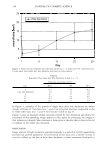
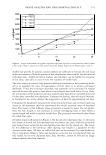
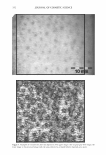
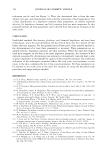
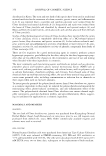
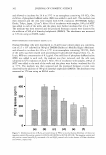
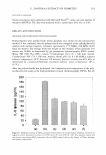
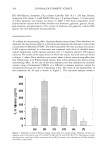
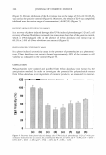
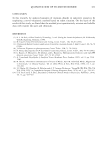
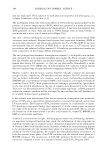
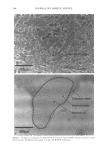
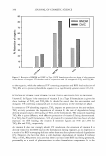
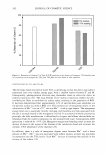
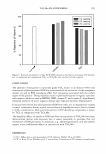
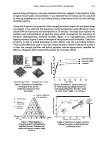
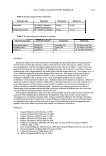
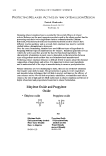
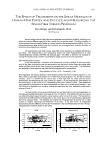
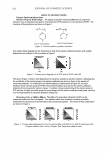
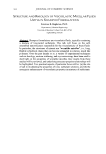
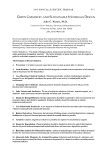
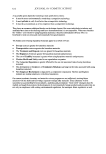
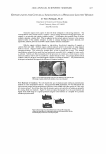
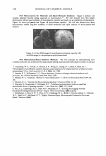
426 JOURNAL OF COSMETIC SCIENCE RESULTS AND DISCUSSION Polymer-Suriactant Interactions. Structure-Property Relationships. The impact of polymer structural differences on coacervate formation was investigated using poly (4-vinyl pyridine) (PVP) and poly (2-vinyl pyridine) (P2VP). The structures of these polymers are shown in Figure 2. +o N H' Poly ( 4-Vinyl Pyridine) Poly (2-Vinyl Pyridine) Figure 2. Cationic synthetic polymer structures. The contour phase diagrams for the interaction of each of the cationic synthetic polymers with sodium dodecylbenzene sulfonate (LAS) are shown in Figure 3. (a) (b) Figure 3. Contour phase diagrams of (a) PVP and (b) P2VP with LAS. The data in Figure 3 shows a clear dependence of coacervate amount on polymer structure, indicating that the availability of the cationic group to the anionic surfactant may be a key factor in the amount of coacervate produced. As evidenced by the limited amount of coacervation in Figure 3b, the steric hindrance of the cationic group of P2VP by the polymer backbone may prevent the anionic surfactant molecules from accessing the cationic charge. In contrast, the para-positioning of the cationic group in PVP provides a highly accessible group for ion-exchange with the anionic surfactant head group, resulting in a very high amount of coacervate formation (Figure 3a). Electrolyte Order of Addition Effects. The effect of a monovalent electrolyte (NaCl) on the coacervate profile was also investigated. Two addition orders were examined, revealing a possible mechanism of coacervation in the semi-dilute and concentrated regimes. The results of these experiments are shown in Figure 4. Figure 4. Contour phase diagrams for poly (4-vinyl pyridine) with LAS (a) No Salt (b) Surfactant, Salt, Polymer addition order and (c) Polymer, Salt, Surfactant addition order.
Purchased for the exclusive use of nofirst nolast (unknown)
From: SCC Media Library & Resource Center (library.scconline.org)