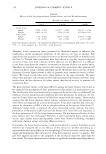
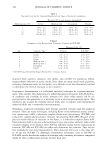
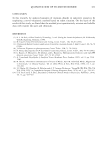
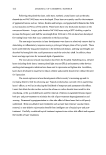
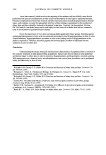
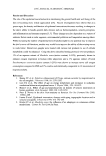
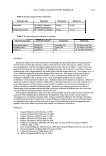
2006 ANNUAL SCIENTIFIC SEMINAR 419 Table 2: Dyeing using peroxide or equivalent Reaction type Reactants Permanent Reference Enzymatic 02 or H2O2 + enzyme + Varies 6a, 6b. standard dye precursors Melanin precursors 02 + indoles or indolines Varies 7a, 7b Table 3: Dyeing using neither peroxide or coupling Reaction/reactants Peroxide tolerant Permanent Reference Fiber reactive dyes Usually No Potentially Yes 8. US Patent 6447554 Polymeric dyes Usually No Usually No 9. US Patent 3597468 Pigments Usually No No I 0. US Patent 6328950 Discussion. Despite the number and variety of alternative technologies for dyeing hair that have been proposed in the last 50 years and the fact that many of these chemistries have achieved technical viability, none has proved competitive with the conventional oxidative dye process. Review of Tables I, 2 and 3 shows that most of the processes are not compatible with hydrogen peroxide, which therefore necessitates a separate bleaching step with hydrogen peroxide for shades lighter than the original hair color. This separate step is a severe limitation especially for products designed for at home use. Also many of the processes deposit dyes on, or only slightly penetrated into the hair surface which generally makes them less durable or permanent compared to dye in the hair cortex. Such technologies therefore are not competitive in performance with conventional oxidative dyes. In addition many of the reactants are expensive, difficult to synthesize, and have stability concerns. Finally there is the requirement that a wide range of shades must be available and many of these chemistries are not able to produce even the minimum combination of yellow, red and blues needed to blend into shades. Frequently the chemistry only produces color in a limited range of the spectrum, and the individual colors may be formed at different rates due to the wide \"ariety ofreactant structures needed to vary the dye color. The stringent requirements to color hair to the variety of shades and in the relatively short reaction times associated with modem products, demonstrate the apparently unique nature of the current oxidative coloring process in satisfying consumer needs. Despite considerable efforts by the scientific community, no alternative process has yet come close to the performance, reliability and ease of use of these products. It is hoped that this review will focus attention on some of the weaknesses of previous approaches and possibly direct future efforts to provide more suitable and competitive alternatives. References. J. Clairol, US Patent 4,921,503, May I, 1990 2. L'Oreal, US Patent 6,077,320, June 20, 2000. 3. Clairol, US Patent 4,932,977, June 12, 1990. 4. Henkel, US Patent 6,770,102, Aug 3, 2004. 5. Henkel, US Patent 6,790,239, Sept 14, 2004. 6. (a) Procter and Gamble, US Patent 3,957,424, May 18, 1976 (b) Novo Nordisk, US Patent 5,948,121, Sept 7, 1999. 7. (a) L'Oreal, US Patent 5,178,637, Jan 12, 1993 (b) L'Oreal, US Patent 6,258,131, July 10, 2001. 8. Procter & Gamble, US Patent 6,447,554, Sept 10, 2002. 9. L'Oreal, US Patent 3,597,468, Aug 3, 1971. 10. Wella, US Patent 6,328,950, Dec 11, 2001.

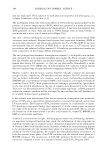
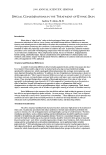
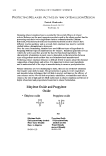
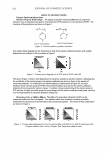
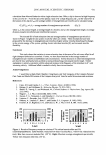
420 JOURNAL OF COSMETIC SCIENCE PROTECTING RELAXER ACTIVES BY WAY OF EMULSION DESIGN Patrick Obukowho Advantage Research Lab LLC Woodbridge, NJ Designing relaxer emulsion base is essential for the overall efficacy of relaxer actives. Relaxers are the most aggressive products used in the ethnic product line for processing curly hair. Active ingredients such as sodium hydroxide, Lithium hydroxide, Potassium hydroxide and Guanidine hydroxide used in relaxers have different reaction pathway and as a result, their emulsion base must be carefully studied before a formulation is drawn out. Over the years, formulating chemists have used different types of ingredients in designing different types of emulsion base for relaxers. Emulsions generally serve as vehicles for actives and they provide the base for functional ingredients. The characteristic of emulsions in most cases is dependent on the interaction between types of ingredients used and how they are formulated and manufactured. Predicting relaxer emulsion behavior is difficult if little is known about the chemical composition of ingredients and actives. It is important to know your ingredients and to understand all of the steps in manufacturing to ensure a good production. Relaxer emulsions are very challenging to make, they are one of the few emulsions that require some skills to make. This presentation is going to review ingredients and manufacturing techniques that will help to protect and improve the efficacy of your relaxers actives. We will look at primary emulsifiers, co-emulsifiers and oils in relaxers, the role of high and low HLB surfactants in relaxer emulsion and the use of highly ethoxylated and propoxylated materials in relaxer formulation. Ethylene Oxide and Propylene Oxide • Ethylene oxide EO � Jjl H-C-C-H \I 0 Ethylene Oxide Ethoxylated fatty alcohols More water friendly Easy to dispene. R-OH + EO Propylene oxide H HJ H-C-C-H PO \I 0 Propylene Oxide Propoxylated fatty alcohols are less Water friendly more oil friendly R-OH + PO
Purchased for the exclusive use of nofirst nolast (unknown)
From: SCC Media Library & Resource Center (library.scconline.org)