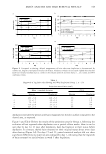
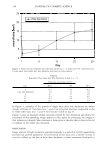
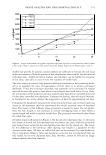
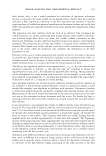
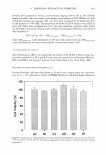
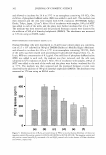
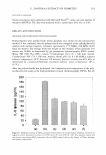
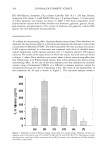
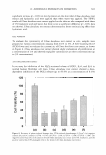
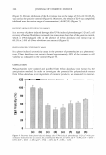
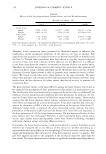
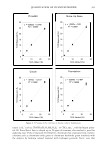
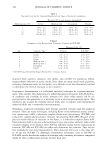
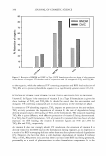
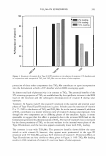
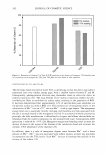
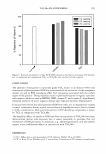
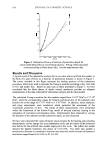
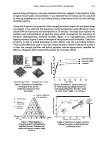
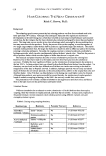
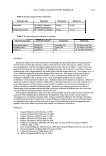
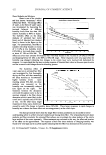
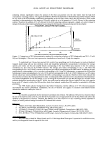
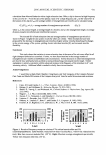
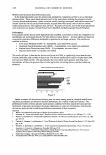
2006 ANNUAL SCIENTIFIC SEMINAR 431 a deviation from Maxwell behavior with a single relaxation time. Often, a dip is observed at high frequency in the curve for G". From the ratio of the plateau value of G' at high frequency (G'ct)) to the value ofG" at the bottom of this dip (G"min), the average number of entanglements per mice lie can be calculated using: G' ..,/G"min �Lelle= average number of entanglements per mice lie (Eq.2) where Le is the contour length, or average length of a micelle, and leis the entanglement length, or average distance along the micelle between intermicellar contacts. The rise and fall of both relaxation time and average number of entanglements per micelle is shown in Figure I (right) for one system results for others are similar. Three mechanisms have been proposed for the decrease in entanglements per mice lie at higher salinity: mice liar branching [7] changes in the scission energy of the system, yielding shorter individual micelles [8] and increased mice liar flexibility. Conclusion This study shows that variation in stress relaxation time is the cause of the salt curve effect for all eight shampoo formulations examined. Further, we have found maxima in the average number of entanglements per micelle at intermediate salt concentrations. Similar decreases in observed entanglements per micelle have alternately been ascribed to increased branching or decreased micelle length. Neither explanation is entirely consistent with the observed increase in the frequency of the minimum in G" with increasing salinity. Additional effort is needed to clarify these inconsistencies. Acknowledgements I would like to thank Mark Chandler, Craig Queen. and Tom Szurgyjlo of the Uniqema Personal Care Team and Sheila DiCostanza of the Uniqema Analytical Team for useful discussions and assistance. References I. Cates, M. E.and Candau. S. J., J. Phys. Condens. Matter, 2, 6869. (1990). 2. Rehage, H. and Hoffmann, H., Molecular Physics, 74,933, (1991). 3. Balzer. D., Varwig, S., and Weihrauch, M., Colloids Surfaces A: Physicochem. Eng. Aspects, 99, 233, (1995). 4. Magid, L. J., J. Phys. Chem 8,102, 4064. (1998). 5. Hassan, P. A., Narayanan, J., and Manohar, C., Current Science, 80, 980, (2001). 6. Lequeux, F., Europhys. Lett., 19,675, (1992). 7. Khatory, A., Lequeux, F., Kem, F., and Candau, S. J., Langmuir, 9, 1456, (1993). 8. Koehler, R. D., Raghavan, S. R., and Kaler, E. W., J. Phys. Chem. B, 104, 11035, (2000). 200 2000 • ii 1500 i 150 C 8 "$ 100 1000 o :11 soo I s: • 50 "i 0 0 a:: 1.5 2 3 3.5 4 5 5.5 6 %NaCl ,a 20.0 C .I I! 15.o IE 10.0 I I 5.o ifi 0.0 3 4 5 6 7 8 9 % NaCl 6000 I 4000: 0 2000 I .!I 0 I Figure I. Results of frequency sweeps on solution of7% sodium laureth sulfate and 3% cocamidopropylbetaine. Left: Red bars: measured low-shear viscosity (Pa.s) Yellow line: relaxation time (ms) Blue line: crossover modulus (Pa). (20° C). Right: Blue bars: average entanglements per micelle Yellow line: relaxation time (ms). (10° C).

432 JOURNAL OF COSMETIC SCIENCE STRUCTUREAND RHEOLOGY OF VISCOELASTIC MI CELLAR f LUIDS USEFUL IN SHAMPOO FORMULATIONS Srinivasa R. Raghavan, Ph.D. Department of Chemical Engineering University of Maryland, College Park, MD 20742 sraghava@eng.umd.edu Abstract: Shampoo formulations are viscoelastic fluids, typically containing a mixture of long-tailed surfactants. This talk will focus on the self assembled nanostructures responsible for the viscoelasticity of these fluids. In particular, the structures of interest are "wormlike micelles", i.e., long, flexible cylindrical chains that can become entangled in solution, much like polymers. Over the past decade or so, a variety of experimental techniques such as rheology, neutron scattering, and cryo-microscopy have been used to shed light on the properties of wormlike micelles. Key results from these studies will be reviewed, and underlying structure-property relationships will be highlighted. Two practical aspects of particular focus will be: (a) the role of salt in modulating the properties of ionic surfactant solutions and (b) the synergistic enhancement of viscoelastic properties in mixtures of surfactants.
Purchased for the exclusive use of nofirst nolast (unknown)
From: SCC Media Library & Resource Center (library.scconline.org)