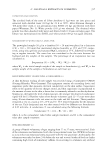
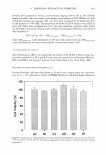
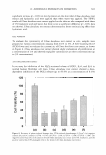
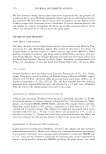
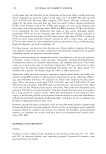
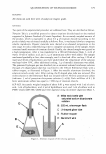
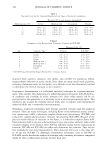
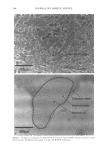
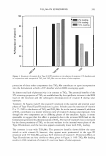
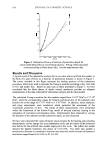
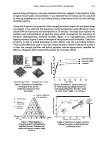
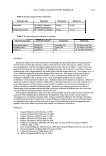
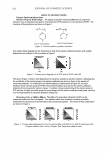
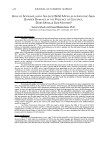
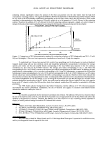
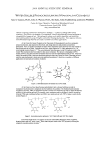
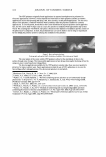
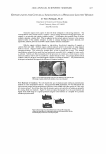
QUANTITATION OF TITANIUM DIOXIDE 379 REAGENTS All chemicals used here were of analytical reagent grade. METHODS Two parts of the experimental procedure are addressed here. They are described as follows. Titration. This is a modified protocol to detect titanium dioxide based on the method suggested in Japanese Standards of Cosmetic Ingredients. An accurately weighed amount of the product, which is equivalent to about 0.2 g of titanium dioxide (according to the product label), was calcinated carefully as follows: First, it was heated slowly to evaporate volatile ingredients. Organic materials were charred at an elevated temperature in the next stage. It took a relatively long time to complete calcinations of the sample, which contained small amounts of titanium dioxide. Finally, the charred sample was ignited at a high temperature. After it was transferred to a 500-ml Erlenmeyer flask, 3-4 ml of water, 30 ml of sulfuric acid, and 12 g of ammonium sulfate were added. The sample was heated gradually at first, then strongly, until it dissolved. After cooling, 120 ml of water and 40 ml of hydrochloric acid were added while the temperature of the solution was kept below 50°C. After additional cooling, 3 g of metallic aluminum was added. The generated hydrogen gas was absorbed into a saturated sodium bicarbonate solution through a U-shaped glass tuqe that was fitted to the 500-ml Erlenmeyer flask with a rubber stopper, as illustrated in Figure 1. After the metallic aluminum dissolved, the solution turned a violet color. After cooling, the U-shaped glass tube was removed. The violet solution in the Erlenmeyer flask was titrated with 0.1 N ferric ammonium sulfate (indicator: 3 ml of potassium thiocyanate solution (1➔10)). Each milliliter of 0.1 N ferric ammonium sulfate was equal to 7 .988 mg of titanium dioxide. ICP-AES. Accurately weighed samples of about 0.05 g were mixed with 3 ml of nitric acid, 1 ml of hydrochloric acid, 2 ml of hydrofluoric acid, and 1 ml of sulfuric acid in PTFE vessels (XPl 500, CEM) and were digested using microwave digestion (Mars 5, A: Wide neck bottle with saturated sodium bicarbonate solution B : 500-ml erlenmeyer flask C : LI-shaped glass tube D : Rubber stopper E : Aluminum wire Figure 1. Schematic diagram of the reducing apparatus.

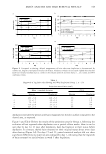
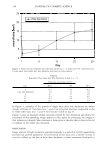
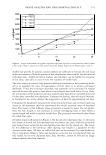
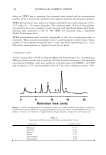
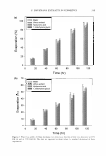
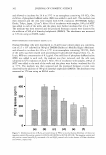
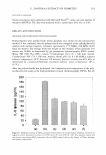
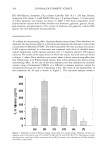
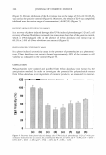
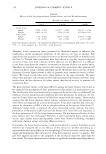
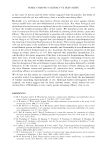
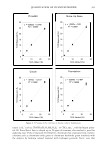
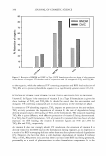
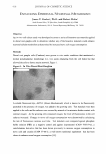
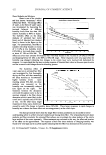
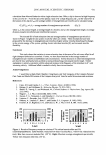
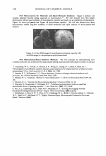
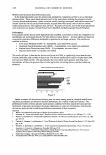
380 JOURNAL OF COSMETIC SCIENCE CEM) for 15 min at 400 W. The digested solutions were analyzed with ICP-AES (OPTIMA 3300DV). The following operational conditions were set for ICP-AES: inci dent power 2000 W cross flow nebulizer plasma gas flow rate 13 1/min auxiliary gas flow rate 0.5 1/min nebulizer gas flow rate 0.5 1/min sample uptake rate 1.8 m/1/min wavelength 323.45 nm. RES UL TS AND DISCUSSION Titanium has two different oxidation states, titanium(III) and titanium(IV). The redox reaction between them is the basis of the quatitation of titanium dioxide in our inves tigation. After calcification of other organic ingredients in the cosmetics, titanium dioxide was dissolved by hot concentrated H2S04 (the boiling points of H2S04 can be elevated by ammonium sulfate up to 500°C). The dissolved titanium(IV) was reduced to titanium (III) by aluminum. Solid zinc amalgam or chromium(II) chloride solution can also be used as reducing agent for titanium(IV) (7). The reduced titanium(III) was titrated against a standard oxidizing agent, Fe(III) (ammonium iron(III) sulfate), with potassium thiocyanate as an indicator. Cosmetics are very complex products. Frequently, more than 20 kinds of organic and inorganic materials are combined together. Although organic ingredients are eliminated by calcination, any remaining inorganic materials could create matrix interferences. In addition, many kinds of inorganic metallic oxides, such as zinc oxide, silica, talc, and iron oxides, remain after calcination. In order to test the accuracy and applicability of the proposed method in the presence of other cosmetic ingredients, we quantified known amounts of titanium dioxide from 1 % to 25% in four types of sunscreen cosmetics. Since the SCCNFP (Scientific Committee on Cosmetic Products and Non-Food Products) proposed the maximum concentration of titanium dioxide as 25%, we did not test over 25%. As shown in Figure 2, R 2 values were acceptable. It appears that linearity was established in the test range. Accuracy was evaluated via percent recovery. The value (i.e., the accuracy) of percent recovery was calculated as follows: Recovery (%) = [Measured amounts (%) / added amounts (%)} x 100 The results are summarized in Table I. The percent recoveries of the four types of formulation were in the range between 96% and 105%. These results reflect that the accuracy of the developed method was also good. We also analyzed seven commercial cosmetics labeled as containing titanium dioxide. We made a comparison between the proposed method and ICP-AES, one of the most powerful atomic analysis tools. The results, given in Table II, show that the titrated amounts accord well with the data from ICP-AES. It appears that the method proposed and studied in this article is adequate for quantifying titanium dioxide in diverse commercial cosmetics. There are many other analytical methods used for the quantitative determination of titanium, but few of them can be applied to cosmetics. A good example of an inappli cable method is colorimetric measurement using a UV-VIS spectrophotometer. A min eral acid solution of Ti(IV) produces yellow-orange-colored acidic cationic species, "per-
Purchased for the exclusive use of nofirst nolast (unknown)
From: SCC Media Library & Resource Center (library.scconline.org)