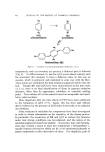
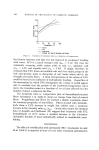
J. Soc. Cosmetic Chemists, 19,351-360 (May 27, 1968) The Rationale of a Dyes Synthesis Program F. F. LOFFEI.MAN, Ph.D.* Presented September 21-22, 1967, Seminar, Chicago Synopsis--The structural features which influence the electronic state of a molecule and thereby confer color to it are surveyed briefly. To illustrate the everyday approach involved in a practical dyes synthesis program, a colorless molecule is taken as a starting point and developed into a line of varying colored azo dyes. INTRODUCTION The color of any molecule is a function of its electronic and geo- metric constitution. It is this constitution that determines which wavelengths of light the molecule will absorb, and which will be trans- mitted or reflected to the eye. If the absorption is strong and selective, a clear bright color will result the more diffuse the absorption band, the duller will be the color. In actuality, of course, the color conveyed to the eye by a molecule being used as a dye or pigment will be a function also of additional factors such as the substrate involved (cotton, wool, etc.), the degree of aggregation of the dye molecules, the type of viewing light, and so forth. In short, the eye will perceive the net result of all the interactions going on in the entire colored system. The selective absorption by a molecule in the visible region of the spectrum (approximately 400-700 mt•) which gives rise to color is deter- mined by the mobility, or delocalization, of its electrons. The more * Dyes Research and Development Section, Organic Chemicals Division. American Cyana- mid Company, Bound Brook, N.J. 08805. 351

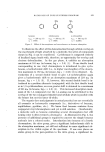
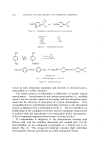
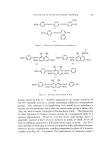
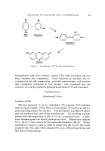
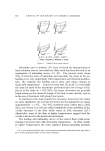
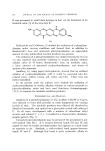
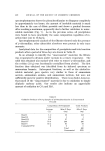
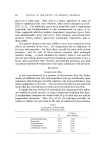
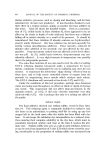
352 JOURNAL OF THE SOCIETY OF COSMETIC CHEMISTS • / •c--o /C----C•. --CH----N• •N----N• vinyl carbony] azomethine azo --N----O •NO• =•• •C•N nitroso nitro quinoid nitrile Figure 1. Chromophoric groups H.•C/CH2•cH2 Hc/CH2•cH2 Hc/CH2•cH Hc/CH•cH H2C•cH2/CH2 HC•cH2/CH2 HC•cH2/CH HC•cH2/CH2 cyclohexane cyclohexene 1,4-cyclohexadiene 1,3-cyclohexadiene X ..... = 165 m• (1) X .... = 182 m• (2) X .... -- 224 m• (3) X .... = 256 m• (4) Figure 2. Effect of increasing electron delocalization on absorption maximum mobile (delocalized) the electrons, the lower the energy required to raise them to excited higher energy levels, the higher the wavelength of the light absorbed, and, therefore, the deeper the color of the molecule. Historically, before science had progressed to its present level of knowledge and technology, electron delocalization was not so termed, but its relation to color was being discussed unknowingly, perhaps, in terms such as chromophores, chromogens, auxochromes, unsaturated centers, etc. It had been observed that colored organic molecules generally contained at least four of certain types of atomic groupings, and these groupings were termed chromophores, from the Greek "to bear color." This term is still in wide use today. It was further dis- covered that these chromophores contained atoms bound together by double or triple bonds, and hence the term "unsaturated centers" arose. A list of the more common chromophores is shown in Fig. 1. With the advent of new knowledge concerning the nature of the chemical bonds between atoms, it became possible to formulate a much more fundamental theory for discussing color in relation to structure, one which could accommodate the wide variety of structures which give rise to color. When one speaks of electron delocalization in unsaturated molecules, one is simply saying that one or two of the electrons associated with one of the multiple-bonded atoms are able to become associated with other atoms in the molecule as well. This is accomplished by an overlapping of the orbitals in which these electrons move.
Purchased for the exclusive use of nofirst nolast (unknown)
From: SCC Media Library & Resource Center (library.scconline.org)