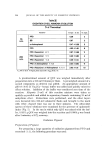
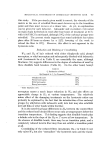
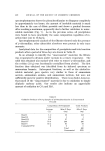
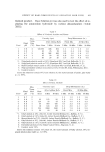
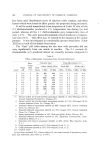
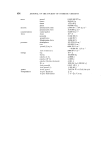
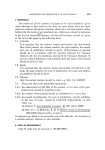
COMPARISON OF CONSUMER PANELS IN PAIRED PREFERENCE TEST. II 389 In contrast, the national panel, being a cross section of the popula- tion, was thought to need some guidance in responding. Consequently, these panelists received a more structured questionnaire: four separate questions called for likes and dislikes about the two test products, and two separate questions asked: "How would you describe the flavor of... ?" These description questions produced more meaningful in- formation than the like-dislike questions, which in turn tended to pro- duce general information. For the national panel, 3407 separate comments were punched, and for the local, 763 were punched. Although the laboratory profile panel found no differences in texture, consistency, degree, and duration of suds, these physical properties (i.e., nonflavor) as well as observations on tooth cleansing were cited. A slightly higher percentage of the national panelists' comments were in the nonflavor category, i.e., 15% national and 13% local. But this is to be expected, since the national panel's instructions required one sample to be used for the first week and the second sample for the second week. This procedure permitted observa- tions on tooth cleansing, brightening, and whitening. Another difference in performance between the two panels is directly ascribable to the difference in questionnaires. The national panel produced 5.1 flavor comments per person, while the local panel produced 2.1 flavor comments. But on the other hand, of all the national panel's flavor comments, 47% were general comments whereas, of all the local panel's flavor comments, only 24% were general ones. Another way of stating this is: the average number of specific (as opposed to general) flavor comments per person was 2.7 for the national panel and 1.6 for the local one. It remains to determine if, despite the difference in "volubil- ity," the two panels provided the same or different information. Rank Order of Specific Flavor Comments One way of determining this is shown in Table VI, which ranks by frequency the specific flavor comments obtained from both panels. These have been segregated according to preference and they include both the positives about the preferred toothpaste and the negatives about the other. In addition, the adults are considered separately from the chil- dren, since they obviously had different attitudes. Two points are immediately evident: (a) good agreement in rank order occurred with the R-preferrers of both panels and with the W-pre- ferrers of both panels (b) the R-preferrers and the W-preferrers saw the issues between the two toothpastes differently. For example, the adult

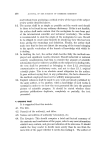
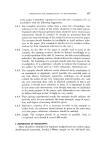
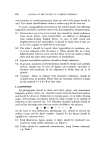
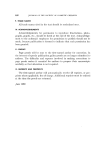
390 JOURNAL OF THE SOCIETY OF COSMETIC CHEMISTS R-preferrers commented most often about flavor-level and flavor-type the adult W-preferrers commented most often about the cleansed im- pression in the mouth and flavor-level. The children R-preferrers were mainly concerned with hot factors, but the children W-preferrers placed hot factors last in rank, emphasizing flavor-type. To help visualize the way the preferrers saw the pairs of samples, typical descriptions are shown in Table VII. The table also illustrates Table VI Rank Order of Specific Flavor Cmnments Adults Children Local National Local National R-Preferrers (q- about R -- about W) Level (44) Type (157) Type (32) Hot (112) Type (39) Level (123) Hot (30) Type (86) Clean (32) Clean (115) Level (29) Level (31) At (28) At (90) Clean (16) Clean (28) Hot (9) Hot (50) At (5) At (5) W-Preferrers (q- about W -- about R) Clean (29) Clean (82) Type (18) Type (42) Level (24) Level (63) Clean (11) Level (31) Type (19) Type (57) Level (8) Clean (28) At (19) At (32) At (8) At (10) Hot (10) Hot (12) Hot (4) Hot (5) Table VII Typical Descriptions for the Two Products By R-Preferrers Key Word -• About R -- About W Level Mild Type Minty Clean Clean feel refreshing At Refreshing Hot Cool didn't burn Too strong fiat Antiseptic soapy powdery Not clean not refreshing Dislike too long not refreshing Too hot burny hurt By W-Preferrers Key Word -• About W -- About R Clean Clean feel refreshing Not clean not refreshing Level Distinct stronger Bland not strong enough Type Minty Soapy oily harsh At Refreshing lively Not long dull Hot More powerful Bity
Purchased for the exclusive use of nofirst nolast (unknown)
From: SCC Media Library & Resource Center (library.scconline.org)