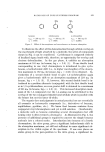
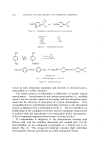
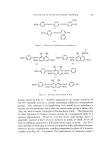
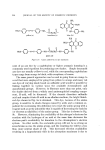
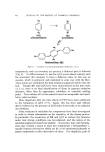
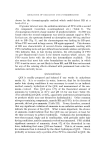
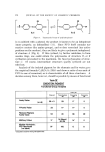
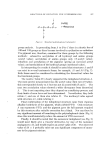
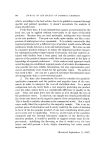
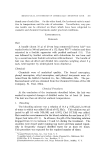
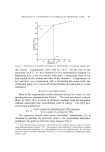
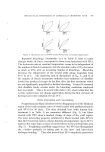
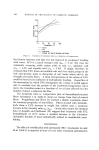
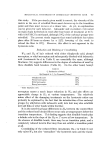
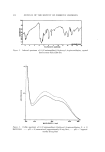
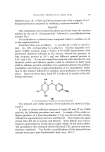
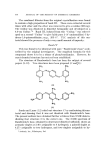
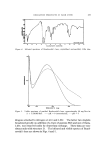
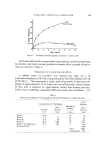
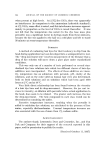
412 JOURNAL OF THE SOCIETY OF COSMETIC CHEMISTS It was presumed to yield black dyeings on hair via the formation of an insoluble azine (3) of the structure B: i • •H / • •"•N / • •NH• Heiduschka and Goldstein (4) studied the oxidation of p-phenylene- diamine under varying conditions and showed that, in addition to Bandrowski's base and unreacted phenylenediamine, an appreciable amount of other unidentified reaction products was present. The oxidation of p-phenylenediamine was studied extensively by Cox (5) who reported that peroxide oxidation in weakly alkaline solution yielded (after 24 48 hours) Bandrowski's base, an insoluble azine, a large amount of unreacted p-phenylenediamine, and traces of quinone plus ammonia. Sandberg (6), using paper electrophoresis, showed that an oxidized solution of p-phenylenediamine (pH 7) could be separated into five colored zones--yellow, brown, red, violet, and blue. These were not further identified. In the present work the authors have studied the oxidation of p-phenylenediamine in weakly alkaline solution at various peroxide to phenylenediamine ratios and have used thin-layer chromatography (TLC) to separate the insoluble oxidation products. EXPERIMENTAL AND RESULTS Solutions of p-phenylenediamine (2-4%) in dilute NH4OH or Na2CO3 were allowed to react with peroxide at room temperature for varying periods of time. The insoluble products were filtered off, dissolved in dimethyl formamide, and spotted on a glass plate coated with silica gel G. In all cases, development with a mixture of chloroform, ethyl acetate, and ethanol (7 d- 2 d- 1) resulted in a characteristic chromato- graphic pattern (Fig. 1). Unreacted phenylenediamine may be present if the precipitate is not well washed with H20. It is located between bands III and IV and cannot be seen on freshly developed plates but appears as a dark band on exposure to air. Similarly, a violet-colored band appears between bands IV and V. Although this band is quite noticeable, efforts to

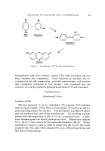
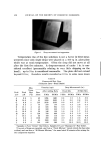
OXIDATION PRODUCTS IN HAIR DYES 413 i ii iii fr Bands Figure 1. TLC pattern--Insoluble oxidation products of p-phenylenediamine. I, faint yellow, Rf 0.68 II, bright yellow, Rf 0.55 III, red, Rf 0.35 IV, intense dark blue, Rf 0.20 V, brown, origin. fr: solvent front. st: starting line. Bands: bands which appear on plate after exposure to air elute it showed it to be present in only very minute amounts, and no further attempt was made to characterize this material. In order to obtain sufficient material for analysis, the TLC separation was scaled-up by the use of "chromatosticks" (7). In this manner, sufficient amounts of bands II, III, and IV were obtained for further analysis. IDENTITY OF TLC BANDS Band I This is always weak and may be absent if the precipitate is well washed with H20. By extracting the tiltrate (after removal of the in- soluble oxidation products) with ether, a yellow material was isolated which had R/and visible spectrum identical with those obtained from band I. This material was identified from its melting point and infrared spectrum as p-nitroaniline. The p-nitroaniline formed varies from a very minor amount at low peroxide concentrations to an important com- ponent at high peroxide concentration. However, most of this material remains in solution. Band II This material gave the following analysis' C, 68.05% H, 5.85% N, 26.14% mol. wt., 212, corresponding to C•2H•2N4. It was found to be
Purchased for the exclusive use of nofirst nolast (unknown)
From: SCC Media Library & Resource Center (library.scconline.org)