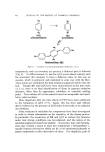
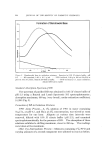
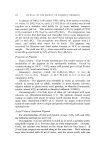
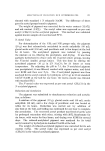
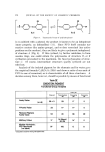
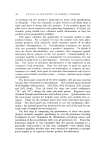
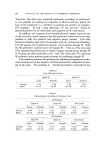
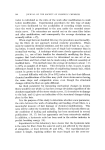
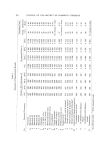
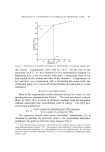
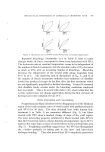
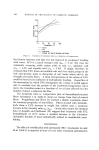
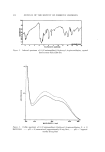
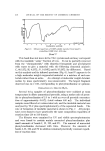
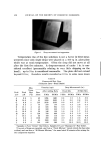
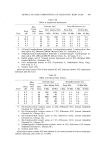
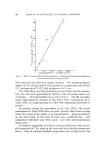
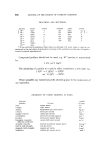
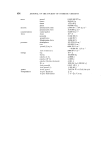
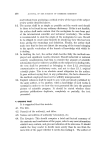
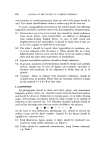
4O6 JOURNAL OF THE SOCIETY OF COSMETIC CHEMISTS 0.8 ÷ o 2'5 50 75 I•)O Temperature øC -- Control .... PFO --o-- Deominoted ......... Reduced with Benzyl MercZlptan ond Blocked Figure 5. Variation of hysteresis ratio as a function of temperature the keratin structure and that it is not removed by prolonged washing with water. PFO is a much stronger acid (PK• = 2.14) (32) than the commonly occurring acidic amino acids in hair, i.e., glutamic acid (pK• = 4.07) and aspartic acid (pr• = 3.86). It might, therefore, be reasoned that PFO forms an insoluble salt with free amino groups in the hair and thereby leads to disruption of salt bonds which add to the strength of keratin fibers. A third interpretation of the action of PFO could be based on the influence of hydrophobic bonding. Regardless of the mechanism by which PFO disorganizes the a-helix, it would appear safe to conclude that the portion of the hysteresis/temperature curve above the transition point is a function of (or at least affected by) the number of intact a-helices in the fiber. The hysteresis ratio rs. temperature plot of formaldehyde-treated fibers (treatment 5 in Table I) shows no change from that of control fibers. Feughelman and Watt (9) reached a similar conclusion about the torsional properties of wool fibers. Fibers treated with formalde- hyde show a 2.5% increase in weight but exhibit only a moderate increase in the viscosity ratio •}wet/•ldry. On the other hand, the chemical data of Asquith and Parkinson (33) suggest that treatment with 37% formaldehyde at 52øC causes a marked increase in the B-keratose (insoluble) fraction of wool undoubtedly related to considerable cross- linking. Esterification The effect of esterification with methanolic HC1 (treatments 4a and 4b in Table I) is opposite to that of every other treatment performed in

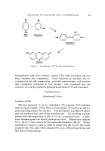
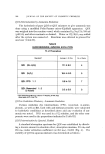
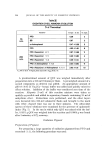
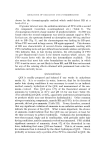
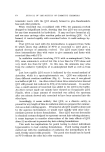
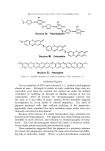
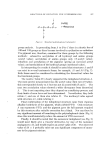
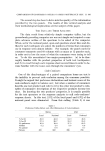
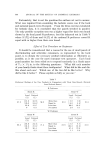
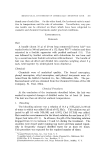
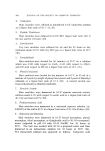
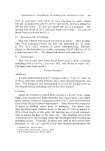
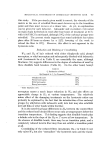
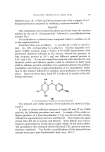
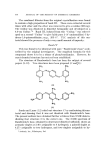
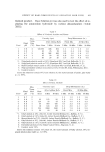
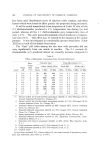
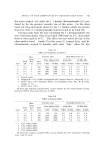
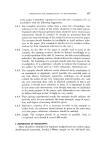
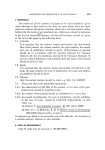
MECHANICAL HYSTERESIS OF CHEMICALLY MODIFIED HAIR 407 this study. If the previously given model is correct, the viscosity of the matrix in the case of esterfried fibers must decrease up to the transition point and then must increase at a slower rate. As yet, no explanation can be given for such behavior. Alexander and co-workers (34) noted no main chain hydrolysis in wool after four hours of treatment at 65 øC with 0.01N HC1 in methanol, although 70% of the carboxyl groups were esterfried. The present study suggests that some hydrolysis has taken place after 20 hours as shown by a 22% lowering of the work to extend the fiber to 20%. However, this effect is not apparent in the hysteresis ratio. Reduction and Blocking or Crosslinking W20 and H20 of hair reduced with either thioglycolic acid, phenyl mercaptan, or ethyl mercaptan and subsequently blocked with iodoacetic acid (treatments 9a-d in Table I) are essentially the same, although Maclaren (24) suggests differences in the degree of reduction of wool by these disulfide bond breakers (Table II). On the other hand, benzyl Table II % Reduction of Wool (by Reagent in 1:1 n-PropanolfWater) • Thioglycolic acid 28% Phenyl mercaptan 40% Ethyl mercaptan 72% Benzyl mercaptan 85% • After Maclaren (24). mercaptan causes a much larger reduction in W20 and also effects an appreciable change in H20 at various temperatures. The relatively minor effect of the damaging treatments on the hysteresis ratios can probably be explained by the fact that the introduction of free carboxyl groups (by alkylation with iodoacetic acid) into hair may also establish new salt links or other bonds within the fiber. It is also noted that large differences in H20 between the control fiber and the reduced and blocked fibers occur only at temperatures below the transition temperature. This finding suggests that disulfide bonds play a definite role in the slope of the H20 vs. T curve at low temperature. In the absence of disulfide bonds, there may be no transition point and a completely reduced keratin fiber may thus not exhibit a transition point at all. Crosslinking of the reduced fibers (treatments 10a-c in Table I) not only raises W20 but also "normalizes" the hysteresis ratio and the transi-
Purchased for the exclusive use of nofirst nolast (unknown)
From: SCC Media Library & Resource Center (library.scconline.org)