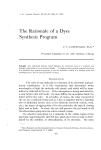
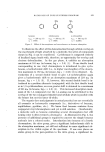
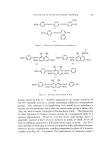
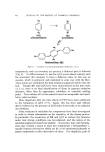
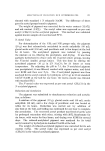
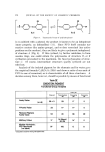
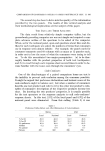
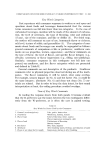
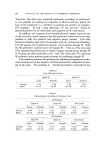
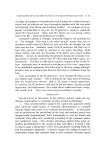
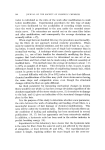
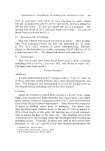
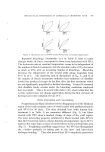
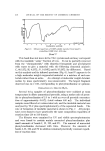
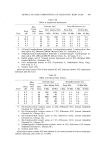
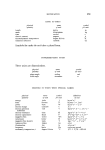
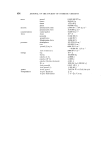
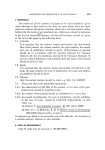
RATIONALE OF DYES SYNTHESIS PROGRAM 353 NO2 NO2 NH2 benzene X ..... = 203 m• (5) (e = 7400) nitrobenzene p-nitroaniline X ..... = 268 rnt• (5) X ..... = 381 m• (5) (• = 7800) (• = •3,5oo) Figure 3. Effect of chromophores and auxochromes on benzene absorption To illustrate the effect of this ddocalization through orbital overlap on the wavelength of light absorbed by a molecule, the series of compounds shown in Fig. 2 can be considered. Cydohexane is composed entirely of localized sigma bonds with, therefore, no opportunity for overlap and electron ddocalization. In the gas phase, it exhibits an absorption maximum at 165 mu (in hexane, log e -- 3.0) (1). If one double bond corresponding to one vinyl chromophore is introduced to give cyclo- hexene, a bathochromic shift (i.e., to higher wavelengths) of the absorp- tion maximum to 182 mu (in hexane, log e = 3.88) (2) is obtained. In- troduction of a second double bond to give 1,4-cyclohexadiene again gives a bathochromic shift to an absorption maximum of 224 mu (in hexane, log • = 1.5) (3). If, however, this second double bond is in- troduced in a position alternate (conjugated) with the first double bond as in 1,3-cyclohexadiene, an even greater shift is obtained to a maximum of 265 m• (in hexane, log e = 3.9) (4). This increased absorption maxi- mum of the 1,3-compound over the 1,4-analog can be attributed to the overlap of the two conjugated double bond orbitals which is possible with the former but not the latter di-olefin. The organic dyes and pigments in actual practical use are essentially all aromatic or heterocyclic compounds (i.e., derivatives of benzene, naphthalene, pyridine, etc.). We know that benzene contains three conjugated vinyl chromophores and yet is still colorless. (Incidentally, a molecule such as benzene containing several chromophores but still lacking color is often termed a chromogen.) As illustrated in Fig. 3, the presence of additional groups is required to convert the simple benzene molecule into a colored entity. Introduction into benzene of a fourth chromophore, the nitro group, gives a significant bathochromic shift to the absorption maximum, yet still not sufficient to cause significant ab- sorption in the visible region of the spectrum. If one now places an amino group in the para-position to the nitro group, a significant in-

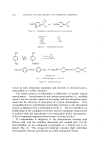
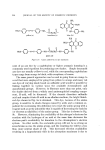
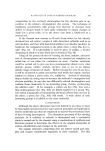
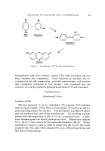
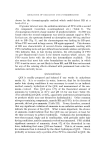
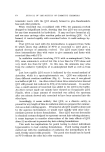
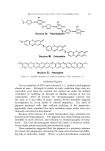
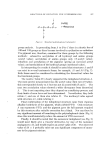
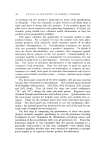
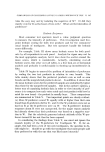
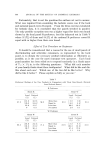
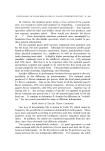
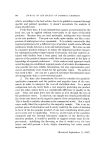
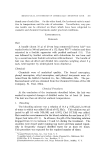
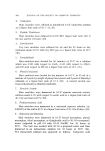
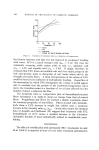
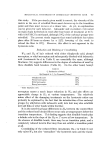
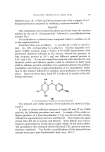
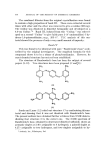
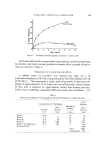
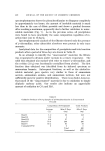
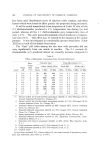
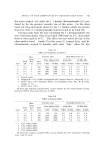
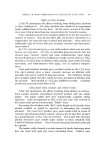
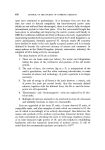
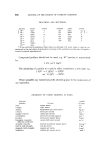
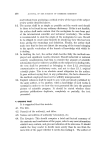
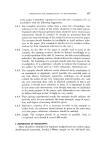
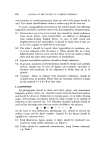
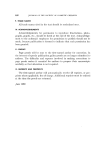
354 JOURNAL OF THE SOCIETY OF COSMETIC CHEMISTS -.•/•k /•.•o + /•k /0- H2N '--•Nxa 0 • H2N•N,• 0 Figure 4. Resonance contribution by an auxochrome (CH:•)2N-- --C1 --NH• --Br --OH --CHa --OCHa Figure 5. Auxochrome Groups N02 N02 ½ 9 HCI + NH2 N-•N:C1- (CH•)2N-• (CH•)0N--•N=N--•N02 + 0- Orange-red X ...... = 470 mt• (log e = 4.5) (6) Figure G. Typical azo dye crease in both absorption maximum and intensity is obtained and p- nitroaniline is a yellow substance. The amino group in p-nitroaniline is illustrative of groups termed auxochromes. Auxochromes do not contain unsaturation (i.e., multiple bonds), but are usually capable of increasing both the absorption maxi- mum and the intensity of absorption of a given chromophore. They accomplish this by contributing nonbonding electrons to the delocalized system as illustrated for p-nitroaniline in Fig. 4. The over-all effect is a lengthening of the conjugated systems, and the maximum enhancement is realized when the auxochrome is in conjugation with a chromophore. A list of commonly employed auxochromes is shown in Fig. 5. If p-nitroaniline is subjected to the diazotization reaction with nitrous acid, and the resulting diazonium salt coupled into N,N-di- methylaniline, an azo compound recognizable as a typical dye is ob- tained (Fig. 6). This orange-red molecule contains eight individual chromophores and one auxochrome in a fully conjugated system.
Purchased for the exclusive use of nofirst nolast (unknown)
From: SCC Media Library & Resource Center (library.scconline.org)