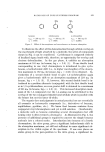
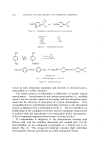
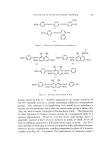
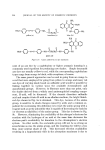
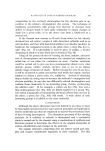
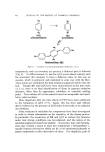
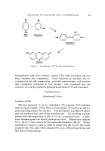
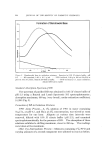
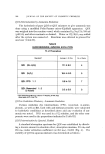
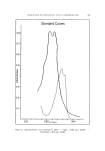
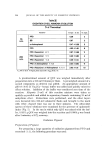
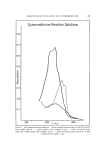
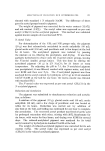
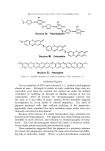
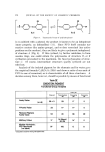
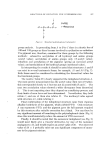
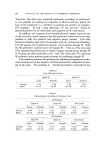
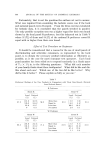
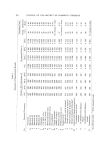
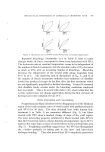
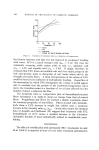
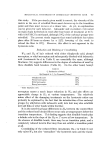
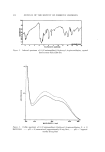
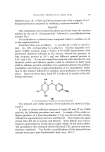
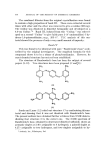
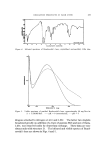
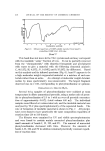
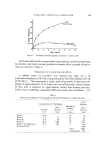
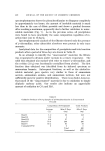
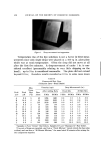
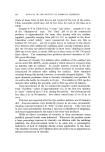
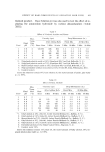
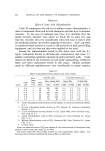
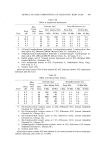
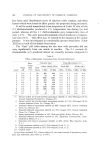
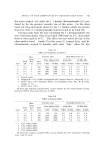
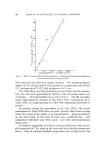
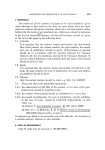
REACTIONS OF OXIDATION DYE INTERMEDIATES 377 I -P-r-P-r-P-r-•-r- i P ! P=PPD r :Resorcinol Figure 8. Branched polyindophenol (schexnatic) group analysis. In proceeding from A to B to C there is a drastic loss of OH and NH groups as these become involved in cyclization or oxidation. The pigment was, therefore, examined for these groups by the following methods: exhaustive acetylation of all hydroxyl and amino groups (acetyl value) acetylation of amino groups only (N-acetyl value) reduction and acetylation of the pigment (giving an increased acetyl value) and methylation of the hydroxyl groups (methoxyl value). In interpreting the results it should be noted that structures A and B can exist in several tautomeric forms, for example, A 1 and A • (Fig. 7). Both forms must be considered in calculating the theoretical values for the functional groups. The results (Table IV) clearly supported the indophenol structure A. The most precise measurement was the acetyl value (first row of Table) this corresponded closely to A but was not in accord with B and C. The next two acetylation values showed a wider divergence from theoretical A. This is not surprising since they depend on a multistep process, and their limits of error have not been determined. Nevertheless, they both refute C, and one of them also refutes B. The methoxyl value agreed with structure A 1, while refuting C. Final confirmation of the indophenol structure came from vigorous alkaline hydrolysis of the pigment, which yielded PPD. Only structure A can regenerate PPD, and the pigment gave the full amount required by this structure after suitable correction for a blank. Nor can there be any significant amount of branching in the polyindophenol chain (Fig. 8) since this would materially reduce the amount of PPD recovered. Finally, it should be noted that the toohomeric indophenol (see Fig. 2) would most likely give a triacetyl derivative, by way of the tautomer analagous to A 8, and would require an acetyl value of 38. The observed value of 29 4- 3 probably rules out any significant component of mono- mer in the pigment mixture.

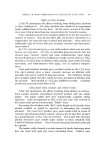
878 JOURNAL OF THE SOCIETY OF COSMETIC CHEMISTS The oxidation pigment under study is, therefore, a linear unbranched polyindophenol. There is no evidence of cyclization to oxazines. This result demonstrates that the early oxidation steps, leading from PPD to polyindophenol, occur with relative ease. The later steps, cyclization to oxazines, occur much more slowly if at all, and it is doubtful if they occur in the presence of much unreacted PPD and resorcinol. In this case, with only a 31% yield of pigment, considerable unreacted PPD remained, and this is also true of most hair dyeing operations. By using the analytical methods described here or similar ones it should be possible to examine other pairs of intermediates and other conditions, as well as the more complicated mixtures used in hair dyeing. It would be interesting to see whether azines of any kind are formed in some cases. CONCLUSIONS Both quinonediimine (QDI) and Bandrowski's base (BB) are formed when p-phenylenediamine alone is oxidized under hair dyeing conditions. However, when PPD is co-oxidized with other dye intermediates in equal amounts, especially resorcinol, neither QDI nor BB appears. Either a different reaction path is followed, excluding both of these, or the QDI reacts as fast as it is formed to give the final colored products. For this reason PPD should never be used alone in patch tests to predict sensitivity to hair dyes, but only in combination with peroxide and other dye intermediates. An oxidation pigment prepared from PPD and resorcinol (1: 1) proved to be a mixture of polymeric indophenols, straight-chain and unbranched, with no significant ring-closure to oxazines. ACKNOWLEDGMENT The authors would like to acknowledge the contribution of Dr. Franz J. Pure in the early stages of this work. (_Received October 11, 1967) _REFERENCES (1) Cox, H. E., The functions and reactions of phenols, Analyst, 65, 893 (1940) The chemical examination of furs in relation to dermatitis, Part IV, Ibid., 59, 8 (1934). (2) Erdmann, E., Oxydations product des p-phenylendiamins, Ber. Deut. Chem. Ges., 37, 2776, 2906 (1904). (3) Austin, W. E., The chemistry of oxidation fur dyeing, J. Tech. Assoc. Fur Ind., 6, 127 (1935).
Purchased for the exclusive use of nofirst nolast (unknown)
From: SCC Media Library & Resource Center (library.scconline.org)