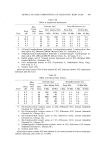
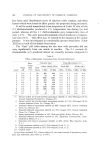
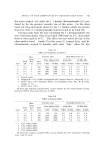
COMPARISON OF CONSUMER PANELS IN PAIRED PREFERENCE TEST. II 3•1 overlaps and apparent contradictions which might have defied interpre- tation had the authors not been thoroughly familiar with the two prod- ucts through their flavor and brushing profiles. An example of an ap- parent contradiction is seen for the R-preferrers' negative comments about W's flavor-level. Some said W's flavor was too strong, others said it was flat. Both descriptions are credible. Consumers, rightly or wrongly, frequently diagnose the problems for us. For example, "this soup is not salty enough" means that the re- spondent would correct its flavor by salt, not that she thought the salt taste was too low. Similarly, some of the R-preferrers felt that the ef- fects they perceived could be ascribed to too much flavoring, while others rightly said that the flavoring of W didn't have much unified identity. In fact, by monitoring the products during the consumer test- ing period, it became evident that W's flavoring had fallen apart, un- fortunately. This fact is reflected in negative remarks about its flavor- type--antiseptic may be menthol or astringency of the base soapy may be an unblended component of the flavoring or the base coming through powdery may be an impression from the flavoring or chalkiness from the base. Now, proceeding to the W-preferrers--they thought W's flavor level was distinct and stronger. This is definitely the same kind of thinking that the R-preferrers showed that is, W made a strong impression. In contrast, the W-preferrers said that R did not make a strong enough impression, and furthermore, they could detect unflavored base (soapy, oily, harsh) in R. They, too, were correct according to profiles. SUMMATION The data given in this paper, in the authors' opinion, make two sig- nificant contributions to consumer product testing methodology: 1. They provide further support for a pilot test approach which asks relatively small panels of articulate discriminators to respond through simple open-end or free-response questionnaires. In this paper and its predecessor the parallelism of the local and national panels was unequivocally demonstrated, both horizontally in over-all trends and vertically when data were considered according to the consumer panel- ists' preference votes. The obvious advantage gained from using ar- timlate discriminators is the saving of time and effort it doesn't take as long to gain a perspective of the test parameters resulting from the two test products' properties it doesn't require the coding of masses of inarticulate terms that emanate from a cross-sectional consumer panel

392 JOURNAL OF THE SOCIETY OF COSMETIC CHEMISTS which, according to the best advice, has to be guided to respond through specific and pointed questions it doesn't necessitate the analysis of reams of print-outs. From these data, it is not claimed that a panel, as represented by the local one, can be applied without reservation to all types of flavorful products. Because they are used nationally, toothpastes were selected as the test products. This pair was really quite similar, not like a com- parison of wintergreen versus spearmint. It is entirely conceivable that regional preferences for a different type of product would create different preference trends between a local and national panel. But since an aim in consumer product testing is to isolate the important product integers for subsequent product improvement if necessary, this aim could be at- tained with facility from a local panel, and the positive and negative aspects of the product integers could then be interpreted in the light of knowledge of regional preferences. A less controversial approach would entail having pre-established regional panels of articulate discriminators, who provide not only reliable information, but also representative pref- erence and hedonic score trends for the particular region. The point of this work is this: one can use a panel of articulate discriminators more advantageously than a cross-sectional panel. 2. The data also demonstrate the need to consider the panelists' qualitative comments and the positive and negative tones of the com- ments in order to interpret the over-all statistical data. In a paired comparison test one rarely finds a vast majority preferring one product over the other, unless there is a considerable difference in quality in the pair. Thus, one must delve into the issues as seen through the eyes of the preference voters. In this test, one sample was clearly preferred but the choice was based on the negative aspects of the not-preferred sample. This is hardly a realistic situation in the commercial world. But a small corps really liked the rejected-by-the-majority sample. This is an im- portant piece of information and it surely could tip the scales of decision in favor of the less popular product, if one were considering which prod- uct to turn over to marketing. Even so, on the basis of the panelists' comments and the internal laboratory analyses of the liked-by-the- minority product, it would be possible to suggest certain steps for im- provement: stabilizing the flavoring so that it would cover the base better and still present a lively highly stimulating but cooler mouth impression. (Received September 11, 1967)
Purchased for the exclusive use of nofirst nolast (unknown)
From: SCC Media Library & Resource Center (library.scconline.org)