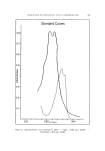
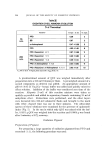
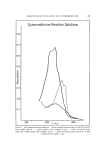
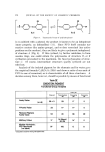
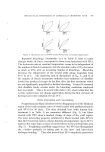
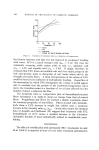
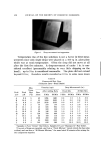
396 JOURNAL OF THE SOCIETY OF COSMETIC CHEMISTS index is calculated as the ratio of the work after modification to work before modification. Experimental procedures for this type of study have been facilitated by the availability of recording tensile testers, since the work is proportional to the area under the recorded stress- strain curve. The extensions are carried out on the same fiber before and after modification, and consequently the average deviations are normally within + 5%. When single hairs are handled this way, the procedures used in modify- ing the fibers do not approach normal cosmetic procedures. Fibers must be soaked in chemical solutions, and the ratio of hair to, e.g., wav- ing lotion, is much smaller in the case of single hair treatment than in normal hair waving. A technique which more closely approaches actual practice, i.e., use of hair bundles for chemically modifying the fibers, requires that load-extension curves be determined on one set of un- treated fibers and that a final run be made using a different assembly of modified hairs. This method raises the average deviations to about + 15 to 30% on samples of 30 hairs. This deviation is due, in part, to great differences found in the cross section of neighboring human hair, which cannot be grown to the uniformity of some wools. A second difficulty with the 20 or 30% index is the fact that different chemical modifications of the fiber may yield stress-strain curves having the same shape and comparable areas, even though the structural changes within the fiber are quite different. An ideal parameter for measuring mechanical changes in keratin fibers would be one which (a) has low average deviation regardless of the absolute magnitudes of the stress-strain curves, (b) is sensitive to damage to the hair, and (c) gives an indication of the structural changes taking place in the hair. It is the purpose of this study to determine whether a new parameter, the ratio between the work of unloading and loading of hair fibers, is a meaningful measure of hair damage or chemical modifications. This ratio will be called the hysteresis ratio. Hysteresis of keratin fibers un- der conditions of loading and unloading has been mentioned in several publications (16, 17) but has apparently not been extensively studied. In addition, a hysteresis ratio has been used in the rubber industry to predict breaking energy (18). Experiments in this laboratory have shown that the hysteresis ratio is the same for fibers from the same lot and is not affected by the degree of elongation, at least between 20 and 30%. The experimental pro- cedure is simple, requiring neither the exact length nor the cross-sec-

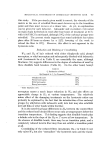
MECHANICAL HYSTERESIS OF CHEMICALLY MODIFIED HAIR 3.97 tional area of each fiber. On the other hand, the hysteresis ratio is sensi- tive to temperature and the rate of extension. Nevertheless, very pre- cise results can be obtained on fibers which have been subjected to cosmetic and chemical treatments under practical conditions. EXPERIMENTAL Materials Hair A bundle (about 50 g) of 20-era long commercial brown hair* was washed twice in 500-ml portions of a 1% Sipon WD©p solution and then extracted in a Soxhlet apparatus with purified methanol (19). This was followed by Soxhlet extraction with chloroform for one hour and by a second one-hour Soxhlet extraction with methanol. The bundle of hair was then air-dried and divided into swatches weighing about 2 g each, held together by nickel-plated brass clinchers. :• Chemicals Chemicals were of analytical quality. The benzyl mercaptan, phenyl mercaptan, ethyl mercaptan, and phenyl isocyanate were ob- tained from the Aldrich Chemical Co., Inc., Milwaukee, Wis. The per- fluorooctanoic acid was obtained from the Chemical Division of the 3M Company, St. Paul, Minn. Chemical Procedures At the conclusion of the treatments described below, the hair was washed in repeated changes of distilled water for at least 24 hours. The hair was then air-dried at ambient temperatures. 1. Bleaching The bleaching mixture was a solution of 14.4 g (NH4)2S208 in 60 ml of water to which was added 120 ml of 6% H202. This solution was ad- justed to pH 9.5 with NH•OH, and 0.05% Chel DTPAõ was added. Hair swatches were immersed in the bleach solution for one hour at 25 øC (liquor/hair ratio of 3: 1). In all cases, the pH of the bleaching solution dropped from 9.5 to between 7.0 and 8.5 during the treatment. The swatches were rinsed under running tap water and then soaked repeat- edly in frequently changed distilled water for at least 24 hours. This procedure was repeated for the required number of times. * Joseph Fleischer & Sons, Inc., New York, N.Y. •' A purified grade of sodium lauryl sulfate, Alcolac Chemical Co., Baltimore, Md. • D225 Clip, E. B. Stimpson Co., Inc., Brooklyn, N.Y. õ Diethylenetriamine pentaacetic acid, Geigy Industrial Chem., Ardsley, N.Y.
Purchased for the exclusive use of nofirst nolast (unknown)
From: SCC Media Library & Resource Center (library.scconline.org)