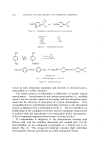
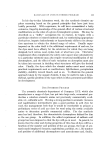
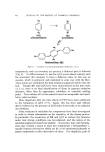
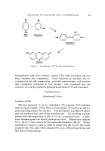
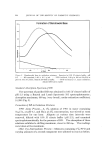
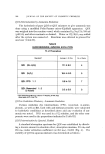
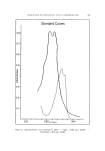
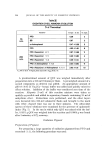
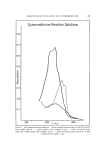
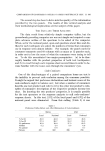
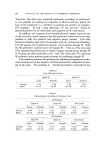
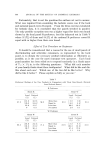
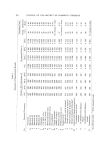
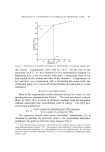
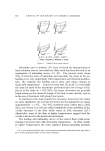
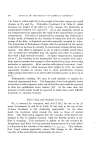
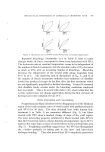
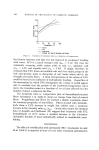
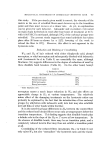
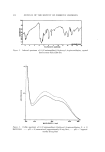
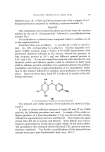
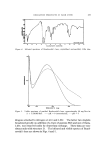
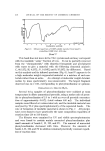
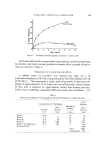
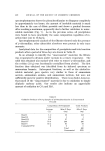
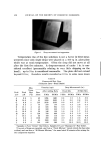
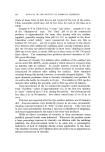
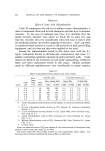
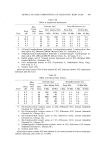
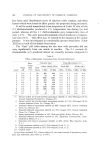
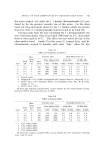
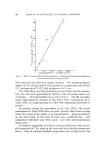
420 JOURNAL OF THE SOCIETY OF COSMETIC CHEMISTS spectrophotometry shows the phenylenediamine to disappear completely in approximately ten hours the amount of insoluble material is much less than in the case of dilute peroxide and shows a gradual decrease after reaching a maximum, apparently due to further oxidation to water- soluble materials (Fig. 7). As in the previous series, all precipitates were found to have practically the same composition regardless of re- action time (one to 16 days). Spectrophotometric analysis of the tiltrates showed only the presence of p-nitroaniline other ultraviolet absorbers were present in only trace amounts. Analytical data for the composition of precipitates and total reaction products after a period of three days are shown in Table II. In an attempt to identify the "unaccounted" material, the tiltrate was evaporated to dryness under vacuum in a rotary evaporator. The solid thus obtained was washed with ether to remove p-nitroaniline, and the residue (2.8 g) was fractionally crystallized from alcohol. The first fraction thus obtained was identified from its infrared spectrum as ammonium formate. Subsequent fractions, as well as the alcohol-in- soluble material, gave spectra very similar to those of ammonium acetate, ammonium oxalate, and ammonium tartrate, but were not sufficiently pure for positive identification. There is no doubt, however, that much of the "unaccounted" material is due to oxidation to simple aliphatic carboxy acids. Our results also indicate an appreciable amount of oxidation to CO2 and H20. Table II Oxidation Products of 4.0-g Samples of p-Phenylenediamine in Concentrated Peroxide Composition of Precipitates Total Products Average After 3 Days After 3 Days (%) (rag) (rag) Band I 1.2 52 215 Band II 0.3 1 1 Band III 8.9 37 37 Band IV 70.4 296 296 Band V 19.2 81 81 Unreacted PPD 0 0 0 Total 630 Unaccounted 3370

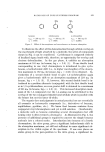
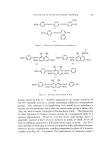
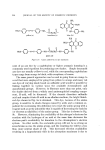
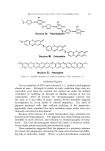
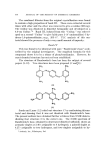
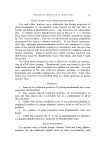
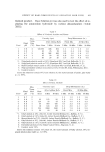
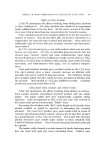
OXIDATION PRODUCTS IN HAIR DYES 421 HAIR DYEING WITH PHENYLENEDIAMINE Cox and other workers have attributed the dyeing properties of phenylenediamine to an insoluble azine formed on the hair fiber by further oxidation of Bandrowski's base. Our work does not substantiate this. A solution of pure Bandrowski's base in H20 or (1 -+- 1) alcohol- H20, when treated with dilute peroxide and NH4OH, showed no change in TLC characteristics. The use of concentrated peroxide completely decomposed the base to colorless materials. It was found experimen- tally that, although phenylenediamine itself is not substantive to hair, each of the colored oxidation products is substantive and can give fast dyeings on wool or hair from alcohol-H20 or DMF-H•O solution without further oxidation. Bands I and II gave yellow dyeings, band III red- dish-brown, band IV (Bandrowski's base) blue-black, and band V dark red-brown. The black shade obtained on hair is believed to be due to a combina- tion of all of these dyeings. Bandrowski's base was found to give the same shade on hair with or without the addition of peroxide. In each case, extraction of the hair with hot ethanol, pyridine, or dimethyl formamide only partially stripped the color from the hair. That color which was recovered was identified from its visible spectrum as Band- rowski's base. SUMMARY 1. Some of the oxidation products of p-phenylenediamine have been separated and identified. 2. The various colored oxidation products are all substantive to hair the final black color is probably due to a combination of all of these dyeings. 3. Under hair dyeing conditions part of the phenylenediamine is completely oxidized to simple aliphatic carboxy acids as well as to CO•. and H•O. 4. No evidence of azine formation from Bandrowski's base was found. 5. NMR data support the N, Nf-bis-(4-aminophenyl)-2,5-diamino - 1,4-quinonediimine structure proposed for B androwski's base. ACKnOWLEDGMEnT The authors wish to thank Joseph Damico, Food and Drug Admin- istration, for the molecular weight data via mass spectrometry, and
Purchased for the exclusive use of nofirst nolast (unknown)
From: SCC Media Library & Resource Center (library.scconline.org)