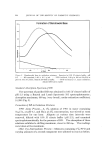
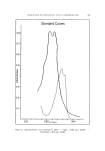
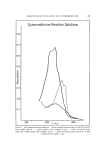
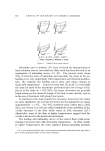
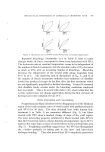
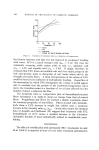
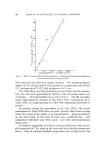
408 JOURNAL OF THE SOCIETY OF COSMETIC CHEMISTS tion temperature to values which approach those of the control fibers more closely. It appears, therefore, that crosslinks, just like disulfide links, have an effect on the transition temperature but that the length of the crosslink is relatively unimportant. Deamination Speakman and Stott (26) used the fact that a completely deaminated fiber gives the same extension curve in water as in 0.1N HC1 as an indica- tion of the extent of deamination. Deaminated fibers would be expected to exhibit the same extension curve in water as in 0.1•V HC1 because HC1 breaks the salt links in the fiber and, therefore, prevents the inter- action of free carboxyl groups with the free amino groups in the fiber (27). The present study introduces a possible second criterion for the degree of deamination, i.e., the linear relationship between hysteresis ratio and temperature. It should be noted that treatment with ninhydrin also causes deamina- tion. As soon as the temperature is high enough to overcome the in- fluence o[ deposition of bulky groups, i.e., beyond 30 øC, the hysteresis- temperature plot approaches the slope of hair that has been deaminated with nitrous acid. As noted previously, the hysteresis-temperature plot for PFO treatment is also linear and could be due to both a-helix disruption and breaking of salt links. Stress-Strain Curves The authors are not aware of any published report which relates processes at the atomic or molecular level with the macroscopic picture shown by the unloading curves. One of the striking features of these curves is the fact that they differ in shape: One extreme is the shape of untreated fibers (Fig. 2B) the second shape is that of fibers treated with phenyl isocyanate (Fig. 2B). In the former, an immediate loss in stress is followed by a slow decrease in stress (almost parallel to the slope of the yield region in the loading curve) and finally by a rapid decrease of stress to the starting point. The final decrease probably occurs at the point at which reformation of hydrogen bonds takes place. The shape of the second type of curve is different. In this case, the stress drops very rapidly to zero while the strain is still relatively large, as much as 15%. An analogy might be drawn between this behavior and that of a spring which is extended (or is allowed to contract) in a very viscous medium. During the loading cycle, a large external force is required to extend the spring, due to the surrounding viscous medium. During the unloading cycle, only internal forces are available to con-

MECHANICAL HYSTERESIS OF CHEMICALLY MODIFIED HAIR 409 tract the spring. The cross head of the tester moves more rapidly than the rate of contraction of the spring therefore, the load is removed rapidly while the spring is held extended by the viscosity of the viscous medium. This analogy explains how the shape of the return curve can be attributed to an increase in the viscosity of the matrix. CONCLUSIONS One of the questions raised by the data presented above is whether the hysteresis ratio, as defined herein, has any real value. The authors believe that this question can be answered affirmatively. The hysteresis ratio has been shown to measure, with considerable precision, changes in the viscosity of hair fibers. The hysteresis ratio vs. temperature plot of normal or moderately damaged hair changes slope at a transition point. The pretransition slope is drastically altered by modification of disulfide bonds in the fiber. The post-transition slope, on the other hand, seems to be affected primarily by salt bonding and/or a-helix organization. It is, therefore, concluded that the hysteresis ratio and its dependence of temperature are useful whenever damage to the fiber involves disulfide bond cleavage, breaking of salt bonds, disruption of a-helices, or other treatments which may increase or decrease the viscosity of the matrix. ACKNOWLEDGMENT The authors wish to acknowledge the technical assistance of Miss Virginia May in conducting many of the experiments and the help of Mr. James Skillman in preparing the figures. 'Received June 20, 1967) REFERENCES (1) Brown, J. C., The determination of damage to wool fibres, J. Soc. Dyers Colourists, 75, 11-21 (1959). (2) Glynn, M. V., Diazo compounds in the determination of wool damage, Ibid., 68, 16-20 (1952). (3) Lemin, D. R., and Vickerstaff, T., Some physico-chemical properties of damaged wools, Soc. Dyers Colourists, Syrup. Fibrous Protein, 129-41 (1946). (4) Zahn, H., Einiges aus der Wollforschung, lerner fiber einfache Methoden zum Nachweis von Wollschaden, Melliand Textilber., 30, 275-81 (1949). (5) Speakman, J. B., Intracellular structure of the wool fibre, J. Textile Inst., Trans., 18• 431-53 (1927). (6) Speakman, J. B., Mechano-chemical methods for use with animal fibres, Ibid., 38, 102- 26 (1947). (7) Mitchell, T. W., and Feughelman, M., The bending of wool fibers, Textile Res. J., 35, 311-14 (1965).
Purchased for the exclusive use of nofirst nolast (unknown)
From: SCC Media Library & Resource Center (library.scconline.org)