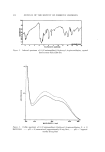
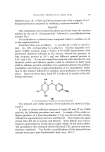
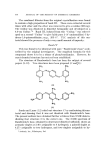
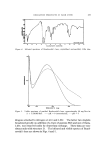
422 JOURNAL OF THE SOCIETY OF COSMETIC CHEMISTS Stanley Koch, Dr. Ernest Lustig, and Margaret Lake, Food and Drug Administration, for NMR spectra and interpretation. Elemental analyses were performed under the direction of William Alford, National Institutes of Health, and Charles Graichen, Food and Drug Administration. (Received September 19, 1967) (1) (2) (3) (4) (5) (6) (7) (8) (9) (10) (11) (12) REFERENCES Bandrowski, E., Ueber die Oxydation des Paraphenylendiamins, Ber., 27, 480 (1894). Erdmann, H., Oxydationsprodukte des p-Phenylendiamins, Ibid., 37, 2907 (1904). Ginzel, A., Die Chemic der Pelzfarbstoffe, Melliand Textilber., 29,384 (1948). Heiduschka, A., and Goldstein, E., Ueber das Oxydationsprodukt des Para-Phenylen- diamins (Ursols) durch Wasserstoffsuperoxyd, Arch. Pharm., 254, 584 (1916). Cox, H. E., The chemical examination of furs in relation to dermatitis, Analyst, 59, 3 (1934). Sandberg, G., Polarography of fur dyes, J. Soc. Dyers Colourists, 72, 235 (1956). Balogh, B., Preparative analog to thin layer chromatography, Anal. Chem., 36, 2498 (1964). Newman, M. S., Ed., "Organic Syntheses," Vol. 40, John Wiley and Sons, Inc., New York, 1960, p. 18. Green, A. G., Quinonoid addition as a mechanism of dyestuff formation, J. Chem. Soc., 1913, 933. Ritter, J., and Schmitz, G., The constitution of Bandrowski's base, J. Am. Chem. Soc., 51, 1587 (1929). Lauer, W. M., and Sunde, C. I., The structure and mechanism of formation of the Bandrowski base, Y. Org. Chern., 3,261 (1938). Sunde, C. I., and Lauer, W. M., Structure of the Bandrowski base, Ibid., 17, 609 (1952).

J. Soc. Cosmetic Chemists, 19, 423-445 (May 27, 1968) Effect of Base Components on the Properties of Oxidation Hair Dyes ROBERT L. GOLDEMBERG, B.S.,* and HAROLD H. TUCKER, Ph.D.$ Presented September 21, 1967, Seminar, Chicago Synopsis--Ten classes of additives were studied for their effect on pH, temperature rise, viscosity, and "drop-movement" of oxidation hair dyes. Included in the study were alkanol- amides, esters, fatty alcohols, ethoxylated fatty alcohols and amine oxides, amphoteric and cationic surfactants, fatty amines, alkanolamines, polypeptides, EDTA, and sodium sulfite. A description of the newly devised "drop-movement test" is provided, plus a discussion of its correlation to viscosity. INTRODUCTION The purpose of this paper is to examine the role and effects of a number of additives commonly used in oxidation hair dye bases. Such additives are used for the purposes of: thickening the hair dye base, either initially or upon admixture with peroxide solutions, so that it does not drip when applied providing easier application to the hair con- trolling the pH, penetration, levelness, and other factors directly con- nected with dye uptake providing sheen, strength, or added body to the hair itself or preserving the efficacy of the hair dye when stored for long periods of time. Although the "shampoo in" oxidation dye has been considered a recent development, Kritchevsky (1) described its use in a U.S. patent issued in 1928. He incorporated 5% oxidation dye plus 10% ethylene * Van Dyk & Co., Belleville, N.J. 07109. } Lowenstein Dyes & Cosmetics, Inc., Brooklyn, N. ¾. 423
Purchased for the exclusive use of nofirst nolast (unknown)
From: SCC Media Library & Resource Center (library.scconline.org)