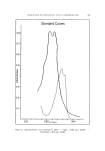
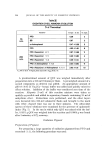
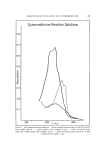
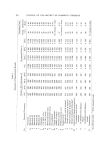
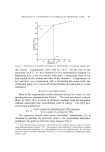
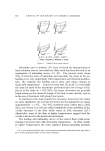
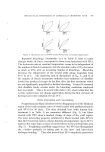
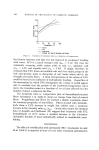
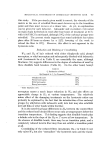
444 JOURNAL OF THE SOCIETY OF COSMETIC CHEMISTS when present at high levels. At 2.5% free DEA, there was apparently no interference (in comparison to the ammonium hydroxide standard) at 5% DEA, some effect is noted, and this interference increases approxi- mately in proportion as the level of DEA is raised thereafter. It was not felt that the temperature rise noted (in the dye base mass plus peroxide) was a significant factor in dyeings made from these mixtures, because the dye was applied to the hair on a cold plate and left to stand 30 minutes at room temperature thereafter. SUMMARY A method of evaluating hair dyes for their tendency to drip from the head during application has been developed into a semiquantitative test. The "drop-movement test" involves measurement of the distance that a drop of dye solution will move down a glass plate under standardized conditions. This was only one of a number of tests performed on several stan- dardized dye base solutions into which ten different classes of hair dye additives were incorporated. The effects of these additives on viscos- ity, temperature rise on admixture with peroxide, pH, clarity of the solutions, and on the color yield on human hair were also determined, both on fresh solutions and on solutions which had been aged 1000 hours at 2 øC and at 48 øC. Very little direct relationship has been found between the viscosity of a hair dye base and its drop-movement. However, the per cent in- crease in viscosity, on dilution with peroxide before actual application to the head, does seem to be related. The greater such increase, the less the drop-movement. The best compound in each class tested can be determined by consulting the tables. Excessive temperature increases, resulting when the peroxide is added to oxidation dye solutions, are attributed to the presence of free amine, especially diethanolamine. Unusual temperature increases are also associated with the use of more than 1% sodium sulfite. ACKNOWLEDGMENT The authors thank Lowenstein Dyes and Cosmetics, Inc., and Van Dyk and Company for their support of the research reported in this paper, and for permission to publish the results. (Received October l l, 1967)

EFFECT OF BASE COMI'ONIoeNTS ()N OXIDATION flAiR DYES 445 REFERENCES (1) Kritchevsky, Wolf, U.S. JPatent 1,665,202 (March 20, 1928). (2) Cook, Marvin K., Bases for permanent hair dyes, Drug. Cosmetic Ind., 87, 316 (Sept., 1960). (3) Clairol international, 13rit[sh l•alent 995,948 (June 23, 1965). (4) Wolfgang, M. J. E., trod Siegfried, R. P., U.S. l'atent 2,769,748 (Nov. (3, 1[)56). (5) Gallia Ltd., London, U.S. l•atettt 23)42,698 (June 2, 1936). (6) Cook, Marvin K., Modern oxidation dyes, 1)rug. Cosmetic Ind., 99, 52 (November, 1966). (7) Kass, G. S., and Tucker, H. H., private communications.
Purchased for the exclusive use of nofirst nolast (unknown)
From: SCC Media Library & Resource Center (library.scconline.org)