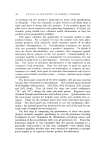
410 JOURNAL OF THE SOCIETY OF COSMETIC CHEMISTS (8) (9) (10) (11) (12) (13) (14) (15) (16) (17) (18) (19) (20) (21) (22) (23) (24) (25) (26) (27) (28) (29) (30) (31) (32) (33) (34) Mitchell, T. W., and Feughelman, M., The torsional properties of single wool fibers-- Part I and II, Ibid., 30, 662-67 (1960) 31,455-59 (1961). Feughelman, M., and Watt, I. C., Torsional properties of chemically modified wool fibers, Ibid., 36,849-50 (1966). Edman, W. W., and Marti, M. E., Properties of peroxide-bleached hair, J. Soc. Cosmetic Chemists, 12, 133-45 (1961). Hamburger, W. J., and Morgan, H. M., Some effects of waving lotions on the mechanical properties of hair, Pro& Sci. Sect. Toilet Goods Assoc., 18, 44-8 (1952), Wibaux, G., et al., Relations entre la solubilit• alcaline de la laine et ses propri•t•s m•caniques, Bull. Inst. Textile France, 17, 709-31 (1963). Watt, I. C., and Morris, R., Comparison of keratin cross-linked with benzoquinone and formaldehyde, J. Textile Inst., Trans., 57, 425-7 (1966). Mason, P., and Griffith, J. C., Crosslinking of fibrous proteins by formaldehyde, Nature, 203,484-6 (1964). Cockburn, R., and Speakman, J. B., Cross-linking reactions in keratin--III. The action of ninhydrin on wool, Pro& Intern. Wool Textile Res. Conf., Australia, C, 314-39 (1955). Alfrey, T., Mechanical Behavior of High Polymers, Interscience Publishers, Inc., New York, N.Y., 1948. Bull, H. B., and Gutmann, M., Elasticity of keratin fibers, J. Am. Chem. Soc., 66, 1253- 9 (1944). Grosch, K., et al., Breaking energy of rubbers, Nature, 212,497 (1966). Rowe, A. W., and Phelps, E. P., Ether studies--II. The quantitative determination of peroxides as a contaminant, J. Am. Chem. Soc., 46, 2078-85 (1924). Watt, I. C., and Leeder, J. D., Effect of chemical modifications on keratin q- water isotherms, Trans. Faraday Soc., 60, 1335-43 (1964). Feughelman, M., and Watt, I. C., Wool fibers treated with ninhydrin or formaldehyde: Mechanical properties, Textile Res. J., 34,643-4 (1964). Koenig, N.H., Isocyanate modification of wool in dimethyl sulfoxide, Ibid., 31, 592- 6 (1961). Feughelman, IV[., and Haly, A. R., Interaction between perfiuoro-octanoic acid and the fibrous proteins keratin and collagen, Blochim. Biophys. Acta, 43,550-1 (1960). Maclaren, J. A., The extent of reduction of wool proteins by thiols, Australian J. Chem., 15,824-31 (1962). Patterson, W. I., et al., Role of cystine in the structure of the fibrous protein, wool, J. Res. Natl. Bur. Std., 27, 89-103 (1941). Speakman, J. B., and Stott, E., A contribution to the chemical theory of dyeing: The affinity of deaminated wool for acid dyes, J. Soc. Dyers Colourists, 50, 341-8 (1934). Alexander, P., et al., Wool, Its Chemistry and Physics, Franklin Publishing Co., Palisades, N.J., 1963. Bull, H. B., Elasticity of keratin fibers--II. Influence of Temperature, J. Am. Chem. Soc., 67, 533-6 (1945). Farnworth, A. J., The reaction between wool and phenyl iso-cyanate, Biochem. J., 59, 529-33 (1955). Nemethy, G., Hydrophobe Wechselwirkungen, Angew. Chem., 79, 260-71 (1967). Zahn, H., Chemische Vorg/inge beim Bleichen von Wolle und Menschenhaar mit Wasserstoffperoxid und Peroxys/iuren, J. Soc. Cosmetic Chemists, 17, 687-701 (1966). Radell, J., et al., Acidity and autocatalysis of esterification of acetylenic and fiuoro acids, J. _Phys. Chem., 69,928-32 (1965). Asquith, R. S., and Parkinson, D.C., The morphological origin and reactions of some keratin fractions, Textile Res. J., 36, 1064-71 (1966). Alexander, P., et al., Esterification of the carboxyl groups in wool, Biochem. J., 48,629- 37 (1951).

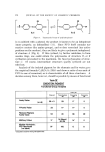
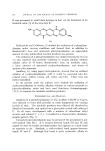
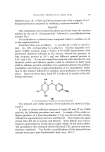
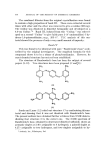
J. Soc. Cosmetic Chemists, 19, 411-422 (May 27, 1968) Oxidation Products of p-Phenylenediamine in Hair Dyes M. DOLINSKY, Ph.D., C. H. WILSON, M.S., H. H. WISNESKI, Ph.D., and F. X. 1)EMERS, Ph.D.* Synopsis--The oxidation of p-phenylenediamine by hydrogen peroxide in ammoniacal solu- tion has been investigated. Some of the oxidation products have been separated by thin- layer chromatography and identified. Their role in hair dyeing is also discussed. INTRODUCTION Hair dyes of the oxidation or "permanent" type, based on alkaline peroxide oxidation of p-phenylenediamine or related diamines, have been used for many years. These diamines are oxidized in combination with other amino and phenoli½ compounds ("modifiers") to yield various shades on hair. The oxidation of p-phenylenediamine was first studied by Bandrow- ski (1) and by Erdmann (2), who reported that a compound C•sH•sN0, known today as Bandrowski's base, was formed in weakly alkaline solu- tion. This compound was assigned the structure A: NHz NHz NH= NH= (A) * Food and Drug Administration, Division of Color and Cosmetic Chemistry, Depart- ment of Health, Education, and Welfare, Washington, D.C. 20204. 411
Purchased for the exclusive use of nofirst nolast (unknown)
From: SCC Media Library & Resource Center (library.scconline.org)