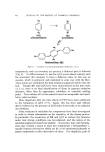
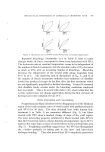
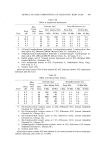
MECHANICAL HYSTERESIS OF CHEMICALLY MODIFIED HAIR 3.97 tional area of each fiber. On the other hand, the hysteresis ratio is sensi- tive to temperature and the rate of extension. Nevertheless, very pre- cise results can be obtained on fibers which have been subjected to cosmetic and chemical treatments under practical conditions. EXPERIMENTAL Materials Hair A bundle (about 50 g) of 20-era long commercial brown hair* was washed twice in 500-ml portions of a 1% Sipon WD©p solution and then extracted in a Soxhlet apparatus with purified methanol (19). This was followed by Soxhlet extraction with chloroform for one hour and by a second one-hour Soxhlet extraction with methanol. The bundle of hair was then air-dried and divided into swatches weighing about 2 g each, held together by nickel-plated brass clinchers. :• Chemicals Chemicals were of analytical quality. The benzyl mercaptan, phenyl mercaptan, ethyl mercaptan, and phenyl isocyanate were ob- tained from the Aldrich Chemical Co., Inc., Milwaukee, Wis. The per- fluorooctanoic acid was obtained from the Chemical Division of the 3M Company, St. Paul, Minn. Chemical Procedures At the conclusion of the treatments described below, the hair was washed in repeated changes of distilled water for at least 24 hours. The hair was then air-dried at ambient temperatures. 1. Bleaching The bleaching mixture was a solution of 14.4 g (NH4)2S208 in 60 ml of water to which was added 120 ml of 6% H202. This solution was ad- justed to pH 9.5 with NH•OH, and 0.05% Chel DTPAõ was added. Hair swatches were immersed in the bleach solution for one hour at 25 øC (liquor/hair ratio of 3: 1). In all cases, the pH of the bleaching solution dropped from 9.5 to between 7.0 and 8.5 during the treatment. The swatches were rinsed under running tap water and then soaked repeat- edly in frequently changed distilled water for at least 24 hours. This procedure was repeated for the required number of times. * Joseph Fleischer & Sons, Inc., New York, N.Y. •' A purified grade of sodium lauryl sulfate, Alcolac Chemical Co., Baltimore, Md. • D225 Clip, E. B. Stimpson Co., Inc., Brooklyn, N.Y. õ Diethylenetriamine pentaacetic acid, Geigy Industrial Chem., Ardsley, N.Y.

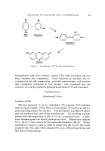
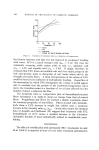
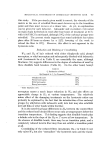
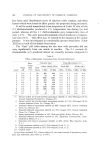
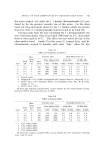
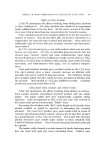
398 JOURNAL OF THE SOCIETY OF COSMETIC CHEMISTS 2. Ninhydrin Hair swatches were refluxed in unbuffered 0.1M ninhydrin solution at a liquor/hair ratio of 50:1 (15, 20). 3. Peptide Hydrolysis Hair swatches were refluxed in 0.01N HC1 (liquor/hair ratio 100: 1) for one and for 24 hours (20). 4. Esterification Dry hair swatches were refluxed for six and for 20 hours in dry methanol made 0.01N with dry HC1 gas at a liquor/hair ratio of 50:1 (20). 5. Formaldehyde Hair swatches were treated for 80 minutes at 25 øC in a solution which was 3.2M with respect to CaC12, 3.521/ with respect to CH20, and 2M with respect to HC1 at a liquor/hair ratio of 50:1 (21). 6. Phenyl lsocyanate Hair swatches were heated for ten minutes at 105 øC in 25 ml of a mixture of 2 parts by weight of phenyl isocyanate and 3 parts of dimethyl sulfoxide at a liquor/hair ratio of 12:1 (22). A control swatch was treated identically in dimethyl sulfoxide. 7. Mereuric Acetate Hair swatches were immersed in 0.1M aqueous mereuric acetate solution made 0.1N with respect to acetic acid at a liquor/hair ratio of 40:1 for one hour at 25 øC (20). 8. Perfiuorooctanoic Acid Hair swatches were immersed in a saturated aqueous solution (ca. 0.023M) of the acid at 25 øC at a liquor/hair ratio of 50: 1 for 30 days (23). 9. Reduction and Blocking Hair swatches were immersed in 0.1M benzyl mercaptan, phenyl mercaptan, ethyl mercaptan, or thioglycolic acid in 50:50 n-propanol/ water (adjusted to pH 6.3 with 0.1M NaOH) for 48 hours at 20øC. The hair was washed with 50:50 n-propanol/water and then immersed in an iodoacetate solution for 24 hours at 20øC (24). The iodoacetate solution was prepared as follows: Iodoacetic acid
Purchased for the exclusive use of nofirst nolast (unknown)
From: SCC Media Library & Resource Center (library.scconline.org)