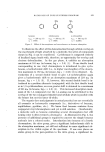
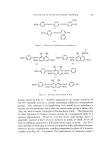
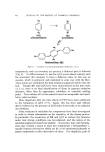
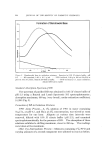
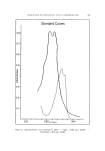
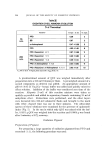
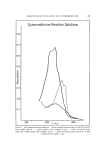
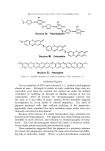
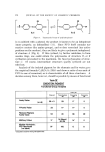
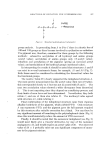
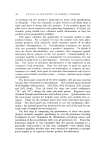
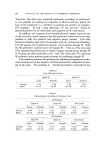
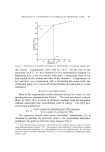
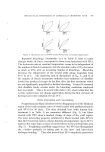
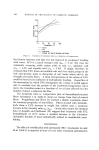
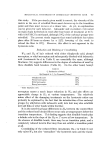
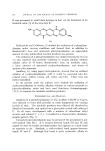
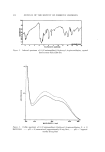
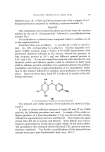
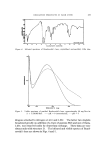
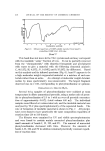
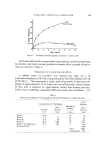
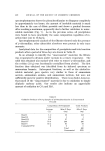
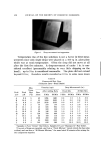
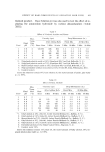
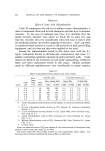
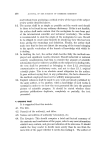
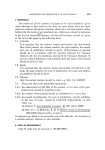
OXIDATION PRODUCTS IN HAIR DYES 415 identical (m.p., Rt', visible and infrared spectrum) with a sample of 4,4'- diaminoazobenzene prepared by oxidizing p-aminoaeetanilide (8). Band III This compound can be isolated in almost pure form from the reaction mixture by the use of "chromatosticks" followed by crystallization from acetone-H20. It is reducible to a colorless leuco compound which re-oxidizes in air to the original material. Analytical data were as follows: C, 64.44% H, 5.73% N, 23.31% mol. wt., 228, corresponding to C•2H•2N40. Nuclear magnetic reso- nance (NMR) analysis, using a Varian A-60 NMR Spectrometer with deuterated dimethyl sulfoxide as the solvent, showed the presence of four aromatic protons at 3.47r and two different quinoid protons at 4.65r and 4.40r. It was also found that material with identical Rf and identical visible and infrared spectra could be obtained in fairly good yield by alkaline peroxide oxidation of an equimolar mixture of p-phenyl- enediamine and hydroxy p-phenylenediamine or by atmospheric oxida- tion of this mixture followed by isolation and purification as described above. Based on these data, band III is believed to consist of the fol- lowing substance: HO N'•NH• NH 2- (4 '-aminoanilino )- 5-hydroxy- 1,4- quinonediimine The infrared and visible spectra of this material are shown in Figs. 2 and 3. In order to obtain sufficient amounts of bands III and IV for NMR analysis, the following procedure was used: A sample of the crude ox- idation products of p-phenylenediamine (7.2 g) was stirred with acetone (200 ml) for approximately one hour and filtered. The residue was again stirred with 200 ml of acetone and filtered. Each tiltrate was concen- trated to approximately 20 ml and an equal volume of hot water added. The precipitates thus obtained showed identical TLC patterns and were therefore combined. Two further crystallizations of this material from acetone-water gave pure Bandrowski's base m.p., 242-5 o

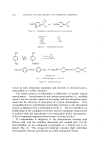
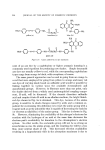
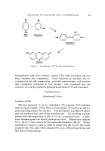
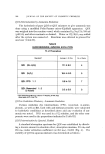
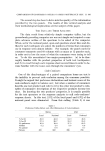
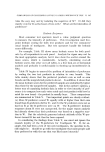
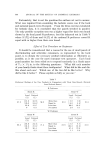
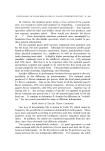
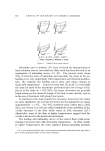
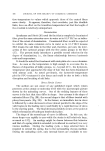
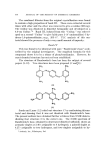
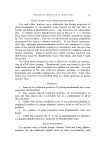
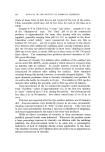
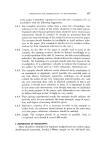
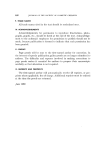
416 JOURNAL OF THE SOCIETY OF COSMETIC CHEMISTS The combined tiltrates from the original crystallization were found to contain a high proportion of band III. These were extracted several times with ether and the ether was removed to give a residue (900 mg). The residue was dissolved in dimethyl formamide and developed on a 4.0-cm Unibar. ©* Band III, isolated from this "Unibar," was redevel- oped on a second "Unibar" to give fairly pure 2-(4'-aminoanilino)-5-hy- droxy-l,4-quinonediimine m.p., 203-6 ø. TLC analysis of this ma- terial showed the presence of only a very small amount of impurity. Band IV This was found to be identical with pure "Bandrowski's base" as de- scribed by the original investigators. The empirical formula for this compound shows it to be a trimer of phenylenediamine. However, its exact chemical structure has not yet been established. The structure of Bandrowksi's base has been the subject of several papers (9-12). Two structures have been proposed (C artdiD): NH•, NH•, NH•, NH•, (c) I H,,N N Sunde and Lauer (12) ruled out structure C by synthesizing this ma- terial and showing that it was not identical with Bandrowski's base. The present authors have obtained further evidence from NMR data in- dicating that structure D is the correct one. The NMR spectrum of Bandrowski's base, obtained in deuterated dimethyl sulfoxide, shows an aromatic singlet at 3.40r assignable to 8 hydrogens, a quinoid singlet at 4.27r assignable to two hydrogens, and two singlets assignable to hy- * Analteeh, Inc., Wilmington, Del.
Purchased for the exclusive use of nofirst nolast (unknown)
From: SCC Media Library & Resource Center (library.scconline.org)