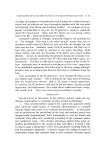
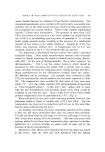
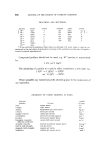
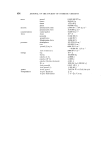
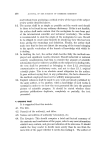
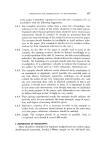
450 JOURNAL OF THE SOCIETY OF COSMETIC CHEMISTS units have continued to predominate. It is fortunate that now that the time has come to discard completely the time-honoured native units (which are not without their advantages), there is to hand a fully developed international system to take their place. Over the years much thought has been given to extending and improving the metric system until finally in 1960 the Conference G•n•rale des Poids et Mesures, the body responsible for maintaining standards of measurements (of which the United Kingdom is an active participant), formally approved SI. Already nearly 30 countries have decided to make it the only legally accepted system and it is clearly destined to become the universal currency of science and commerce. In many spheres in the United Kingdom (schools, universities, industry) the adoption of SI is being actively encouraged. The main features of SI are as follows: 1. There are six basic units (see below), the metre and kilogramme taking the place of the centimetre and gramme of the old metric system. 2. The unit of force, the newton (kg m s-2), is independent of the earth's gravitation, and the often confusing introduction, in some branches of science and technology, of g into equations is no longer necessary. 3. The unit of energy in all forms is the joule (newton x metre), and of power the joule per second (watt) thus the variously defined calories, together with the kilowatt hour, the B.t.u. and the home- power are all superseded. 4. 'Electrostatic' and 'electromagnetic' units are replaced by SI elec- trical units. 5. Multiples of units are normally to be restricted to steps of a thousand and similarly fractions to steps of a thousandth. Lists are appended of the basic SI units, of some derived SI units, of compatible units, and also examples of units which run counter to SI, the use of which is accordingly to be actively discouraged. Also listed are the names and symbols of the prefixes representing numerical factors: these are both convenient in obviating the need to write large numbers of zeros or in some instances high powers of 10, and also helpful in establishing familiarity with the numerical framework of modern science. It will be noted that the recommended prefixes are limited to 10 •3n.

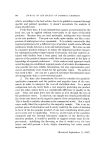
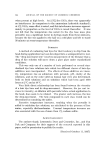
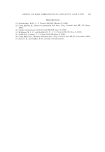
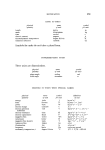
METRICATION 451 BASIC SI UNITS physical name quantity of unit length metre mass kilogramme time second electric current ampere thermodynamic temperature degree Kelvin luminous intensity candela Symbols for units do not take a plural form. symbol for unit m kg s A *K cd SUPPLEMENTARY UNITS These units are dimensionless. physical quantity plane angle solid angle name of unit radian steradian symbol for unit rad sr DERIVED SI UNITS WITH SPECIAL NAMES physical name symbol quantity of unit for unit energy joule J force newton N power watt W electric charge coulomb C electric potential volt V difference electric resistance ohm fl electric capacitance farad F magnetic flux weber Wb inductance henry H magnetic flux density tesla T luminous flux lumen lm illumination lux lx frequency hertz Hz customary temperature, t degree Celsius øC definition of unit kg m 2 s -2 kgms -2 = Jm-' kg m 2 s -3 ---- J s -x As kgm 2s -3A-' •- JA-'s -• kgm 2s -3A -2= VA -• A 2 s 4 kg-' m -2 ---- A s V -• kg m 2 s -2 A-' ---- V s kg m 2 s -2 A -2 -• V s A -• kg s -2 A-' ---- V s m -2 cd sr cd sr m -2 cycle per second t/øC = T/øK--273.15
Purchased for the exclusive use of nofirst nolast (unknown)
From: SCC Media Library & Resource Center (library.scconline.org)