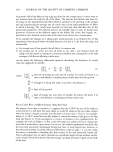
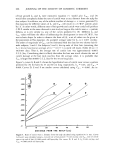
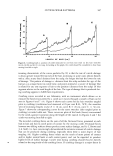
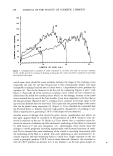
J. Soc. Cosmet. Chem., 29,99-115 (March 1978) New methods for the in-vivo assessment of skin smoothness and skin softness SIDNEY WEINSTEIN NeuroCommunication Research Laboratories, Inc., West Kenosia Ave., Danbury, CT 06810. Received June 3, 1977. Synopsis TWO SYSTEMS are described for the ASSESSMENT, IN VIVO, of SKIN SOFTNESS and SKIN SMOOTHNESS. Tests of validity and reliability are reported, as well as examples of their use in the evalua- tion of typical cosmetics employed for softening and smoothing skin. A system is described for the assess- ment of the effectiveness of shaving creams or razors by measuring closeness of shave. INTRODUCTION Blank (1) observed in 1952 that one of the factors which is responsible for skin soft- ness is its moisture content. However, it is clear there are skin treatments which utilize procedures other than moisturization to soften the skin (2). The term "softness" is also frequently and uncritically used as though synonymous with the term "smoothness," when applied to skin. Yet it is not difficult to distinguish these two terms subjectively and, more importantly, operationally. Numerous systems have been employed in evaluating the efficacy of various skin treat- ments in softening and smoothing the skin. Some employ essentially judgmental ap- proaches, e.g., rating scales (3-5). Others, which employ objective systems such as "surfometry" (6), require skin surface biopsies, a procedure which severely limits practical application and which is based upon the assumption of obtaining consistency of intracorneal adhesion. Skin hardness has been measured (7) by causing "a stylus visibly to scratch the skin." This method requires drawing a stylus repeatedly across the skin, with increasing force applied, until the scratch is visible by its "ability to scatter light." The hardness, defined by the minimal force required to scratch, is detected by an individual's ability to detect the scattering of light. In addition to the indirect nature of using scattering of light, this method also seems to have limited practical utility. Surface topography, utilizing a "sili- cone rubber replica" of the skin, has also been employed as a means of measuring skin smoothness (7). The disadvantages of a series of procedures which first require making replicas of the skin and then the determination of a surface profile by stylus displace- 99

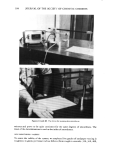
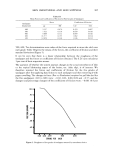
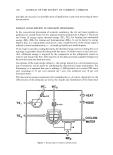
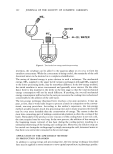
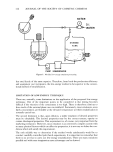
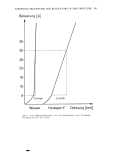
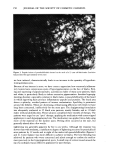
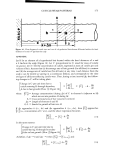
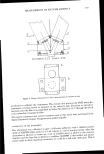
100 JOURNAL OF THE SOCIETY OF COSMETIC CHEMISTS ment studies are obvious in routine measures of skin smoothness to assess new cos- metic preparations. INDENTATION AS A METHOD OF DETERMINING SKIN SOFTNESS The development of a device for assessing skin softness was initiated by consideration of what consumers operationally do when asked which of various body parts are soft or hard. The majority were found first to prod their faces, palms, etc., with, for example, the tips of their index fingers, a pencil, etc. When questioned concerning what they were attempting to determine, a typical remark was "to see how deep the pencil would go." These observations are not dissimilar to industrial measurements made of hard- ness of materials. We therefore designed an instrument comprising a piston, within a cylinder (Figure 1), whose vertical movements are detectable in 10-4-in. units. The body part to be tested is kept immobile by velcro straps and the tip of the piston is brought to rest very lightly on a section of skin. After a load is placed on the piston, the depth of indentation of the skin, which is measured continuously, asymptotes at about 3 sec. Repeated measures are taken at slightly different areas, since testing the same site has the tendency to modify the skin's elasticity at that point varying the testing site at points around a 1-cm circle gives consistent readings. SKIN SOFTNESS: VALIDITY We applied the device to inert substances varying in softness, e.g., paper, wood, soap, glass, toothpaste, etc., and found that degrees of indentation conformed to our concep- Figure 1. The device for assessing skin softness
Purchased for the exclusive use of nofirst nolast (unknown)
From: SCC Media Library & Resource Center (library.scconline.org)