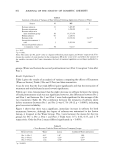
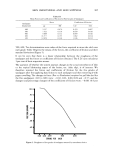
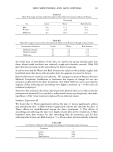
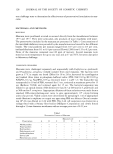
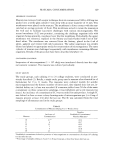
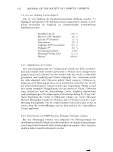
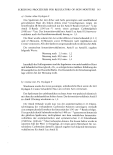
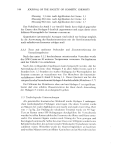
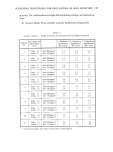
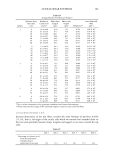
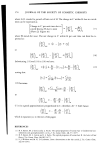
SKIN SMOOTHNESS AND SKIN SOFTNESS 111 Table XI Mean Percentage Increase in Skin Smoothness After Three Treatments in Men and Women Treatments Sex Lotion Water Bath Solution Men 12.6 17.6 19.3 Women 4.4 2.8 8.3 Difference 8.2 14.8 11.0 Table XII Mean Percentage Increase in Skin Smoothness in Subjects with Relatively Rough or Smooth Skin Pretreatment Condition Lotion Water Bath Solution Relatively Smooth 8.7 3.5 9.9 Relatively Rough 4.7 9.8 13.3 __ Difference 4.0 6.3 3.4 the initial state of smoothness of the skin, we divided the group (median split) into those whose initial condition was relatively rough and relatively smooth. Table XII gives the mean increase in skin smoothness for these two groups. It can be seen that for Water and Bath Solution the subjects with initially rougher skin benefitted more than those with smoother skin the opposite was true for Lotion. Relationship between smoothing and softening. We computed a series of Pearson Product Moment Correlation Coefficients to determine the degrees of change for our two measures as affected by the three treatments. (See Table XIII.) It can be seen that the degrees of skin softening and smoothing were highly correlated (p 0.001) after all treatments employed. Interview data indicated that those individuals who showed little or no effect from the treatments as measured by us tended to utilize hand lotions very frequently, thus mak- ing efficacy of the 5-min treatment employed by us relatively minor. Summary.' Experiment III We found that: 1) Water significantly softens the skin. 2) Lotion significantly softens and smooths the skin. 3) Bath Solution significantly softens and smooths the skin. 4) These effects are nondifferential among the three treatments. 5) The effects of smoothing and softening the skin were highly related after all the treatments. 6) Men benefited more than women for skin smoothing after all treatments, and for skin softening after Lotion and Bath Solution. 7) a-Those whose skin Xvas initially relatively Table XIII Correlations (r) Between Percentage Smoothing and Softening for Each Treatment Treatment r Lotion 0.87 Water 0.86 Bath Solution 0.87

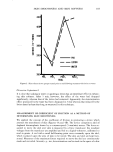
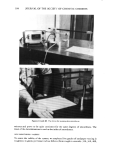
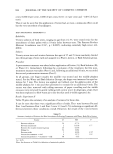
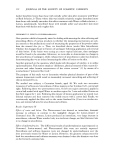
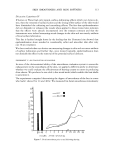
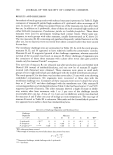
112 JOURNAL OF THE SOCIETY OF COSMETIC CHEMISTS harder benefitted more than those with initially softer skin after treatment with Water or Bath Solution, b-Those whose skin was initially relatively rougher benefitted more than those with initially smoother skin after treatment with Water or Bath solution, c- Lotion, paradoxically, benefitted those with initially softer and smoother skin more than those with harder and rougher skin. EXPERIMENT IV: EFFECTS OF EPIDERMABRASION One question which is frequently raised in dealing with assessing the skin softening and smoothing effects of various products is whether the measuring instruments are sub- ject merely to the artifactitious result of measuring the properties of the product rather than the treated skin per se. Thus, we described above (under Skin Smoothness: Validity) the changes found in friction of sandpaper following application and removal of skin lotion. If the lotion were acting as a mere topical lubricant, then sandpaper would be found to be smoother. However, we were able to demonstrate no change in the smoothness of sandpaper, while enhancement of smoothness in skin was obtained, demonstrating that we are indeed measuring the effect of lotion on the skin. Another approach to the question, which deals with this aspect of validity, is to utilize epidermabrasion. This system employs "deliberate, physical removal of the stratum dis- junctum and other keratin excrescences of the statum corneum" (2) by means of a nonmedicated "polyester fiber web." The purpose of this study was to determine whether physical abrasion of part of the stratum disjuncture would result in measurably increased smoothing and softening of skin as measured by us. We studied one subject, a Caucasian female, aged 48. We took two successive measures of softness and smoothness of three regions on her forehead: left, central and right. Following these two pretreatment tests, we left one region untreated, applied a cotton ball soaked with tepid Water to another region for 5 rain and rubbed Lotion on the third region for 1 min. Following the minute of Lotion application we waited 4 ad- ditional minutes and then removed the visible excess with a cotton ball. Finally, we continuously applied the fiber web to the entire forehead for 30 sec in a circular mo- tion, and retested all sites for smoothness and softness. Results.' Experiment IV Efj•cts of water and lotion. The Water-treated site showed an immediate, dramatic increase in softness in contrast to the negligible changes for Lotion-treated or Untreated sites. By contrast, Lotion produced an immediate, very large increase in smoothness, whereas Water resulted only in a moderate change, and the Untreated site in no change in smoothness. Effects ofepidermabrasion. The differential results of epidermabrasion superimposed on Untreated, Lotion-treated, and Water-treated skin were not entirely expected. Smoothness and softness measures were not changed by epidermabrasion over the sites previously treated by Water or Lotion. However, the greatest enhancement for both the smoothness and softness measures was obtained when the abrasion was done on the formerly untreated site.
Purchased for the exclusive use of nofirst nolast (unknown)
From: SCC Media Library & Resource Center (library.scconline.org)