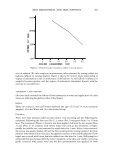
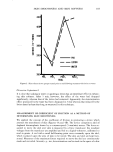
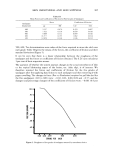
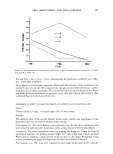
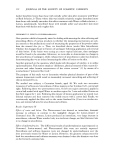
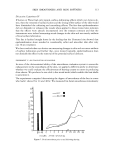
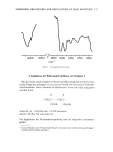
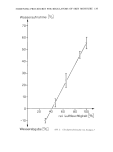
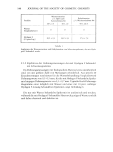
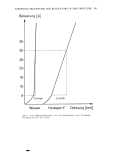
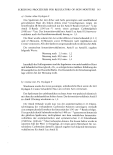
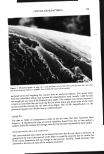
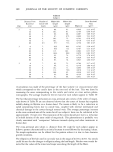
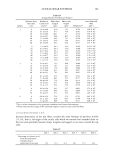
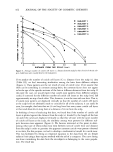
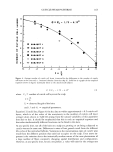
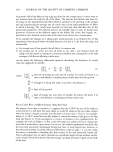
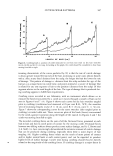
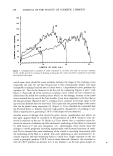
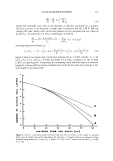
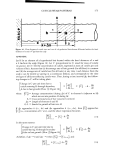
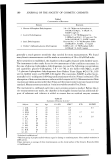
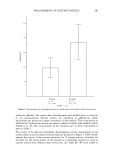
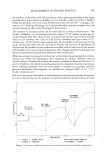
164 JOURNAL OF THE SOCIETY OF COSMETIC CHEMISTS of growth of all of the fibers on the scalp and also for the average rate of cuticle wear at any distance from the scalp for all of the fibers. The analysis that follows was done by focusing on one hypothetical hair fiber which is assumed to be growing at the average. rate and experiencing the average rate of cuticle wear of the large population of fibers to which it belongs. The cuticle-wear dynamics of this hair thus describes that of the parent hair population. The minimal amount of available data on rates of human hair growth as a function of the different stages of the follicle life cycles, hair length, etc., precludes a more detailed analysis that would take those factors into consideration. If we consider the changes in C taking place simultaneously in an element (H) of this hypothetical hair located within the fixed distances of x and x -I- Ax from the scalp, and assume that a) the average rate of hair gro-wt•_(for all fibers) is constant and b) the average rate of cuticle loss (for all hairs) at any time t and distance from the scalp x can be treated as varying in a continuous fashion and corresponds to the time averages of all factors affecting cuticle wear, we can derive the following differential equation describing the dynamics of cuticle wear (see Appendix •for details). N dx dt w where Net rate of change per unit time of number of cuticle cell layers C at time t, and distance x resulting from cuticle wear and hair growth. dx dt Change in C along hair shaft (x) at time t and distance x. - Rate of hair growth. Rate of change per unit time of number of cuticle cell layers C at time t, and distance x, resulting just from cuticle wear. Rate of Cuticle lVear at Different Positions Along Hair Xha]9 The fitness of our data to equation [1] suggests that the C.W.P. for any of the subjects (corrected for Co) will have the same shape as would be observed for any other subject when the former's length coincides with the latter's at some time t. That is, for example, Subject l's C.W.P. would become like Subject 5's when the former's hair gets to be that long (see Figure 3). If this assumption is correct, it remains to be explained how, for example, the ends of Subject l's hair could still retain 0.5 cuticle cell layers during the time that it would take to grow from 30 to 60 cm. An unlikely explanation would be that the ends were practically undamaged during that time. A more logical one, however, is that when the number of cuticle cell layers falls below a critical range ( 1.5) the cortex becomes so vulnerable to handling that that section of the hair eventually breaks off. This could explain why we rarely observed any significant length of hair without cuticle, even on hairs which were shorter than the average (perhaps trimmed) length of the bulk of the hairs.

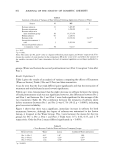
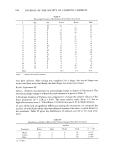
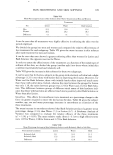
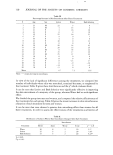
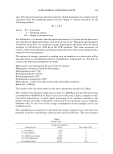
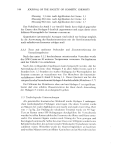
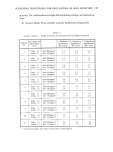
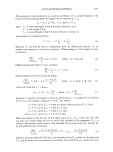
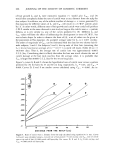
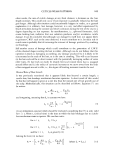
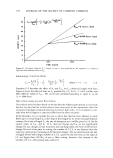
CUTICLE-WEAR PATTERNS 165 This argument is introduced into our analysis as follows: If Lc (critical length) is the length at which breakage begins to happen, we can write for Lo Lc: L, = Lo + LL (ifLo N Lc, then Lo = L,) where Lo = observed length of hair (previously referred to as L) LL = lost length of hair Ln = natural length of hair if it did not break or was not cut and equation [ 1] can then be written x x 2 C = Co - 1.7•o 4.1 [3] Lo 2 Equation [3] can then be used in conjunction with the differential equation [2] to analyze some aspects of cuticle-wear dynamics. Differentiating [3] with respect to time (x constant) dC) _ ko f2 •- N•, Lo (1.7f + 8.2 ) (where Differentiating with respect to x (Lo constant) dC_ 1 (_ 1.7 - 8.2f) dx Lo Substituting[4] and [ 5] in[ 2] and rearranging _ d(•_) = (k0f - kn) (1.7 -1- 8.2f) (where w Lo ko = dLo/dt) [4] [5] k• = dx/dt = dL•/dt) [6] at the end of the hair f = 1 Equation. [7] predicts the for any C w,•. For example, L o = 86. cm Lo = 58. cm Lo = 43. cm and Lo = 35. cm , hence (ko - k,) 9.9 where (•w• -dC [7] L0 ' dt W,(f= 1) length at which k0 will be zero (i.e., no apparent hair growth) making ko = 0 in [7] we obtain: for (•w,• = 0.004 for cuticle cell layers/day (C.C.L./day), for (•w,• = 0.006 C.C.L./day, for (•w,• = 0.008 C.C.L./day for (•w,• = 0.01 C.C.L./day. What this means is that for any of the above pairs of L0, (•w,, values the hair will not grow any longer unless the rate of cuticle wear (defined by the parameter (•w,,) is reduced. Minimizing cuticle wear is thus essential for growing long hair. Solving for ko and substituting in [6] wehave (t•t ) = - (1.7 + 8.2f) f _ dC (1.7 + 8.2f)k,(f 1) _ (•w,, [8] w Lo 9.9 Equation [8] gives values for (dC/dt)w as a function off and Lo (which are known) and (•w,• and Kn which were not measured in our study. Note that if for any subject the rates
Purchased for the exclusive use of nofirst nolast (unknown)
From: SCC Media Library & Resource Center (library.scconline.org)