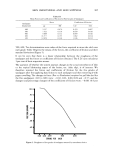
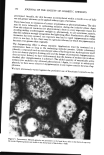
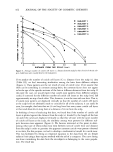
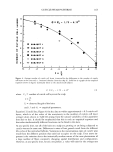
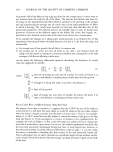
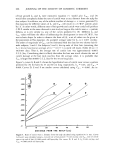
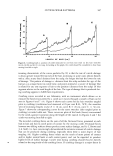
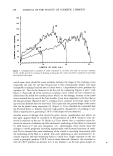
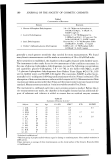
172 JOURNAL OF THE SOCIETY OF COSMETIC CHEMISTS CONCLUSIONS 1. Determining the number of cuticle cell layers at different positions along the hair shaft by means of Scanning (or Transmission) Electron Microscopy is a good method for quantitating and analyzing the degree and type of wear that hair has been sub- jected to. We believe that this approach will prove more productive than previous ones which have been based on the qualitative description of observations of changes in the appearance of the outermost cuticle cell layers along the hair shaft. 2. Although well aware that the number of subjects included in our study was very small, the similarity of the cuticle-wear patterns among subjects and the fact that all of the data can be reasonably well superimposed by plotting the number of cuticle cell layers versus the fractional distance from the scalp suggest that, under normal wear conditions, there is a common, general pattern for cuticle wear in human hair. An empirical equation describing this pattern was presented. 3. An expression for the rate of cuticle wear versus distance from the scalp, which would generate the type of cuticle-wear patterns shown by our data, was mathematically de- rived. This expression excludes age/•er se as a major factor in cuticle wear and points instead to a source of hair surface wear which accelerates as we move closer to the hair ends. An analysis of combing curves shows that the type of damage known to be produced by combing (or brushing) can very well be responsible for the shape of cuticle-wear patterns that our data reveals. 4. The rate of cuticle wear rs. x function [8] will have a different shape depending on the value of its parameters k, and (•,,•. Any member of this family of curves will, however, satisfy the differential equation [2] thus producing a C.W.P. described by [ 3]. It is therefore possible to have different rates of damage rs. x patterns for different subjects and still end up with C.W.P. which have the same shape. 5. Our data shows that, at any common distance from the scalp x, the state of preserva- tion of the cuticle is better for a long-hair subject than for a short-hair one. 6. As the cuticle wears during hair growth, the cortex appears to gradually expand, reaching an expansion of the order of 15 per cent in its cross-sectional area as we ap- proach the tip ends. 7. It was found reasonable to assume that beyond a certain length, which we refer to as the critical length (L,), human hair will appear to be growing slower due to a cuticle-loss-fracture mechanism. If the hair is cut, it will then appear to be growing faster. This apparent faster growth will continue until a new Lc is reached. 8. Hair that is kept at a constant length will be in better condition in regard to its cuticle than hair of the same length which is growing freely. 9. Last, but most important, the care with which hair is treated and handled directly affects the maximum length that it can attain. The use of products which reduce combing damage should effectively enable a person to grow longer hair. Faster rates of hair growth, more cuticle cell layers on the hair at the follicle and longer follicle growth cycles will also contribute to increasing the maximum attainable length. The authors are well aware that the number of subjects participating in our study was relatively small. Our assumptions and results should therefore be tested further by gathering more extensive data of the type presented in this paper. It is hoped, however, that our conclusions, some of the questions they pose, and the mathematical tools pro- posed for their analysis will stimulate additional research on the subject of cuticle wear and, what is even more important, on its prevention.

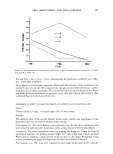
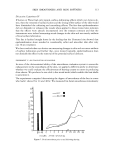
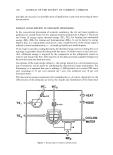
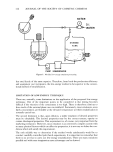
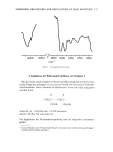
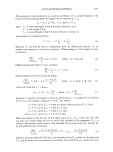
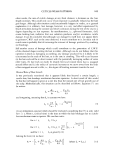
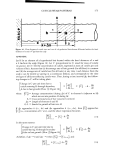
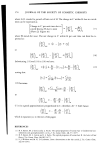
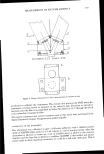
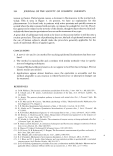
CUTICLE-WEAR PATTERNS 17 3 ' 4 - x'.._._,,.. ', Figure 10. Flow diagram ooe cuticle into and out ooe a hypothetical hair element H located within the fixed distances of x and x + Ax from the scalp APPENDIX Let H be an element of a hypothetical hair located within the fixed distances of x and x + Ax from the scalp (Figure 10). Let C' (proportional to C) stand for mass of cuticle (in grams). Let [C' ] be the concentration of cuticle, expressed as mass of cuticle per unit volume of hair. Assume that (a) the average rate of hair growth (for all fibers) is constant and (b) the average rate of cuticle loss (for all hairs) at any time t and distance from the scalp x can be treated as varying in a continuous fashion, and corresponds to the time averages of all factors affecting cuticle wear. Then, during a time interval At, the follow- ing changes in C' will be taking place: hange in'C' per unit time due to I [•C t Ax cuticle entering H through boundary = = IC'h] ß A ß due to hair growth (Flow (• Figure 10) k/xtJ G ,. At -- where [C'C] = Average concentration (during At) of C' in element h (adjacent to H) which moves into position H during At A = Cross-sectional area of hair (assumed constant) Ax = Length of elements h and H G.I. = Stands for growth of hair into H -- If At approaches 0 (i.e., dt) and ZXx approaches 0 (i.e., dx), then [-C•,'] approaches [C'•] (i.e., concentration of C' at x), and the above expression becomes (5t') G •. d-• [ 15] In the same manner: I•hange in C' per unit time due to uticle leaving H through boundary = [•'] due to hair growth (Flow (•)Figure 10 6 o As before, if At --• 0 and Ax --* 0 then [C•] --* [C•x+dx)], and: = ^. •.o dt = •Z•] ß A. A-• x At [ 16]
Purchased for the exclusive use of nofirst nolast (unknown)
From: SCC Media Library & Resource Center (library.scconline.org)