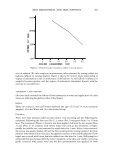
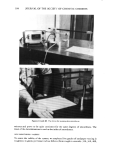
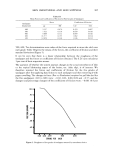
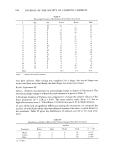
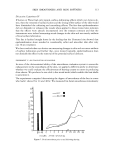
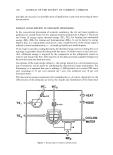
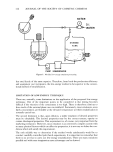
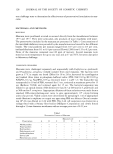
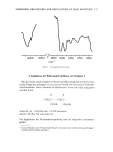
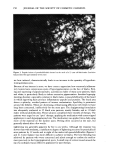
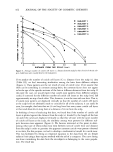
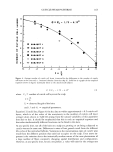
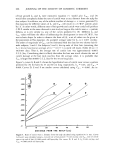
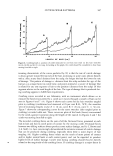
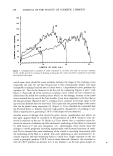
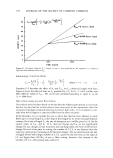
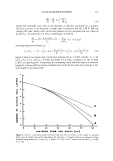
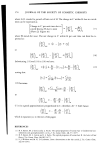
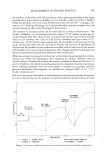
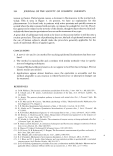
168 JOURNAL OF THE SOCIETY OF COSMETIC CHEMISTS 160 _ B i t 140 120 lOO so so 40 =o 0 liltIll c 0 10 20 30 LENGTH OF HAIR (cm.) Figure 7. Combing loads vs. position of comb (measured in cm from root end) on wet hair swatches 10.(A), 20.(B), and 30.(C) cm long. In looking at the graph, the comb should be considered to have been moving from left to right cuticle wear, there should be some similarity between the shape of the combing curves (especially the ones for wet hair because hair is then mechanically weaker and more susceptible to damage) and the rate of cuticle wear vs. x hypothetical curves predicted by equation [8]. This can be observed to be the case by comparing Figures 6 and 7 with Figure 5. Practically all of the numerous combing curves which we have observed are characterized by initial low combing forces which, on the average, increase as the comb moves towards the tip end of the hair bundles. Even more important is the fact that as the hair gets longer (Figures 6 and 7) combing forces continue to be large closer to the tip ends and diminish near the root ends. This is precisely the general shape of the curves that can be plotted using expression [8] (Figure 5). It can therefore be concluded that the frictional forces vs. distance from the scalp pattern characteristic of combing is very likely a major factor in generating C.W.P. of the shape we have observed. Another source of damage that should be given serious consideration and which, on first sight, appears likely to contribute to the generation of C.W.P. similar to ones ob- served is exposure to the sun. R. Beyak et al. have shown that a correlation exists be- tween the amount of radiation and the mechanical weakening of hair fibers as measured by yield forces at 15 per cent elongation (20). Interestingly, these results show the changes in tensile properties increasing exponentially with increased amounts of radia- tion. If it is assumed that some weakening of the cuticle is occurring concurrently with the weakening of the fiber as a whole, that such weakening is also accelerated by in- creased exposure and that weakening leads to cuticle loss, simple exposure to the sun could, in principle, produce C.W.P. such as those observed. However, the evolution in time of C.W.P. produces an increase in C at any distance x as the hair grows longer. In

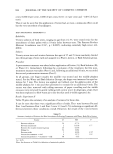
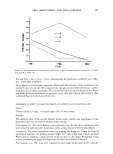
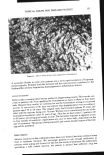
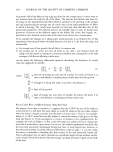
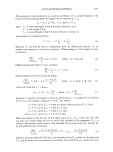
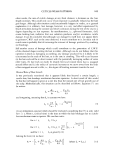
CUTICLE-WEAR PATTERNS 169 other words, the rate of cuticle damage at any fixed distance x decreases as the hair length increases. This could only occur if sun exposure is gradually reduced as the hair gets longer. Although this situation could occasionally happen in reality, as a general explanation it is arbitrary. Sun damage, however, is a very real effect experienced by beach attendants during the summer and which continues during the rest of the year to a degree depending on sun exposure. Its manifestations, i.e., split-end formation, dull, coarse looking hair, indicates that sun radiation produces and/or accelerates cuticle damage. It can be concluded that although sun damage by itself does not appear likely to generate C.W.P. such as the ones observed, it must contribute to it. Its main role in cuticle wear is probably that of increasing the amount of damage produced by combing (or brushing). Still another source of damage which could contribute to the generation of C.W.P. of the observed shape is setting the hair in rollers. Although we do not believe that this operation is nearly as damaging as combing, any damage produced by it is likely to be concentrated at the ends of the hair, as is the case in combing. This will occur because (a) the hair ends will be in direct contact with the potentially damaging surface of some roller types, (b) hair ends can easily be sharply bent and twisted when hair is wrapped around rollers and (c) the radius of curvature increases as we move away from the ends of hair wrapped around a roller, i.e., the degree of bending increases towards the end. Observed Rates of Hair Growth It was previously mentioned that it appears likely that beyond a certain length, a cuticle-loss, hair-breakage mechanism becomes operative. A direct result of this would be that hair will appear to grow at a rate less than the natural rate of hair growth out of the scalp. Mathematically, this situation can be described as follows. Equation [7] can be written ko - dLo _ k. (•w,•Lo dt 9.9 and integrating, assuming that k. is constant we have dw ' • (• +^)'] L0- 9.9 k, - e 9.9 ] [9] A is an integration constant which should be evaluated considering that [9] is only valid for t _ tc where tc (critical time) is the time at which the hair breakage due to cuticle- loss mechanism starts to operate. We can then write: for t t c L0 = k,t _ 9.9 for t = tc L0 = k,t• Cw,• and for t t• L0 is given by [9] [lo] Solving for A in [10] we have: Cw,• "9.9 /] (where L• = k.tc) [11]
Purchased for the exclusive use of nofirst nolast (unknown)
From: SCC Media Library & Resource Center (library.scconline.org)