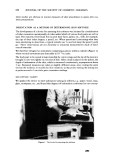
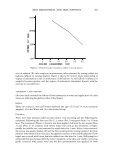
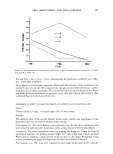
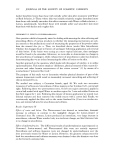
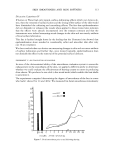
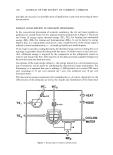
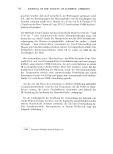
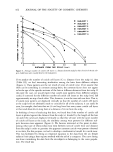
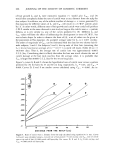
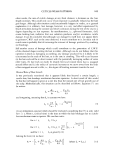
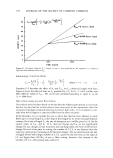
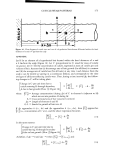
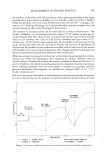
170 JOURNAL OF THE SOCIETY OF COSMETIC CHEMISTS 80 7O 6O 5O 4O 3O 2O 10 ?roME (DAYS) Figure 8. Calculated observed (Lo) length of hair vs. time predicted by the equation [12] shown in figure for three different values of Cw• • Substituting [ 11] in [9] we obtain _ k,9.9 1 - (•w,•tc e 9.9 I (wheret' = t - to) [12] Lo Cw,• 9.9 Equation [12] describes the effect of k, and (•w,• on L0 (observed length) with time. Figure 8 shows the effect of time on L0 predicted by [12] for k. = 0.035 cm/day and three different values of Cw,,. The curves were calculated assuming Lc equal to 35 cm (to = 1000 days). Effect of Hair Cutting on Cuticle- IF'ear Patterns Our analysis so far has been based on the fact that the subjects participating in our study had not cut their hair for at least three to four years prior to the experiment (with the exception of perhaps occasional trimming to remove split ends). It is of interest to con- sider what would happen in cases that differ from the above situation. In the first place, let us consider the case in which hair that has been allowed to grow freely up to a certain length L0 is then kept at that length by its owner through frequent cuttings. For a hair of length L0, the rate of damage at any x will be given by 181 for the correct values of &w,, and k,. If k, does not change and (•w,•,is not significantly changed by any changes in hair treatment and handling habits, the form of[8] will not change. For such a hair prior to cutting, the number of C.C.L. at any distance from the scalp was continuously increasing as the hair grew longer. This occurred because the rate of supply of hair with a larger number of C.C.L. (given by the first term on the right of [2] was bigger than (dC/dt)w at any x. After cutting, however, this increase in the number of C.C.L. will continue only until in[2]

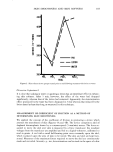
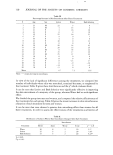
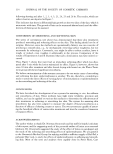
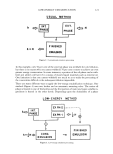
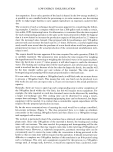
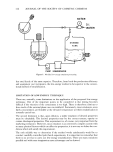
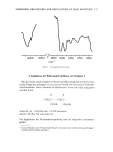
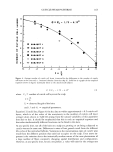
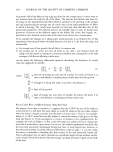
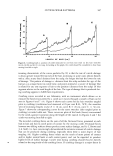
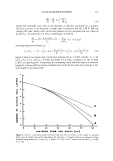
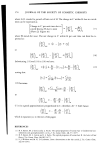
CUTICLE-WEAR PATTERNS 171 dx dt •tt w [ 13] which will eventually occur due to the decrease in (dC/dx) produced by a positive (dC/dt)NET at any x. At this point, a steady state is achieved and the C.W.P. will not change with time. Steady state cuticle-wear patterns can be calculated for any value of k, and (•xv,•, by means of{[13]. Thus, combining [13] with [8] dC_ (1.7 + 8.2f)(f - 1) L (•xv,• (l.7 + 8.2f)f dx Lo 9.9 k, and integrating (for constant Lo) C =Co _ 1.7f _ (3.2 +0.1 (•w,L0) f2 ( (•w,,Lo)f, [14] • + 2.8 - 0.3 Figure 9 shows two steady state cuticle-wear patterns for k, = 0.035 cm/day, Lo = 60 cm, Co = 6 C.C.L. and (•w,, = 0.002 and 0.004 C.C.L./day, compared to the normal C.W.P. of a growing hair. It illustrates the interesting result that hair kept at a constant length by cutting will be in better condition than would be that same hair arriving at the same length by growing freely. • A o 0 10 20 30 40 50 60 DISTANCE FRO" THE SCALP {cm.} Figure 9. Curve A: cuticle-wear pattern of 60-cm-long hair that has arrived at this length by growing freely. Curve B.' steady state cuticle-wear pattern for hair kept at a length of 60.cm by frequent cutting, calculated using equation [14] in text, (•,,• = 0.004 C.C.L./day. Curve C.' same as Curve B but •w,• = 0.002 C.C.L./day
Purchased for the exclusive use of nofirst nolast (unknown)
From: SCC Media Library & Resource Center (library.scconline.org)