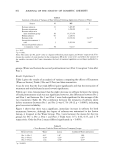
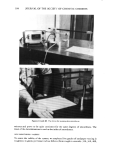
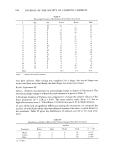
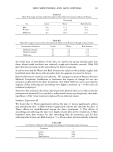
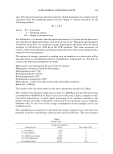
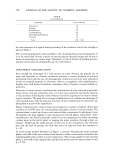
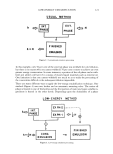
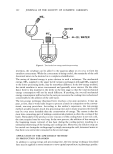
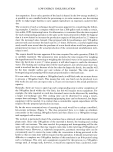
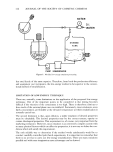
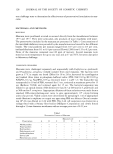
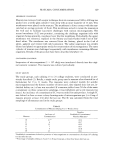
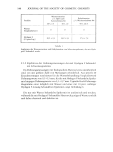
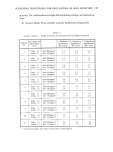
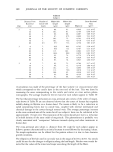
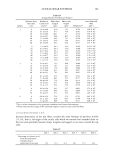
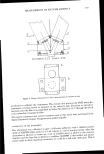
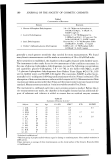
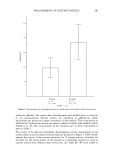
MASCARA CONTAMINATION 129 MEMBRANE CHALLENGE Mascara was removed with aseptic technique from its container and 300 to 400 mg was packed into a sterile glass cylinder 3 mm deep with an inner diameter of ! 3 mm. Two membranes were placed on the mascara. The membrane in direct contact with the mas- cara had an average porosity of 8/zm. This membrane served to retain the mascara in the well and to facilitate successive challenges with various microorganisms. The second membrane (0.22/zm porosity), containing the challenge organism (side with organism facing upwards), was placed over the first membrane. Periodically, the upper membrane was removed, replaced in the Swinny and back-flushed with 6 ml of buf- fered saline. The membrane was removed from the Swinny, placed in the 6 ml of saline, agitated and treated with mild sonication. The saline suspension was serially diluted and plated on appropriate media for enumeration of microorganisms. The same cylinder of mascara was challenged sequentially with membranes containing different organisms. Details of this procedure have been described elsewhere (3). CONTAINER CHALLENGE Suspension of microorganisms (1 x l0 n cfu/g) was introduced directly into the origi- nal cosmetic container. The mascara was cultured periodically. STUDY GROUPS The study groups, each utilizing 15 to 25 colle_ge students, were conducted as pre- viously described (2). Briefly, a single study group used a mascara of an identical lot of formulation for 9 to 11 weeks. The mascaras were cultured weekly for aerobic microorganisms and the history (number of times used, time elapsed since last use, in- dividual habits, etc.) of use was recorded. If a mascara yielded over 50 cfu of the same contaminant on three consecutive samplings, it was withdrawn and a new mascara was issued. An incidence of contamination (IC) was recorded for each product. A single IC was defined as four or more colony-forming units of microorganisms per 3 to 8 mg of mascara present at least 4 hr after the last use. The IC was calculated from the total samplings of all mascaras used in the study groups. Table II Contamination of Mascaras During 9 to 11 Weeks of Use Number Incidence of Established Contaminants/ Mascara Contamination Number Mascaras* B 61'* 6/13 C 6 0/17 D 33 O/22 F 7 0/17 G 9 0/18 H 23 O/21 ½Established contaminants defined as presence of microorganisms at concentrations of at least 10 3 cells/mg ten days after last use. '•*Percentage of samples yielding 4 cfu per 3 to 8 mg of mascara, at least four hours after last use.

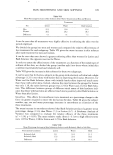
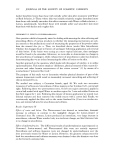
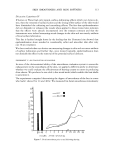
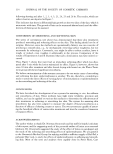
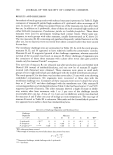
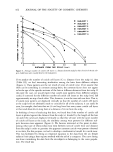
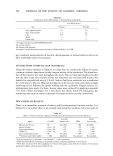
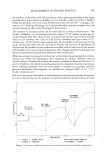
130 JOURNAL OF THE SOCIETY OF COSMETIC CHEMISTS RESULTS AND DISCUSSION An analysis of study-group results with selected mascaras is presented in Table II. Eight containers of mascara B yielded high numbers ofS. epidermidis after an average of 22 uses. In excess of 10 s cells/g was isolated from six of the mascaras ten days after their last use. In addition to S. epidermidis, three of these six each contained high numbers of either K/ebsie//a pneumoniae, Pseudomonas putida or Candida parapsi/osis. These three mascaras were used by participants wearing hard contact lenses. These same par- ticipants, in study groups with other mascaras, usually demonstrated an IC above 20. The two mascaras (D, H) containing only parabens frequently yielded bacteria 4 to 8 hr after use, but no bacteria were recovered from these containers after they were stored for ten days. The membrane challenge tests are summarized in Table III. As with the study groups, mascaras B, D, and H appeared to have relatively ineffective preservative systems. Mascaras B and D supported growth of the challenge organisms, whereas extended survival of the inoculum was found on mascara H. Direct challenge of organisms into the containers of these three mascaras with culture after seven days gave positive results only for mascara D with P. aeruginosa. Two new lots of mascara B, one obtained just after production and one fortified with Dowicil 200 instead of imidazolidinylurea, and one new lot of mascara D supple- mented with thimersol were obtained. These mascaras were given to small study groups of six to eight individuals and challenged with the double membrane procedure. The study group IC for the three was less than seven after 25 uses with none showing established contaminants. No organisms were recovered at three days with the membrane challenge test. Containers of these mascaras were stored (closed) for seven days at 37 and 56øC and then challenged with the membrane test. Only mascara B containingparabens and imidazolidinylurea (Table I) that had been kept at 37 and 56øC supported growth of bacteria. The other mascaras showed a slight decrease in inhibi- tory activity after heat treatment with 2 to 3 per cent of the challenge inocula recoverable after one day. A loss of 1 to 3 per cent in inhibitory activity was observed for mascaras A and F after one year of storage at room temperature. The exact age of mascara B tested in Table III is unknown. Mecurials and the formaldehyde preserva- tive appeared more stable to heat than imidazolidinylurea. Table III Recovery of Challenge Organisms with Membrane Test Challenge Organisms Mascaras (1 x 10 •) A B C D E F G H WP* S. epidermidis 0.1'* 51 0 6 0 P. aeruginosa 0 3 0 1 O0 0 P, aeruginosa*** --**** 1 O0 0 1 O0 0 0 0.3 9 37 0 0 2 14 0 0 46 15 *WP, white petrolatum control. **Percentage ofinoculum recovered after three days, mean often tests. (X i -- 5) ? S 2 n--1 ***Sequential challenge, initial challenge with S. epidermidis. ****--not done.
Purchased for the exclusive use of nofirst nolast (unknown)
From: SCC Media Library & Resource Center (library.scconline.org)