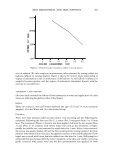
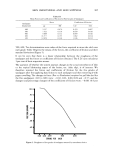
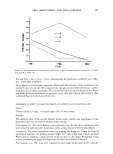
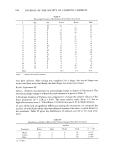
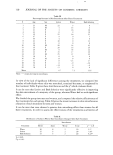
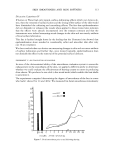
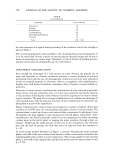
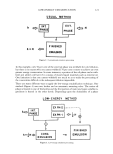
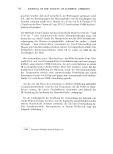
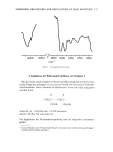
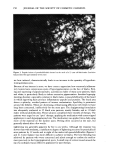
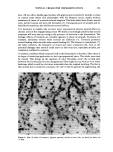
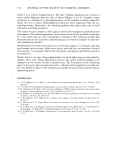
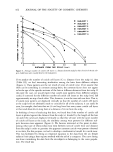
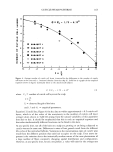
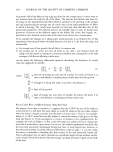
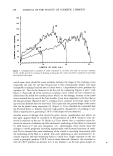
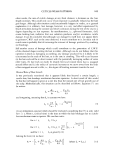
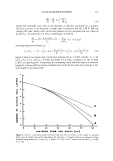
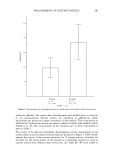
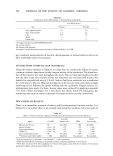
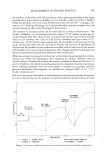
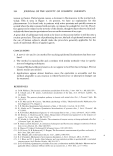
162 JOURNAL OF THE SOCIETY OF COSMETIC CHEMISTS 9 SU BJ ECT 2 SUBJECT 4 • 6 SUBJECT 5 0 0 10 20 30 40 50 60 DISTANCE FROM THE SCALP (cm.) Figure 3. Average number of cuticle cell layers rs. distance from the scalp for hair of each of the six sub- jects. Solid lines were visually fitted to the data points If we analyze the number of cuticle cell layers (C) rs. distance from the scalp (x) data (Table III), we find interesting similarities among the hairs from different subjects (Figure 3). These patterns are the net result of years of cuticle wear. If we assume that there can be something in common among them, the common factor does not appear to be the age of the specific sections of the hair at different distances from the scalp. If this were the case, we would expect that cuticle-wear patterns from different subjects could, if corrected for the different number of cuticle cell layers at the scalp level, fall approximately on top of each other. This, however, is not the case with our data. That is, if cuticle-wear patterns are displaced vertically so that the number of cuticle cell layers at the scalp level are arbitrarily made to coincide for all of the subjects, it can easily be seen, for example, that hairs that are 30 cm long have lost many more cuticle cell layers at their ends than 60-cm-long hairs at a distance of 30 cm from the scalp. In thinking of ways of analyzing this data, we found that if the number of cuticle cell layers is plotted against the distance from the scalp (x) divided by the length of the hair (L) and if the curves are displaced vertically so that they all start with the same number of cuticle cell layers at the scalp, the similarity among wear patterns for different sub- jects becomes more apparent (Figure 4). We became interested at this point in deter- .mining what type of relationship must exist between rates of cuticle wear and distance from the scalp in order to generate the apparent common cuticle-wear pattern observed in our data. For this purpose, we had to develop a mathematical model for cuticle wear. This was facilitated by fitting an empirical equation to the data from the six female subjects' hair using a least-squares method with the aid of a computer. The curve fitting was done considering the data from the six subjects as belonging to the same popula- tion. The result was

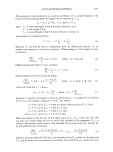
CUTICLE-WEAR PATTERNS 163 C = C o- 1.7f - 4.1f ß SUBJECT 1 • SUBJECT 2 •, SUBJECT 3 ß SUBJECT 4 0 SUBJECT 5 • SUBJECT 6 O. .1 .2 .3 .4 .5 .6 .7 .8 .9 .1 X Figure 4. Average number of cuticle cell layers (corrected for the differences in the number of cuticle cell layers at the root end) rs. fractional distance from the scalp (f). Solid line is a graph of the empi'rical equation (shown in figure) statistically fitted to the data from all subjects C = Co - 1.7f -4.1f 2 [1] where Co = number of cuticle cell layers at the scalp x f- L L = observed length of the hairs and 1.7 and 4.1 = empirical parameters. Equation [ 1] (solid line, Figure 4) fits the data to within approximately + 0.5 cuticle cell layers, which is of the order of the uncertainty in the number of cuticle cell layer average values shown in Table III arising from the natural variability of this parameter from hair to hair. It should be emphasized that this is only an empirical equation and that other mathematically different functions can be fitted to this data. At any specific time, not all of the hairs on a scalp are growing or are being subjected to cuticle wear at the same rate. Differences in rates of hair growth result from the different life cycles of the individual follicles. Variations in the instantaneous rates of cuticle wear result from the different position that each hair occupies on the scalp. Even more im- portant is the variation due to the intrinsically random nature of the wear phenomena of a large number of fibers constantly changing spatial distribution and configuration. However, at any specific time, for any one person, a value will exist for the average rate
Purchased for the exclusive use of nofirst nolast (unknown)
From: SCC Media Library & Resource Center (library.scconline.org)