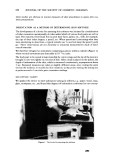
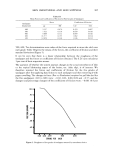
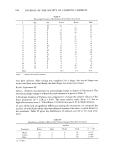
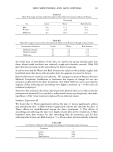
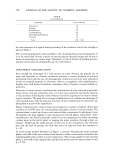
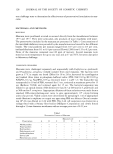
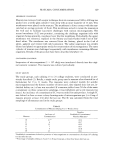
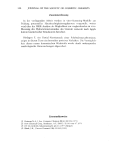
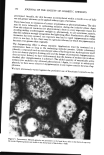
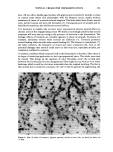
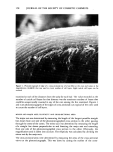
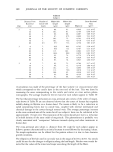
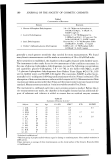
160 JOURNAL OF THE SOCIETY OF COSMETIC CHEMISTS Table II Subject 1 Distance From Number of Major Axis Minor Axis Cross-Sectional Root End Cuticle Cell Length Length Area Hair (cm) Layers (/.tm) (/.tm) Ellipticity (/.tm 2 ) 2 0 8. 99. 63. 0.636 5.15 x 10³ 10 8. 102. 81. 0.794 6.49 x 10³ 20 6. 96. 66. 0.687 5.09 x 10³ 30 5. 97. 67.5 0.696 5.33 x 10³ 40 4. 101. 75. 0.743 6.19 x 10³ 50 1. 102. 73.3 0.718 6.33 x 10³ 60 0.5 97.7 73.3 0.750 5.83 x 10³ 3 0 7. 93.5 69.5 0.743 5.38 x 10³ 10 6. 95.5 73.3 0.767 5.23 x 10³ 20 6. 115. 104. 0.904 6.33 x 10³ 30 4. 104.3 69.9 0.670 6.02 x 10³ 40 2. 95. 74. 0.779 5.70 x 10³ 50 2. 86. 54. 0.628 4.34 x 10³ 60 0. 83. 70. 0.843 4.66 x '103 5 0 7. 93. 73. 0.784 5.37 x 10³ 10 7. 94. 73. 0.776 5.80 x 10³ 20 6. 102. 71. 0.696 5.99 x 10³ 30 5. 113. 76.6 0.678 7.14 x 10³ 40 4. 100. 65. 0.650 5.55 x 10³ 50 1. 95. 69. 0.726 5.29 x 10³ 60 0. 92. 60. 0.652 4.95 x 10³ A calculation was made of the percentage of the hair volume (or cross-sectional area) which corresponds to the cuticle layer at the root end of the hair. This was done by measuring the areas corresponding to the cuticle and cortex on cross section photo- micrographs. The average results for the ten hairs for each subject appear in Table IV. The fact that percentage reductions in cross-sectional area values of the order of magni- tude shown in Table IV are not observed shows that the cortex of human hair expands radially during its lifetime on a human head. The reason is likely to be a reduction in radial constraining forces due to cuticle loss, coupled with internal mechanical and chemical damage to the cortex through normal wear. The average percentage increase in the cross-sectional area of the cortex for all our subjects' hairs can be calculated to be approximately 15.0 per cent. This expansion of the cortex should give rise to a reduction in its bulk density of the same order of magnitude. This phenomenon is probably very closely associated with •'overporous" behavior towards dyeing and other treatments in human hair. The cross-sectional area values vs. distance from the scalp for each subject appear to follow a pattern characterized by an initial increase in area followed by decreasing values. No simple explanation can be offered for this pattern unless it is due to hair diameter growth variations. The ellipticity of the hair used in our study was in tb.e range of 0.635 to 0.853. No trends could be seen for the changes in ellipticity along the hair length. Neither were trends de- tected for the values of the minor and major axes along the length of the fibers.

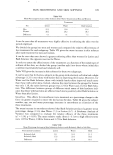
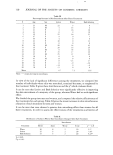
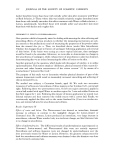
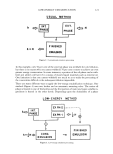
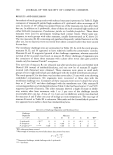
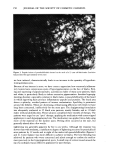
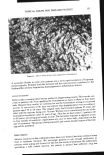
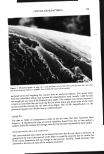
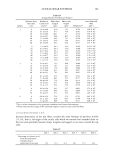
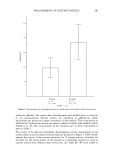
CUTICLE-WEAR PATTERNS 161 Table III Average Results (Ten Hairs per Subject) Subject Distance From Number of Maior Axis Minor Axis Cross-Sectional Root End Cuticle Cell Length Length Area (cm) Layers* (#m) (#m) Ellipticity** (#m 2 ) 1 0 7.0 4-0.58 97.0 73.3 0.758 5.69 x 10³ 10 6.7 4-0.59 97.7 76.8 0.781 5.79 'x 103 20 5.6 4-0.96 104.1 75 0.714 5.95 X 10³ 30 5.0 4-0.67 99.8 80.5 0.739 5.96 X 10³ 40 3.7 4-0.90 98.5 74.1 0.758 5.87 X 10 3 50 2.4 4-0.75 97.6 74.0 0.732 5.58 x 10³ 60 0.4 4-0.48 94.1 70.0 0.741 5.33 x 10³ 2 0 7.1 4-0.79 85.1 53.4 0.635 3.64 x 10³ 10 6.5 4-0.51 83.4 53.0 0.683 3.97 x 10³ 20 6.0 4-0.34 84.4 54.4 0.653 3.95 x 10³ 30 5.5 4- 0.61 85.5 55.3 0.647 3.75 x 10³ 40 4.5 4-0.77 82.5 54.1 0.656 3.76 X 10³ 50 2.6 4- 0.96 82.9 52.9 0.647 3.58 X 10³ 60 1.2 4- 1.25 82.9 54.0 0.661 3.67 ) lO 3 3 0 6.4 4-0.37 74.3 46.8 0.698 3.12 ) lO 3 10 5.7 4-0.59 78.7 51.4 0.654 3.32 ) lO 3 20 4.8 4- 0.56 73.6 48.3 0.604 3.31 ) 103 30 3.3 4- 0.48 81.2 50.2 0.617 3.40 ) 103 40 0.4 4- 0.33 78.1 49.4 0.632 3.24 ) 103 4 0 8.7 4-0.48 67.3 48.1 0.733 3.01 ) 103 10 7.7 4-0.68 66.1 51.2 0.777 3.13 ) 103 20 6.8 4-0.56 71.5 50.0 0.713 3.32 )'103 30 5.5 4- 0.61 67.1 54.0 0.816 3.40') 103 40 2.5 4- 1.22 63.2 51.9 0.756 3.23 ) lO 3 5 0 6.4 4- 0.50 64.2 53.7 0.853 2.79 ) 103 15 3.5 4- 0.84 69.5 56.1 0.804 3.27 X 10³ 30 0.3 4- 0.25 67.7 53.6 0.815 2.93 ) 103 6 0 6.0 4- 0.39 76.4 57.9 0.763 4.03 ) 103 15 4.3 4- 1.02 82.0 64.5 0.768 4.30 ) 103 30 1.3 4- 0.93 80.9 59.2 0.711 4.06 ) 103 *The 4- values correspond to the 95 percent confidence level limits of the averages. **These values are the average of the individual ellipticity values for each of the ten fibers. CUTICLE-WEAR PATTERNS (C.W.P.) External observation of the hair fibers revealed the same findings of previous studies (13, 14) that is, the edges of the cuticle cells which are smooth and rounded close to the root ends gradually become sharp, irregular and jagged as we move toward the tip ends. Table IV Sub. 1 Sub. 2 Sub. 3 Sub. 4 Sub. 5 Sub. 6 Percentage of volume (or of Cross-Sectional Area) corresponding to cuticle layer at root end 13.5 12.1 11.4 19.1 17.1 14.4
Purchased for the exclusive use of nofirst nolast (unknown)
From: SCC Media Library & Resource Center (library.scconline.org)