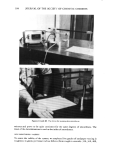
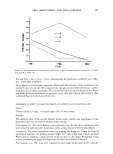
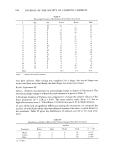
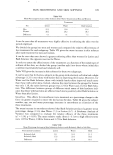
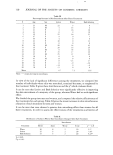
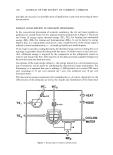
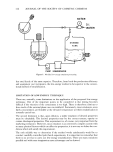
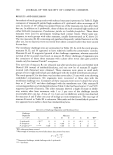
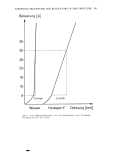
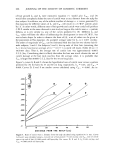
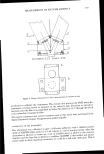
124 JOURNAL OF THE SOCIETY OF COSMETIC CHEMISTS METER STORAGE TANK DI. WATER PUMP HOMOGENIZER Figure 5. Modified low-energy emulsion processing less steel kettle of the same capacity. Therefore, from both the production efficiency and equipment cost viewpoints, the low-energy method is far superior to the conven- tional method of emulsification. LIMITATION OF LOW-ENERGY TECHNIQUE There are, naturally, some limitations on the application of the proposed low-energy technique. One of the important points to be considered is that mixing becomes difficult if the viscosity of the concentrate is too high. There is therefore a limit as to how much of the external phase one can withhold. Fortunately, most emulsions, even fairly concentrated, are flowable at the elevated temperature at which emulsification is normally carried out. The second limitation is that, upon dilution, a stable emulsion of desired properties must be obtainable. The desired properties may be the correct texture, opacity or certain rheological properties. This requirement is, of course, very important from the marketing viewpoint. However, since emulsion is an extremely complex system with so many physical factors which can affect its properties, it is not easy to define the con- ditions which will satisfy this requirement. The only reliable way to determine if the method works satisfactorily would be to conduct carefully controlled pilot batch experiments. It is important to remember that there is no set way to carry out low-energy emulsification. There are many variations possible and with some imagination many advantages can be derived.

LOW-ENERGY EMULSIFICATION 12 5 In some instances, for example, the presence of a thickener can make the concentrate very thick and cause difficulty in mixing. Sometimes such a problem can be solved by dispersing the thickener in the diluting water. If the viscosity of the thickener is pri- dependent, it may also be possible to avoid the problem by carefully controlling the pH of the concentrate. Phase inversion of the concentrate can cause a problem if the emulsion does not invert to the desired type upon dilution. Sometimes such a problem can be prevented by changing the order of phase combination or the surfactant location (3). It should be cautioned that since cold aleionized water is used in the second stage, this water must be sterilized to avoid microbial contamination. CONCLUSION Although the technique described here lends itself readily to the processing of low- solids, O/W emulsions, there is no reason why it would not apply to W/O emulsions or nonemulsified products. In fact, the method works very nicely on processing most shampoos and even some make-up preparations. The author has successfully tested a W/O system by withholding parts of both the oil and aqueous phases. However, such a technique becomes rather involved and requires experience to handle properly. In using the technique, it is well to reexamine the emulsification temperature used. In many instances it is possible to lower the emulsification temperature without affecting the emulsion quality. In some emulsions stabilized with nonionic surfactants, it may be desirable to keep the emulsification temperature above the PIT (phase inversion temperature) in order to facilitate emulsification. In some cases, considerable savings in mechanical energy used in mixing or homoge- nizing can be achieved by changing emulsification method. Elimination of energy- consuming high-shear equipment can be frequently accomplished by optimizing emulsification conditions. For example, without changing formulation, it is sometimes possible to significantly facilitate emulsification by controlling the emulsifier location or presolubilizing the oil phase (4). In some instances, one can obtain a finer emulsion using the low-energy technique than using a conventional method. The author has conducted considerable basic work on variables affecting droplet size distribution and stability of emulsions prepared by this low-energy technique. A paper dealing with these aspects will be published in the future. REFERENCES (1) T. J. Lin, Process engineering for cosmetic emulsion, part III. semi-cold processing of emulsion, American Perfumer and Cosmetics, 80, 35 ( 1965). (2) P. Becher, "Emulsions: Theory and Practice," 2nd ed, Reinhold Publishing Corp., New York, 1965, p 6. (3) T.J. Lin and J. C. Lambrechts, Effect of initial surfactant location on emulsion phase inversion, J. Soc. Cosmet. Chem., 20, 185 (1969). (4) T.J. Lin, H. Kurihara and H. Ohta, Effects of phase inversion and surfactant location on the formation of O/W emulsions, J. Soc. Cosmet. Chem., 26, 121 (1975).
Purchased for the exclusive use of nofirst nolast (unknown)
From: SCC Media Library & Resource Center (library.scconline.org)