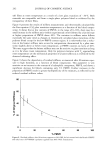
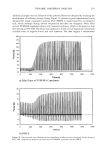
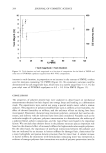
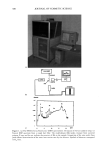
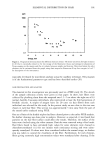
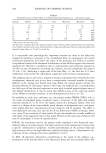
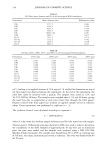
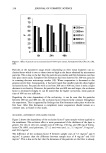
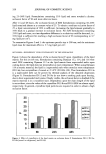
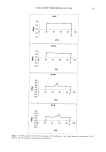
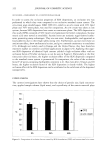
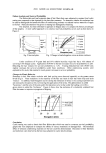
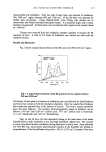
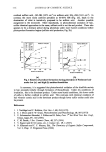
310 JOURNAL OF COSMETIC SCIENCE A secondary effect of this is that the specimen suffers mass loss due to heating in the volume analyzed, which is not the case in X-ray fluorescence analysis. Furthermore, reexamination of the same section (volume) of the specimen is possible with our XRF instrumentation. The reproducibility is highly satisfactory, taking into account the precision with which the actual sampled volume can be reestablished and the biological variation of elemental concentrations as a function of position in the sample. X-ray fluorescence spectrometry is a sensitive bulk method. However, this property is less pronounced for low X-ray energies (light elements), due to attenuation of the emitted low-energy photons in the bulk material. The effect is clearly demonstrated in the experiments using hair fiber rotation (Figure 3). The variation in hair fiber diameter is less pronounced for the heavy metals such as Zn than for the light elements such as S and K. The elemental concentrations recorded in this study are in reasonable agreement with those obtained earlier (9), taking into account that the previous PIXE data were not corrected for variations in the cross sections. These data will provide a basis for future analysis of pathological hair fibers and for forensic analysis of hair fibers retrieved in crime investigations. ACKNOWLEDGMENTS We are indebted to the National Laboratory of Forensic Science of Sweden for making resources available for this study, and to the Edvard Welander and Finsen Foundations, the research funds of the Karolinska Institutet, for financial support. REFERENCES (1) J. Andrasko and B. Stocklassa, Shampoo residue profiles in human hair, J. Forensic Sci., 35, 596-579 (1990). (2) A.J.J. Bos, On the incorporation of trace elements into human hair measured with micro-PIXE, Nuclear Instr, Meth. Phys. Res, B3, 654-659 (1984). (3) O. Braun-Falco and E. Christoffers "Hair Root Pattern in Male Pattern Alopecia," in Biopatho/ogy of Pattern Alopecia, A. Baccaredda-Boy, G Moretti, and JR Frey, Eds. (Karger, Basel and New York, 1968), pp. 141-145. (4) W. R. Collie, T. J. Goka, C. M. Moore, and R. R. Howe, "Hair in Menke's Disease: A Comprehensive Review," in Hair, Trace Elements and Human Illness, Brown and Crounse, Eds. (Praeger Scientific, New York, 1980), pp. 197-209. (5) D.J. Eatough, J.J. Christensen, R. M. Izatt, and C. Hartley, "Levels of Selected Trace Elements in Human Hair," in The First Human Hair Symposium, A. C. Brown, Ed. (Medcom Press, New York, 1974), pp. 377-387. (6) P. Engstr/Sm, Development of Capillary Optics for X-ray Focusing, Thesis, Chalmers Institute of Technol- ogy, Gothenburg, Sweden, 1991. (7) P. Engstr/Sm, S. Larsson, A. Rindby, and B. Stocklassa, A 200 rnm X-ray microbeam spectrometer, Nucl. Instr. Meth. Phys. Res., B36, 222-226 (1989). (8) B. Forslind, "The Growing Ariagert Hair," in Hair and Hair Diseases, C. E. Orfanos and R. Happie, Eds. (Springer Verlag, Berlin, New York, London, Paris, Tokyo, 1990), pp. 73-97. (9) B. Forslind, H. K. Li, K. G. Malmqvist, and D. Wiegleb, Elemental content of ariagert hairs in a normal Caucasian population studies with proton induced X-ray emission (PIXE), Scanning Electron Microsc., I, 237-241 (1986). (10) B. Forslind, K. Wiren, and K. G. Malmqvist, Assessment of qualitative and quantitative data from

ELEMENTAL DISTRIBUTION IN HAIR 311 pathological hairs-•A critical evaluation of scanning electron microscope and proton induced X-ray emission analyses, Scanning Microbe., 1, 159-] 67. (11) B. Forslind, K.G. Malmqvist, and K. Wiren, "Genetic Diseases, Hair Structure and Elemental Content," in The Biology of Woo/and Ha]r, G. E. Rogers, P.J. Reis, K. A. Ward, and R. C. Marshall, Eds. (Chapman 8: Hall, London, New York, 1988), pp 275-285. (12) C.L. Gummer, R. P. R. Dawber, and V. Price, Trichothiodystrophy: An electron histochemical study of the hair shaft, Br. J. Dermato/. 110, 439-449 (1984). (13) G.V. Iyengar, W. E. Kollmer, and H. J. M. Bowen, The Elemental Composition of Hi#nan Tisszxes and Body Fluids: A Compilation of Values for AdMts (Verlag Chemie, Weinheim, New York, 1978), pp. 51-54. (14) M. Kutner, K. Miller, and A. C. Brown, "A Critique: Hair Sulfur Analysis for Evaluation of Normal and Abnormal Hair," in The First Human Hair Symposium, A. C. Brown, Ed. (Medcom Press, New York, 1974), pp. 363-376. (15) S. Larsson, X-ray Microbeam Spectroscopy, Thesis, Chalmers University of Technology, Gothenburg, Sweden, 1991. (16) S. Larsson, P. Engstr/3m, and A. Rindby, X-ray capillary microbeam spectrometer, Adv. X-ray Anal. 33, 623-628 (1990). (17) B. Lindel/3f, B. Forslind, M.-A. Hedblad, and U. Kaveus, Human hair form morphology revealed by light and scanning electron microscopy and computer aided three-dimensional reconstruction, Arch. Dermatol., 124, 1359-1363 (1988). (18) K.G. Malmqvist, L.-E. Carlsson, K. R. Akselsson, and B. Forslind, Proton induced X-ray emission analysis: A new tool in quantitative dermatology, Scanning Electron Microsc., IV, 18] 5-1825 (1983). (19) V. H. Price, "Structural Anomalies of the Hair Shaft," in Hair and Hair Diseases, C. E. Orfanos and R. Happle, Eds. (Springer Verlag, Berlin, New York, London, Paris, Tokyo, 1990), pp. 363-422. (20) A. Rindby, Software for energy dispersive X-ray spectrometry, X-ray Spectrometry, 18, 113-118 (1989). (21) A. Rindby, P. Engstr/3m, S. Larsson, and B. Stocklassa, Microbeam technique for energy dispersive X-ray fluorescence, X-ray Spectrometry 18, 109-112 (1989). (22) G.M. Roomaris and B. Forslind, Copper in green hair. Investigation by electron probe X-ray micro- analysis, Uhrastrm't. Pathol., 1, 301-307 (1980). (23) S. Seta, H. Sato, and M. Yoshino, Quantitative investigation of sulfur and chlorine in human head hairs by energy dispersive X-ray microanalysis, Scanning Electron Microsc., II, 193-201 (1979). (24) S. Seta, H. Sato, M. Yoshino, and S. Miyasaka, SEM/EDX analysis of inorganic elements in human scalp hairs with special reference to the variation with dif/?•rent locations on the head, Scanning Electron Microsc., I, 127-140 (1982). (25) J. A. Swift, "The Hair Surface," in Hair Research: Status and Future Aspects, C. E. Orfanos, W. Montagna, and G. Stuttgen, Eds. (Springer Verlag, Berlin, 1981), pp. 65-72.
Purchased for the exclusive use of nofirst nolast (unknown)
From: SCC Media Library & Resource Center (library.scconline.org)