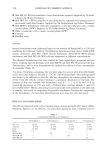
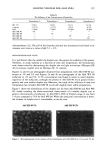
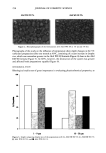
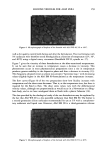
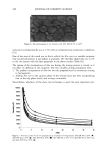
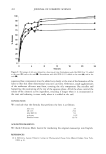
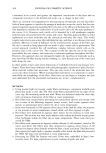
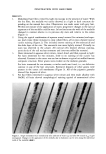
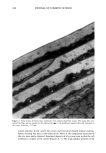
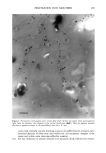
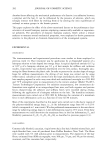
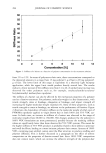
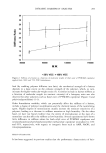
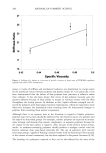
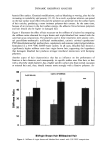
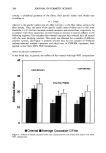
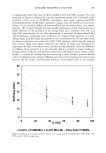
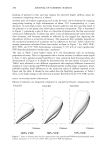
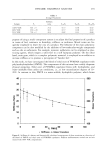
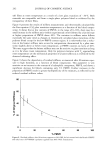
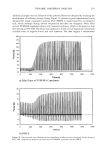
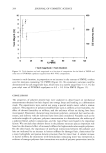
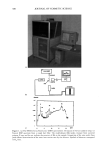
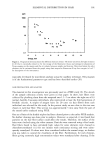
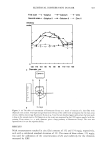
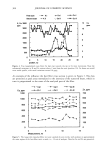
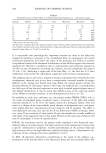
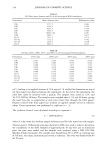
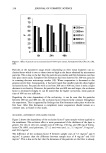
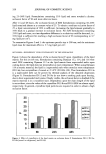
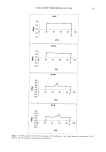
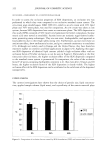
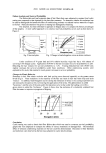
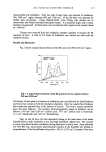
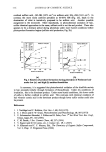
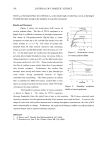
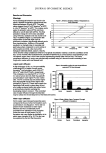
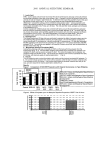
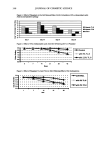
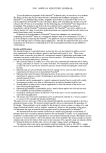
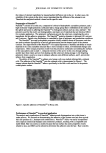
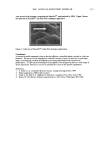
342 JOURNAL OF COSMETIC SCIENCE Results and Discussion Rheology Vernix rheological behavior was found to be plastic. Marked temperature dependence was observed between 25 and 40øC. The yield value dropped from 6.7x10³ dyne/cm• at 25øC to 4.0x10³dyne/cm 2 at 40øC. This makes vernix easier to spread in utere (37øC) and more difficult to rub off after birth (25øC). The flow activation energy for vernix was calculated using Arrhenius analysis and was found to be 102.7 Kcal/Mole (Figure 1). Interaction with components of amniotic fluid such as pulmonary surfactant significantly altered vernix flow characteristics. Addition of Survanta© resulted in a dramatic drop in viscosity and yield value when compared to vernix alone or vernix+saline (control). Like many other biological materials (blood, sputum, etc) (4), Figure 1. Arrhenius Analysis of Effect of Temperature on Vernix Rheology 3.S 3.0 u •.0 $.1•E-O• , vernix showed creep compliance behavior of a typical viscoelastic material. Under the conditions of the test, vernix showed initial instantaneous compliance followed by a curved portion corresponding to the viscoelastic region then a third linear portion representing steady state viscous flow. The creep compliance behavior of vernix was mechanically modeled using a 4-element model consisting of one Voigt unit in series with one Maxwell unit. Liquid water diffusion At film thickness of 20 • m, the permeability coefficients(PC) of water through vernix, Aquaphor © and petrolatum were 203x10 -3, 96.1 x10 '3 and 8.3x10⁻³cm/hr, respectively. This compares to a reported PC of 1.7x10 -3 for native human skin (5). Both Aquaphor• and petrolatum have higher PC than native skin. The PC of vernix was two times higher than Aquaphor• and 25 times higher than petrolatum (Figure 2). These data support the hypothesis that vernix in utero does not act as a totally occlusive biofilm but rather forms a semiocclusive barrier overlying the developing stratum corneum. This controlled rate of water diffusion through the fetal skin Figure 2. Permeability coeffient of water through different materials (37"C/20urn thickness) Vernix Aquaphor Petrolatum Skin may be critical for the development of the fetal skin barrier. Water vapor diffusion Vernix water vapor transpert properties were compared to those of other formulations such as petrolatum and Aquaphor. Vernix did not •- 8o present much resistance to water vaper •- diffusion and was considerably more • •' 60 permeable than petrolatum and Aquaphor. •' • Unlike the case of liquid water (Fig. 2), 4o Aquaphor was very similar to petrolatum in its • 2o -- water vaper transpert (Fig. 3). This fact can • be explained by the fact that ^quaphor 0 Figure 3. Rate of Water Vapor Transport Through different Formulations 100 Gortex Vernix Petrolatum Aquaphor

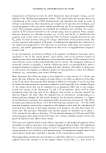
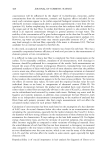
2001 ANNUAL SCIENTIFIC SEMINAR 343 contains glycerin, which absorbs more water when in contact'with liquid water and, therefore, becomes more permeable than petrolatum. Water vapor transport through different thicknesses of vernix was also investigated. The correlation between permeability coefficient and the reciprocal of thickness was consistent with Fick's first law of diffusion. Vernix water vapor permeability also showed marked temperature dependence in the physiological range from 25øC to 37 Conclusions The data are consistent with the hypothesis that vernix has a skin protective role before and after birth. The temperature dependence of the rheology shows that vernix will spread in utero but will be difficult to remove post parturn when the skin surface cools. While vemix is permeable to water and allows vapor transport it presents a hydrophobic surface that repels water. These data indicate that vernix has important differences from other commonly used skin creams. This information is critical to formulating bioengineered material films based on vernix as a prototype. Further characterization of this naturally occurring biofilm may allow insight into the mechanism(s) by which the fetus develops a functionally mature and highly aesthetic skin surface. References 1. W.L. Pickens, R.R. Warner, R.E. Boissy, and S.B. Hoath. Characterization of vernix caseosa: water content, morphology, and elemental analysis. Journal of Investigative Dermatology 115: 875-881, 2000. 2. Y. ,Sumida, M. Yakumaru, Yo Tokitsu, Y. Iwamato, T. Ikemoto, and K. Mimura. Studies on the function of vernix caseosa, the secrecy of baby's skin. Preprints of the IFSCC 20th International Conference, Cannes, France Poster 201, 1998. 3. W. Youssef, R.R. Wickett, and S.B. Hoath. Surface free energy characterization of vernix caseosa. Potential role in waterproofing the newborn infant. Skin Research and Technology 7:10-17, 2001. 4. A. Martin. Rheology. In'. Physical Pharmacy, edited by A. Martin. 453-476, 1993 5. M. Walker, T. Hulme, M. Rippon, R. Walmsley, ,S. Gunnigle, M. Lewin, and S. Winsey. In vitro model(s) for the percutaneous delivery of active tissue repair agents. Journal of Pharmaceutical Sciences 86: 1379-1384, 1997.
Purchased for the exclusive use of nofirst nolast (unknown)
From: SCC Media Library & Resource Center (library.scconline.org)