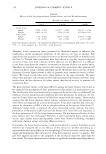
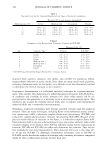
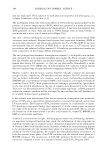
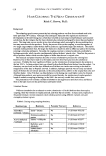
418 JOURNAL OF COSMETIC SCIENCE HAIR COLORING: THE NEXT GENERATION? Keith C. Brown, Ph.D. Background. The technology used in most present day hair coloring products was first discovered and used in the latter part of the 191h Century. Although it has undergone many and often significant incremental developments in the intervening years which have resulted in much improved performance and consumer satisfaction, the fact remains that the basic chemistry has remained unchanged for more than one hundred years. This long term success resides in two clear advantages which outweigh by far any problems that a user may associate with the products. Firstly, the process relies on the coupling, or reaction together, of two single ring aromatics inside the hair shaft to produce a significantly larger dye molecule. The smaller reactants readily penetrate hair, the larger dye molecule is much less able to diffuse out and so the resulting coloring is relatively permanent. Secondly, the coupling reaction is initiated oxidatively, preferably by hydrogen peroxide, which can also simultaneously lighten the hairs' natural color. Therefore the process is able to produce shades which are either lighter or darker than the user's original color. The technical and patent literature describes a variety of alternative processes for coloring hair. However, few of these have made it to the market, and even fewer have proven to be commercial successes. Probably the most significant of these was the introduction of semipermanent dye products in the late l 950's. In these products hair was colored by dyes that diffused into the hair from the product. No chemistry was involved, and the dyes diffused out of the hair at a similar rate resulting in the need for reapplication of the dyes at frequent intervals. In addition, hydrogen peroxide was not used, and indeed many of the dyes do not tolerate peroxide, so the color produced was additive to the original hair color and therefore darker. Only if the hair was bleached prior to the dyeing step could lighter colors be obtained. Although these products were quite successful for several decades, the introduction of similar products based on oxidative coupling technology in the 1980's has seriously eroded their market share. This presentation will evaluate a number of alternative dyeing processes and chemistries, and discuss them in the light of present day performance and market needs. Literature Review. While not intended to be an exhaustive review, chemistries will be divided into those that employ coupling, those that tolerate or employ peroxide, and those that use neither. In many cases, especially in the patent literature, several companies claim similar processes using different reactants only one exemplary citation is given. Table 1: Dyeing using coupling chemistry. Reaction tvpe Reactants Peroxide Tolerant Reference Schiff Base lsatin + amines No 1. US Patent 4921503 ( carbonyl + amine) Diiminoisoindoline + No 2. US Patent 6077320 amines Active methylene Indoles + aldehydes No 3. US Patent 4932977 + carbonyl Barbituric acid + No 4. US Patent 6770102 aldehydes lndane dione + No 5. US Patent 6790239 aldehydes

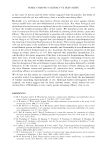
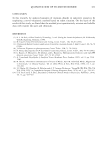
2006 ANNUAL SCIENTIFIC SEMINAR 419 Table 2: Dyeing using peroxide or equivalent Reaction type Reactants Permanent Reference Enzymatic 02 or H2O2 + enzyme + Varies 6a, 6b. standard dye precursors Melanin precursors 02 + indoles or indolines Varies 7a, 7b Table 3: Dyeing using neither peroxide or coupling Reaction/reactants Peroxide tolerant Permanent Reference Fiber reactive dyes Usually No Potentially Yes 8. US Patent 6447554 Polymeric dyes Usually No Usually No 9. US Patent 3597468 Pigments Usually No No I 0. US Patent 6328950 Discussion. Despite the number and variety of alternative technologies for dyeing hair that have been proposed in the last 50 years and the fact that many of these chemistries have achieved technical viability, none has proved competitive with the conventional oxidative dye process. Review of Tables I, 2 and 3 shows that most of the processes are not compatible with hydrogen peroxide, which therefore necessitates a separate bleaching step with hydrogen peroxide for shades lighter than the original hair color. This separate step is a severe limitation especially for products designed for at home use. Also many of the processes deposit dyes on, or only slightly penetrated into the hair surface which generally makes them less durable or permanent compared to dye in the hair cortex. Such technologies therefore are not competitive in performance with conventional oxidative dyes. In addition many of the reactants are expensive, difficult to synthesize, and have stability concerns. Finally there is the requirement that a wide range of shades must be available and many of these chemistries are not able to produce even the minimum combination of yellow, red and blues needed to blend into shades. Frequently the chemistry only produces color in a limited range of the spectrum, and the individual colors may be formed at different rates due to the wide \"ariety ofreactant structures needed to vary the dye color. The stringent requirements to color hair to the variety of shades and in the relatively short reaction times associated with modem products, demonstrate the apparently unique nature of the current oxidative coloring process in satisfying consumer needs. Despite considerable efforts by the scientific community, no alternative process has yet come close to the performance, reliability and ease of use of these products. It is hoped that this review will focus attention on some of the weaknesses of previous approaches and possibly direct future efforts to provide more suitable and competitive alternatives. References. J. Clairol, US Patent 4,921,503, May I, 1990 2. L'Oreal, US Patent 6,077,320, June 20, 2000. 3. Clairol, US Patent 4,932,977, June 12, 1990. 4. Henkel, US Patent 6,770,102, Aug 3, 2004. 5. Henkel, US Patent 6,790,239, Sept 14, 2004. 6. (a) Procter and Gamble, US Patent 3,957,424, May 18, 1976 (b) Novo Nordisk, US Patent 5,948,121, Sept 7, 1999. 7. (a) L'Oreal, US Patent 5,178,637, Jan 12, 1993 (b) L'Oreal, US Patent 6,258,131, July 10, 2001. 8. Procter & Gamble, US Patent 6,447,554, Sept 10, 2002. 9. L'Oreal, US Patent 3,597,468, Aug 3, 1971. 10. Wella, US Patent 6,328,950, Dec 11, 2001.
Purchased for the exclusive use of nofirst nolast (unknown)
From: SCC Media Library & Resource Center (library.scconline.org)