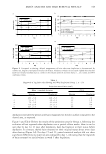
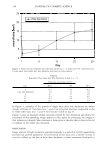
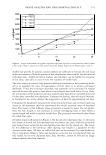
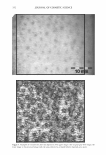
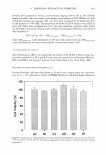
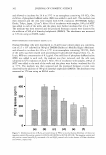
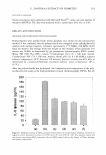
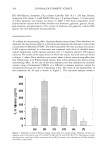
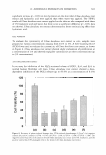
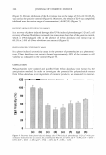
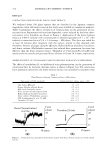
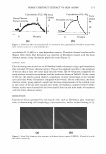
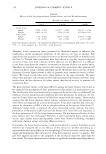
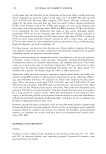
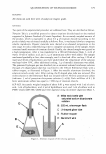
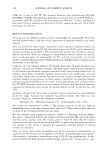
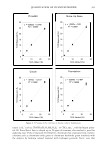
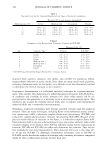
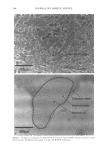
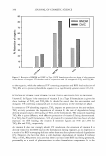
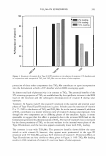
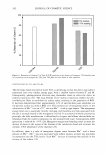
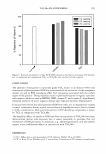
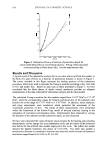
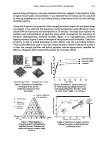
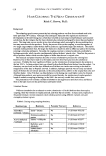
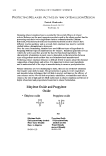
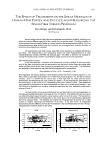
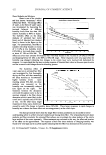
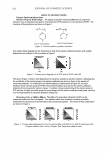
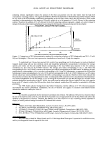
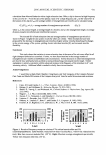
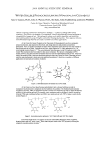
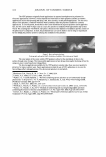
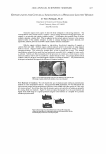
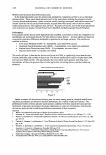
426 JOURNAL OF COSMETIC SCIENCE RESULTS AND DISCUSSION Polymer-Suriactant Interactions. Structure-Property Relationships. The impact of polymer structural differences on coacervate formation was investigated using poly (4-vinyl pyridine) (PVP) and poly (2-vinyl pyridine) (P2VP). The structures of these polymers are shown in Figure 2. +o N H' Poly ( 4-Vinyl Pyridine) Poly (2-Vinyl Pyridine) Figure 2. Cationic synthetic polymer structures. The contour phase diagrams for the interaction of each of the cationic synthetic polymers with sodium dodecylbenzene sulfonate (LAS) are shown in Figure 3. (a) (b) Figure 3. Contour phase diagrams of (a) PVP and (b) P2VP with LAS. The data in Figure 3 shows a clear dependence of coacervate amount on polymer structure, indicating that the availability of the cationic group to the anionic surfactant may be a key factor in the amount of coacervate produced. As evidenced by the limited amount of coacervation in Figure 3b, the steric hindrance of the cationic group of P2VP by the polymer backbone may prevent the anionic surfactant molecules from accessing the cationic charge. In contrast, the para-positioning of the cationic group in PVP provides a highly accessible group for ion-exchange with the anionic surfactant head group, resulting in a very high amount of coacervate formation (Figure 3a). Electrolyte Order of Addition Effects. The effect of a monovalent electrolyte (NaCl) on the coacervate profile was also investigated. Two addition orders were examined, revealing a possible mechanism of coacervation in the semi-dilute and concentrated regimes. The results of these experiments are shown in Figure 4. Figure 4. Contour phase diagrams for poly (4-vinyl pyridine) with LAS (a) No Salt (b) Surfactant, Salt, Polymer addition order and (c) Polymer, Salt, Surfactant addition order.

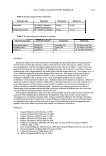
2006 ANNUAL SCIENTIFIC SEMINAR 427 The No Salt contour phase diagram (Figure 4a) was used as the baseline diagram for understanding the mechanisms associated with various salt addition orders. As is known from the literature, the mechanisms of coacervation in the No Salt system are ion-exchange and hydrophobic association (3-5). In the contour phase diagrams that do contain salt (4b and 4c) there is a constant salt amount (0.05%) for all points on the diagram. Despite the inter-mixing of the surfactant and salt layers, the Surfactant, Salt, Polymer contour phase diagram ( 4b) does not show a strong influence from micelle growth. Polymer collapse ( described below) is likely the predominant mechanism of coacervation. There may also be some ion-exchange shielding indicated by a small lessening of coacervate amount in ion-exchange regions. However, the overall Surfactant, Salt, Polymer contour phase diagram is very similar to the No Salt contour phase diagram. In the Polymer, Salt, Surfactant experiment (4c), polymer collapse is the predominant mechanism. The polymer is inter-mixed with salt before the surfactant is added, which can cause shielding of the cationic groups on the expanded polymer chain from one another, leading to chain collapse. When the chains collapse they become localized areas of "super-salts" which may attract greater amounts of surfactant. This explains the high coacervate amount at low surfactant/low polymer concentrations. In the case of a collapsed polymer, the surfactant is bound to a more curved region which could sterically shield hydrophobic tail associations among bound surfactant molecules. This could lead to resolubilization due to bound surfactant tail-free surfactant tail hydrophobic associations, indicated by a loss in coacervation at intermediate surfactant concentrations. The Polymer, Salt, Surfactant phase diagram ( 4c) shows a more dramatic change in coacervate amount with an increase in surfactant concentration than the Surfactant, Salt, Polymer phase diagram ( 4b) because polymer collapse is more prominent due to the inter-mixing of polymer and salt as the first two layers. The increase in phase separation at low polymer/high surfactant concentrations in the Polymer, Salt, Surfactant experiment may be due to structuring of the free surfactant molecules. CONCLUSIONS The high-throughput screening formulation method that had previously been developed in our research group has allowed the understanding of structure-property relationships and coacervation mechanisms in the semi-dilute and concentrated surfactant regimes. Using synthetic polymers we have determined that the positioning of the cationic group along the polymer chain can impact the amount of coacervate formed. The more available the cationic group is to the surfactant molecules, the greater the amount of coacervate produced. We have also determined that the addition order of materials affects the coacervate profile and the coacervation mechanism. Pre-mixing of the salt and polymer causes a decrease in coacervation at low polymer/intermediate surfactant concentrations due to a polymer collapse/resolubilization mechanism. This knowledge of polymer structure-coacervate property relationships, as well as the understanding of addition order effects can guide the formulator to better products and a better understanding of interactions among formulation materials. ACKNOWLEDGEMENTS The authors wish to thank Tony Convertine of the McCormick Research Group (The University of Southern Mississippi) and Rhodia, Inc. for supplies and The Society of Cosmetic Chemists for funding. REFERENCES 1. Wang, X. Li, Y. Li, J. Wang, J. Wang, Y. Guo, Z. Yan, H.J. Phys. Chem. B 109, 10807-10812, (2005). 2. Convertine, A. J. Sumerlin, B. S. Thomas, D. B. Lowe, A. B. McCormick, C. L. Macromolecules 36, 4679-4681, (2003). 3. Goddard, E. D. In Interactions of Surfactants with Polymers and Proteins Goddard, E. D. Ananthapadmanabhan, K. P., Eds. CRC Press: Boca Raton, FL pp 123-170, (1993). 4. Hayakawa, K. Kwak, J.C. T. J. Phys. Chem. 81, 506-509, (1983). 5. Wang, C. Tam, K. C. Langmuir 18, 6484-6490, (2002).
Purchased for the exclusive use of nofirst nolast (unknown)
From: SCC Media Library & Resource Center (library.scconline.org)