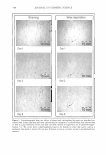
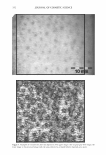
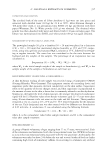
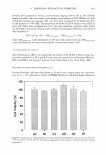
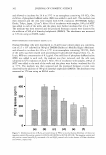
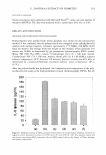
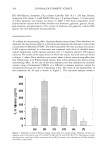
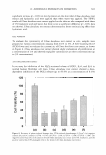
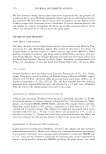
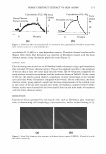
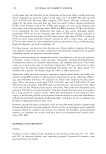
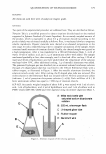
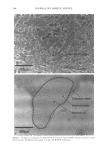
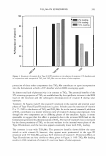
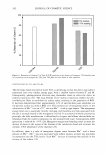
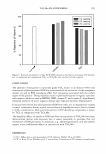
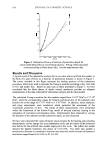
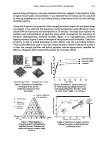
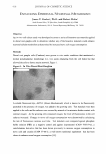
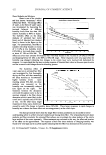
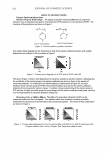
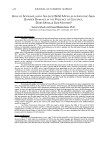
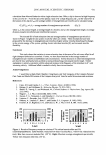
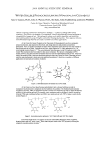
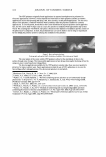
352 JOURNAL OF COSMETIC SCIENCE Figure 5. Examples of irritated skin after wax depilation. The upper image is the original grey-level image the lower image is the processed image with the areas detected as irritated follicles (hatched grey spots).

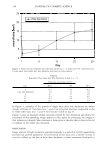
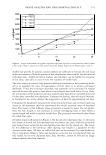
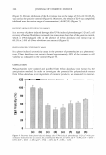
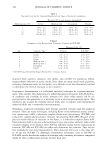
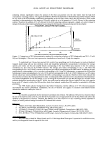
IMAGE ANALYSIS AND HAIR REMOVAL EFFICACY 353 Hair length, thus, is not a useful parameter for evaluation of depilation techniques because it represents the mean length of non-depilated hairs shortly after hair removal and gives a false impression, especially in the first days after hair removal. Using the projection area, all visible hair material contributes to the assessed values, and so the data reflect the same for wax-depilated and shaved test areas, namely the completeness of hair removal. The projection area also correlates with the view of an observer who recognizes the visible hair parts as a clearly contrasting dark matrix of hairs, often unable to discrimi nate between single hairs. Even very short, but visible, stubble contributes to this observation. Therefore, no detectable hair should be removed to obtain a valid regrowth parameter. The projection area of hairs also enables a valuation of the closeness of hair removal. Hair length, hair width, and hair count each could contribute one interesting part to the result, while the projection area combines the information of all three parameters in one. However, in the case of studies measuring hair growth actives for increases or decreases in growth rate, hair length still should be regarded as the parameter from which to calculate growth velocity because, in these studies, the more relevant parameter is the length of grown hairs in a certain time than the overall amount of hairs. The efficacy of a depilation method can be expressed as E r = t m / t s . E r is the relative time expansion compared to shaving, t m the detected time for a method to obtain hair regrowth after its use, and t s the time for hair regrowth after shaving. These parameters can be determined in a study design such as we used. As an example, in our study, E r was evaluated to approximately 2.3, meaning wax depilation extended the reappearance of hairs by a factor of 2.3 compared to usual shaving. Since plucking methods vary in their outcome (influence of subjects and the closeness of the methods), a new plucking method should be tested in a paired test against a usual method (for example, wax depilation or plucking with tweezers). Treatments claiming to reduce hair growth should be compared to regrowth after shaving without the active. Measurement of the active should be performed in the same test panel and on the same test area as the assessment without treatment with the active. For female leg hairs, a growing period of at least one week is needed to accurately measure the regrowth of hairs after shaving. In our experiments, wax-depilated hairs broke in different depths inside the follicles (see Figure 4). The mean follicle depth on the legs can be estimated to be approximately 2.7 mm (5 ). In case all hairs break at the bottom of the follicle and assuming a growth speed of 140 µm (data derived from our measurements), it would take approx. 20 days for the hairs to return to the surface. This correlates well with our overall finding that the original status was reached approximately 18 days after hair removal. The beginning increase of the projection area values approximately one week after hair removal and the findings on single hairs (Figure 4) give an indication that hairs break at different depths in the follicle, with a mean of approximately 1.3 mm beneath the surface. Improvement of the depilation method theoretically could increase the delay up to twofold without interfering with the hair growth cycle. Depilation with different methods, especially electrical energy-based depilation (14, 15 ), may result in different skin irritation. Image analysis of the red fraction of the image enables one to quantify spotty irritation, which is typical for depilation techniques due to irritation of the hair follicles. Image processing of the same pictures as for hair
Purchased for the exclusive use of nofirst nolast (unknown)
From: SCC Media Library & Resource Center (library.scconline.org)