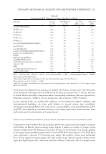
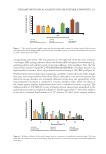
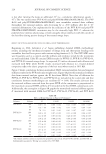
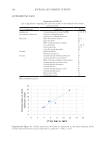
213 J. Cosmet. Sci., 73, 213–236 (July/August) 2022) Address all correspondence to T.W. Gillece, tgillece@yahoo.com Examination of Hair-Polymer Composites Failure Using Dynamic Mechanical Analysis T.W. GILLECE, R.L. MCMULLEN AND W.T. THOMPSON Ashland Inc., Bridgewater, New Jersey, USA (T.W.G., R.L.M., W.T.T.) Accepted for publication August 02, 2022. Synopsis Dynamic hairspray analysis (DHSA) was developed nearly 30 years ago as a tool to study the influence of applied mechanical stresses on the strength and durability of fixative-treated hair fiber assemblies. Calculated DHSA indices permit quantitative comparisons of styling performance attributes, including elasticity, plasticity, and stiffness of hair-polymer composites. The aim of the current work was to advance the description of fixative-treated style failure by performing viscoelastic measurements on neat fixatives and fixative-treated tresses using uniaxial and torsional dynamic mechanical analyses (DMA). Changes in viscoelasticity were studied as a function of fixative chemistry, molecular weight (MW), and dilution oscillation frequency and strain and controlled environmental humidity. Common styling fixatives were applied to omega loop-shaped tress assemblies, and DHSA and uniaxial DMA performance attributes were compared with results from torsional oscillation testing, including large-amplitude oscillatory shear. The results indicate that torsional stiffness results extracted from Lissajous curves correlate with the maximum resistance to compression (F1 index) extracted from DHSA (R2 = 0.94), and with neat-film storage moduli from uniaxial DMA (R2 = 0.99). Torsional DMA results demonstrate that omega loops styled with higher MW resins had greater stiffness and dissipated stress more efficiently than lower MW analogues. Increases in the applied torsional deformation frequency amplified the elastic and nonlinear strain-stiffening responses of omega loops treated with higher MW polymers, especially at higher humidity levels. Lissajous curves obtained from torsionally deformed omega loops may additionally be used to subjectively visualize the build-up of stresses and subsequent elastoplastic (lower humidity) and viscoplastic (higher humidity) failures of interfiber seam welds as a function of angular displacement. Uniaxial stress relaxation testing on fixative-treated omega loop tresses was applied to study the slow dissipation of imposed strain as a function of environmental humidity, and field emission scanning electron microscopy was implemented to image their unique failure mechanisms. INTRODUCTION Profiling the performance of styling fixatives using hair tresses formed into the shape of omega loops has been embraced by the hair care industry for nearly 30 years (1–5). DHSA has been used to characterize reversible deformation processes, where the elastic modulus (E1) and modulus of resilience have been used to index the enviromechanical performance of undamaged fixative-treated hairstyles. In addition, DHSA has been applied to examine nonreversible, or catastrophic, weld failure, where: (1) F1 measures the maximum force

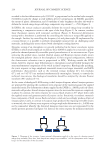
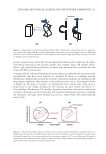
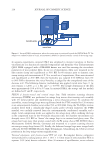
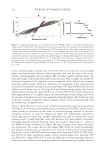
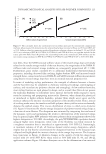
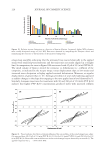
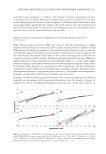
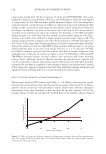
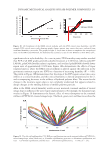
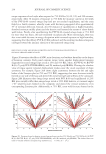
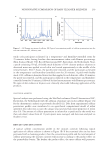
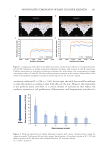
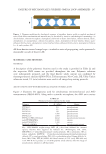
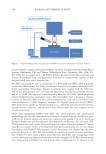
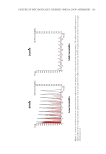
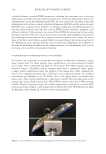
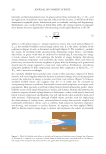
214 JOURNAL OF COSMETIC SCIENCE recorded in the first deformation cycle (2) F10/F1 is proportional to the residual style strength (3) E10/E1 records the change in style stiffness after 10 compressions (4) H10/H1 quantifies the extent of plastic deformation and (5) modulus of style toughness describes the work to deform the treated omega loops with large compressive step strains (γ = 25%) (Figure 1). In DHSA, the texture analyzer uniaxially deforms the treated omega loop assembly by introducing a compressive strain to the apex of the loop (Figure 1). In contrast, modern shear rheometers operate with rotational oscillation (Figure 2). Rotational deformation testing with a rheometer is performed by controlling the velocity or torque (M) applied to the sample. Further, by controlling the frequency (ω) and phase angle (θ) implemented by a torsion fixture, it is possible to perform meaningful torsional tests on challenging solid materials, including hair tresses treated with elastoplastic styling fixatives. Dynamic testing of an elastoplastic is typically performed in the linear viscoelastic region (LVER), in which small amplitude oscillatory shear (SAOS) is applied to a material to gently probe the thermodynamically reversible spatial perturbations of its microstructure. Upon removing the applied stress, residual thermal energy and Brownian motion slowly return the entangled polymer chains in the elastoplastic to their original configurations, wherein the characteristic relaxation time is proportional to MW 3 . Working outside the LVER limits, however, imposes large deformations to elastoplastics and irreversibly damages the structural-memory components of the welds in fixed composites. Rheologically speaking, the stress response to large-amplitude sinusoidal strain is no longer sinusoidal, and SAOS performance characteristics such as the torsional storage modulus (G’), loss modulus (G”), and tan δ (G”/G’) are rendered mathematically meaningless. Instead, to remedy the technical inaccuracies, the rheological waveforms should be analyzed by discrete Fourier transform (FT) analysis (6–11). At the center of rheological LAOS testing is the Lissajous diagram, where Lissajous patterns are generated by plotting the oscillatory stress response of the material against the applied sinusoidal strain. For deformation schemes applied in the LVER (i.e., SAOS), perfectly elastic materials will produce linear Lissajous responses since the stress and the strain are completely in phase. In contrast, the stress response for viscous fluids results in 90° phase shifts with the applied strain and generates perfect Lissajous circles. Intuitively, viscoelastic materials have components of both viscous fluids and elastic solids and accordingly produce elliptical Lissajous plots. Lastly, in contrast to Lissajous loops produced by imposing reversible strains to materials, the oscillatory stress response to large-amplitude deformation (i.e., LAOS) may not be sinusoidal, whereby the distorted Lissajous trajectories are not represented by the model patterns presented in Figure 3A. Instead, the stress response for nonlinear materials 4 mm Figure 1. Diagram of the iterative 4-mm uniaxial deformation applied to the apex of a fixative-treated omega loop assembly. Note that “hair shaped into omega loop assemblies” will be synonymous with “omega loops” for the remainder of this document.
Purchased for the exclusive use of nofirst nolast (unknown)
From: SCC Media Library & Resource Center (library.scconline.org)