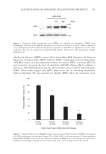
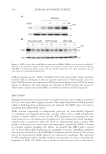
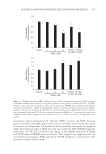
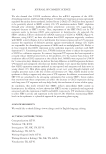
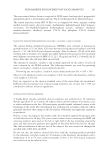
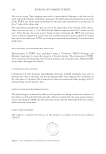
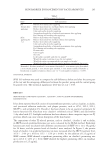
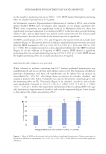
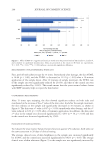
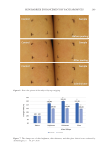
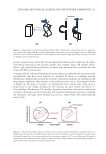
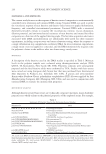
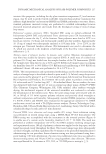
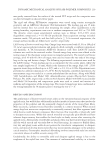
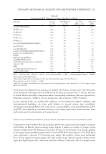
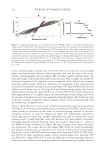
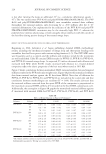
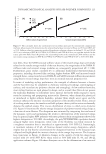
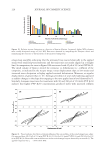
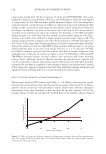
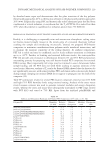
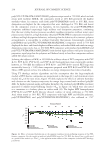
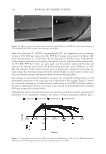
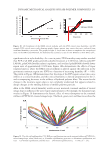
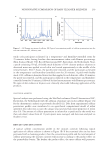
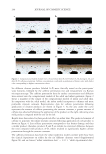
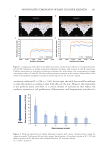
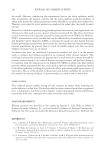
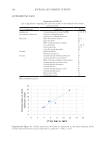
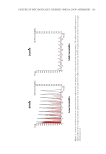
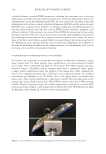
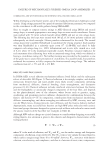
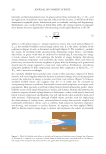
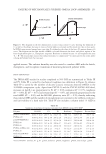
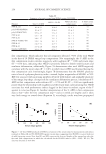
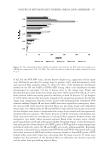
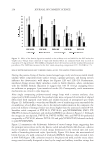
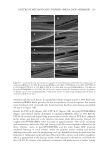
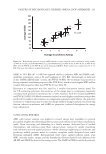
231 DYNAMIC MECHANICAL ANALYSIS OF HAIR-POLYMER COMPOSITES torsional strain. Interestingly, at 75% RH the PET-poly(VP/DMAPMA) composite did not demonstrate strain-stiffening behavior (S app ), supporting the hypothesis that interfacial chemical adhesion between the hair fiber and pseudocationic polymer augmented the strain-stiffening response observed in frequency testing with poly(VP/DMAPMA)-treated omega loops (see Figure 12). For clarity, strain stiffening is a LAOS parameter that is derived from the dimensions of individual loops in a σ versus γ Lissajous overlay (10). Hence, to differentiate the neat-film characteristics from those of the PET composite, the apparent strain-stiffening ratio (S app ) is used in Figure 14 to represent the strain-stiffening characteristics of the fixative-PET composite. EFFECTS OF AMBIENT HUMIDITY ON THE TORSIONAL AND UNIAXIAL STRESS RELAXATION PROPERTIES OF FIXATIVE-TREATED OMEGA LOOPS To visualize trends in the enviromechanical transient response of hygroscopic fixatives, stress relaxation experiments were performed with our DMA on PVP-treated omega loops to monitor the force response as a function of controlled humidity and time. The log- log force against time plot in Figure 15 illustrates that the stiffness of PVP K-120 was measurably higher than PVP K-30 when tested at 25% RH however, the polymeric chains in both polymers similarly relaxed under the imposed deformation to alleviate structural film stresses. After equilibrating at 75% RH, both PVP K-30 (T g, 75% RH = 7°C) and PVP K-120 (T g, 75% RH = 12°C) were predictably plasticized by water vapor, whereby both fixatives completely relaxed in approximately 2 minutes. The FESEM images in Figure 16 demonstrate that environmental humidity altered the plastic deformation mechanism of omega loops fixed with hydrophilic resins. In Figure 16A, the PVP K-30–treated omega loop was subjected to stress relaxation testing at 35% RH, 0.01 0.1 1 10 100 1E-02 1E-01 1E+00 1E+01 1E+02 1E+03 1E+04 Time (s) PVP K-30 25% RH PVP K-30 75% RH PVP K-120 25% RH PVP K-120 75% RH Figure 15. Stress relaxation overlay for PVP K-30 and PVP K-120 tested at 25% and 75% RH. (A) The deformation was rapidly increased at a constant rate until the setpoint was reached and (B) after reaching the deformation setpoint and the maximum applied stress, the force required to compress the loop intrinsically decayed as a function of time. Force (g)

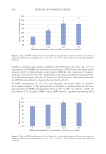
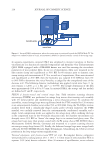
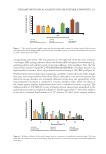
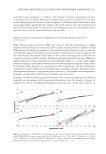
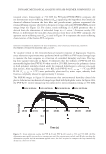
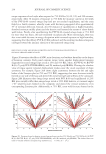
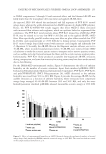
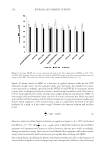
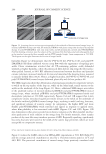
232 JOURNAL OF COSMETIC SCIENCE where the plasticized T g of PVP is approximately 85°C. In comparison, stress relaxation testing at 90% RH was imposed on the PVP K-30 omega loop pictured in Figure 16B, where the plasticized T g is well below the freezing point of distilled water. Undoubtedly, both polymers underwent brittle-plastic deformation, but by different failure mechanisms. At 35% RH, PVP K-30 films are quite rigid, and the polymer welds failed brittly and adhesively by forming microcracks and delaminating from the cuticle. However, at 90% RH the polymeric bonds failed cohesively and viscoplastically—instead of fracturing, the strain energy was thermally dissipated by the softened welds as cavities formed in the crack zone and polymer strings subsequently flowed between adjoining fibers. One strategy to increasing the humidity resistance of a susceptible styling resin is to add hydrophobic monomers to the repeating unit of the polymer. For example, Figure 17 shows the successful consequence of adding lauryl methacrylate to the PVP backbone, wherein the plastic deformation kinetics for omega loops treated with hydrophobically modified PVP were improved by almost 900%. Although our reported enviromechanical outcomes have primarily involved measurements performed at an equilibrated isohume, the kinetics of vapor adsorption likewise play a 0.01 0.1 1 10 100 1E-02 1E-01 1E+00 1E+01 1E+02 1E+03 1E+04 Time (s) PVP K-30 25% RH PVP K-30 75% RH p(VP/LM/AA) 25% RH p(VP/LM/AA) 75% RH Figure 17. Stress relaxation overlay for PVP K-30 and poly(VP/LM/AA) at 25% and 75% RH. Hydrophobic modification of PVP significantly increased the relaxation time at 75% RH. Figure 16. Effect of water vapor plasticization on seam weld failure for (A) PVP K-30 after stress relaxing at 35% RH and (B) PVP K-30 after stress relaxing at 90% RH. Force (g)
Purchased for the exclusive use of nofirst nolast (unknown)
From: SCC Media Library & Resource Center (library.scconline.org)