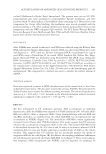
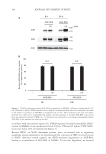
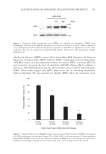
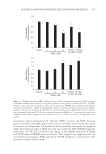
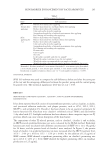
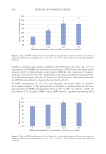
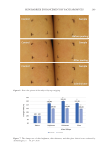
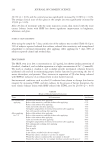
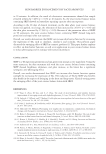
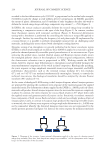
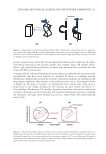
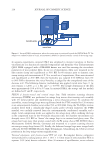
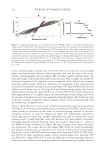
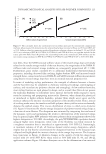
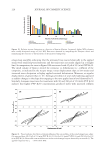
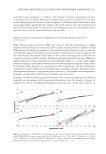
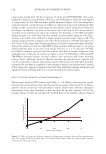
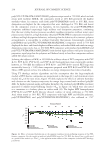
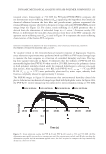
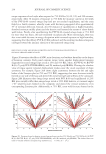
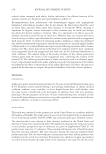
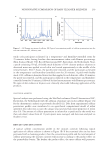
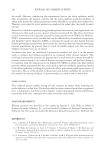
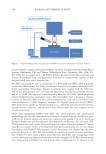
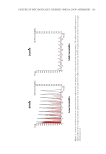
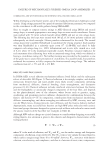
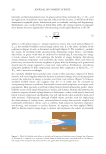
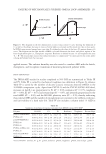
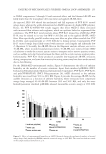
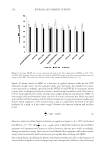
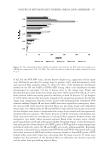
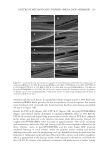
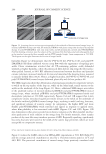
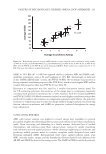
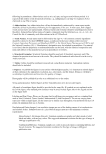
233 DYNAMIC MECHANICAL ANALYSIS OF HAIR-POLYMER COMPOSITES significant role in style durability. As a case in point, DVS humidity ramp studies revealed that PVP of all MW grades generally adsorbed moisture at 0.20%/min, whereas poly(VP/ LM/AA), poly(OAA/[meth]acrylates) copolymer, and imidized poly(IB/MA) showed slower regain rates of approximately 0.02%/min. Figure 18A demonstrates the effects of vapor sorption kinetics, where the DMA critical isohume is plotted against the inflection in the gravimetric moisture regain rate (DVS) as a function of increasing humidity (R2 = 0.94). The profile in Figure 18B demonstrates that the slope of the DVS regain versus time curve inflects at a critical humidity, and this critical humidity is directly proportional to the T g and accompanying decreases in the stiffness of hydrated polymer films. The reason for the change in the moisture regain slope is not completely understood but appears related to abrupt changes in the swelling kinetics of swollen polymer particles. Akin to the DMA critical humidity results on neat materials, torsional analysis of treated omega loops is influenced by water vapor sorption kinetics. For example, the Lissajous loops overlay in Figure 19 demonstrates the kinetic effect of water absorption on the torsional stiffness of PVP K-90–treated omega loops. The black, green, red, and blue traces show the Figure 19. The effect of high humidity (75% RH) pre-equilibration time on the torsional stiffness of PVP K-90– treated omega loops, where: black trace = 30-minute equilibration green trace = 60-minute equilibration red trace = 120-minute equilibration and blue trace = 240-minute equilibration (ω = 1.0 Hz 26 ± 2°C). R² = 0.938 50 55 60 65 70 75 80 85 90 40 50 60 70 80 DVS Critical Onset (% RH) 0 1 2 3 4 5 6 7 8 0 100 200 300 400 500 Time (min) 349 min 73% RH (A) (B) Figure 18. (A) Correlation of the DMA critical isohume with the DVS critical onset humidity and (B) example DVS critical onset result showing weight change against time onsets that were evaluated from isothermal humidity scan results. The graph of weight % versus time is shown to emphasize the extrapolated onset. In the DMA and DVS work, the humidity was scanned at a rate of 0.5% RH/min to 90% RH at 26°C. DM A CriticalOnset (% RH) Weiht%

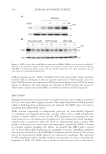
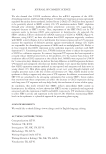
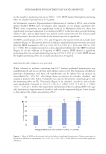
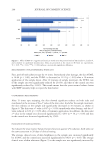
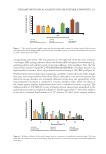
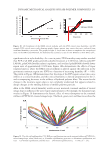
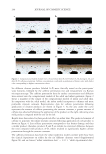
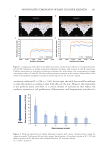
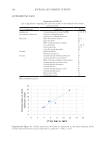
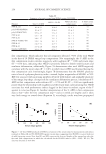
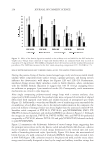
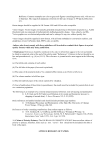
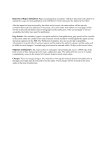
234 JOURNAL OF COSMETIC SCIENCE torque responses of each style when exposed to 75% RH for 30, 60, 120, and 240 minutes, respectively. After 30 minutes of exposure to 75% RH, the moisture content in the welds of the PVP K-90–treated omega loop had not yet reached equilibrium, and the resin failed in a brittle manner, whereby seam weld fractures propagated after approximately 55° of torsional deflection. Instead, after 60 minutes of equilibration at higher humidity, absorbed moisture mildly plasticized the fixative and lessened the extent of elasto-brittle weld failure. Finally, after equilibrating the PVP K-90–treated omega loops at 75% RH for more than two hours, the style weakened viscoplastically. More interestingly, there was also a noticeable decrease in energy dissipation with increased exposure to high humidity, suggesting that the rubbery PVP K-90 film softened, and the resulting mechanical response converged toward the intrinsic elasticity of the untreated omega loop. INFLUENCE OF MW AND RESIN CHEMISTRY ON THE TORSIONAL PROPERTIES OF FIXATIVE-TREATED OMEGA LOOPS Figure 20 examines the effects of MW, resin chemistry, and ambient humidity on the shapes of Lissajous contours. Each panel contains torque versus angular displacement Lissajous diagrams for treated omega loops tested at 25% and 75% RH, where: A) PVP K-30 B) PVP K-90 C) poly(VCL/VP/DMAEMA) and D) imidized poly(IB/MA). Plotting the absolute value of torque against torsional displacement makes easier the visual assessment of shape symmetry. For example, Figure 20A shows slight asymmetry between the left and right halves of the Lissajous plot (at 25% and 75% RH), suggesting that more fractures initially formed on one side of the loop and altered the overall strength and stiffness of the composite. Figure 20B illustrates that omega loops treated with PVP K-90 and equilibrated at 25% RH were initially stiffer than omega loops tested at 90% RH however, at torsional angles 40° small fractures formed in the composite and altered the vertical symmetry of its corresponding Lissajous plot. Additionally, at 75% RH, seam weld fractures formed in the Figure 20. Lissajous loops for fixative-treated omega loops tested at 25% (black) and 75% RH (red): (A) PVP K-30 (B) PVP K-90 (C) poly(VCL/VP/DMAEMA) and (D) imidized poly(IB/MA). The dashed lines are used to visually reference Lissajous loop symmetry (ω = 1.0 Hz 26 ± 2°C).
Purchased for the exclusive use of nofirst nolast (unknown)
From: SCC Media Library & Resource Center (library.scconline.org)