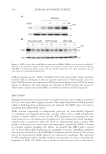
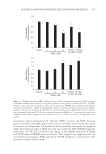
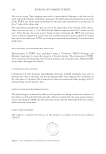
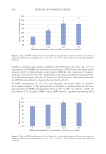
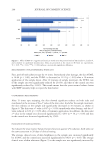
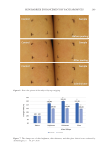
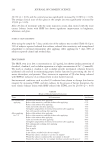
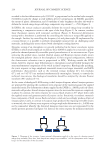
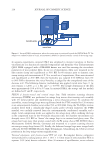
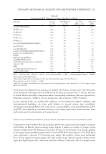
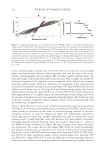
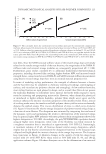
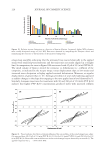
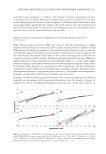
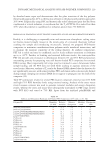
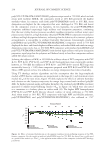
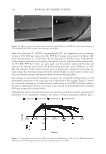
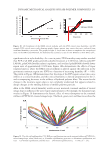
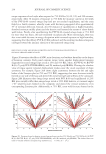
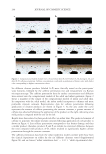
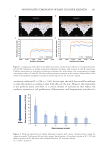
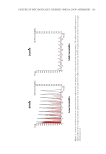
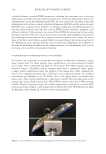
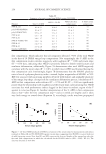
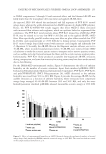
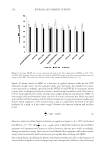
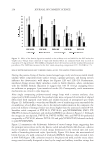
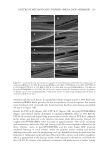
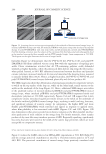
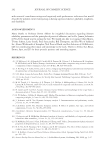
227 DYNAMIC MECHANICAL ANALYSIS OF HAIR-POLYMER COMPOSITES and higher stress dissipation. In addition, the Lissajous trajectories developed curvature at the distal ends of higher-deformation Lissajous loops, which is indicative of nonlinear strain stiffening and the resistance of the composite to additional plastic flow. Hence, with increasingly higher applied fixative volumes, the trends advocate that the performance of fixative-styled omega loops was dictated by the elastoplastic response of the polymer rather than the elasticity of the untreated omega loop assembly. EFFECTS OF TORSIONAL DEFORMATION FREQUENCY ON FIXATIVE-TREATED OMEGA LOOP PERFORMANCE When characterizing materials by DMA, the extent of time that deformation is applied influences the stress response of the material. For example, if steady pressure is applied to a high MW polymer, the long chain segments in the polymer backbone may have time to rearrange and thermally dissipate the applied energy however, if deformation is quickly applied to the film and released, the polymer chains may not have time to rearrange and instead the film responds in a brittle or elastic manner. Aside from standard chronological testing, DMA uses applied frequency to study time processes more efficiently, where ω = 1/time. Thus, higher imposed frequencies correspond to shorter times and lower frequencies represent longer times. In extension, higher frequencies are analogous to colder temperatures, and lower frequencies correspond to warmer temperatures. For hygroscopic amorphous polymers, the trends dictate that segmental relaxations corresponding to the practical T g will depend on the temperature, frequency, and humidity of the testing and application environments. Keeping in mind that lowering angular frequency and increasing temperature or ambient humidity are synonymous with increasing deformation time, the panels in Figure 12 illustrate the effects of isothermal rheological time processes on the stress response of Figure 12. The effect of humidity and frequency on the contours of Lissajous loops is demonstrated for poly(VP/DMAPMA) treated omega loops: (A) 25% RH and ω = 0.1 Hz (B) 25% RH and ω = 4.0 Hz (C) 75% RH and ω = 0.1 Hz and (D) 75% RH and ω = 4.0 Hz. The red circles highlight strain-stiffening phenomena. The terminal Lissajous loop formed at a torsional angle of ca. ± 45°.

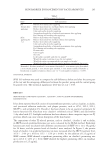
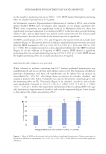
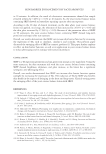
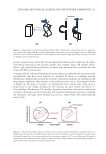
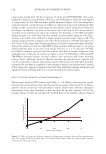
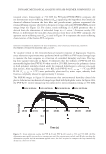
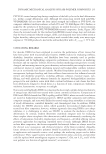
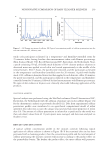
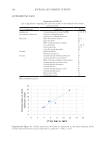
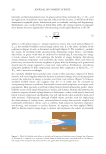
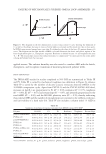
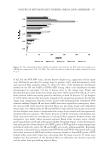
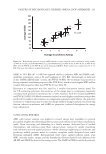
228 JOURNAL OF COSMETIC SCIENCE omega loops treated with 180 µL of aqueous 1% (w/w) poly(VP/DMAPMA). The results displayed in Figures 12A and B were collected at 25% RH using 0.1 Hz and 4.0 Hz applied ω, respectively. At 25% RH and lower applied frequency (Figure 12A), the elastoplastic composite showed a steady decrease in stiffness as a function of increased deformation. The change in slope was gradual, indicating that the polymer yielded under stress rather than fracturing—in addition, curvature in the distal ends of the loop at 45° torsion indicates assessable strain stiffening (see red circles in Figure 12). Similarly, at 25% RH and higher applied frequency, no seam weld fractures formed, but the polymer appeared very elastic, resilient, and mildly strain stiffened at higher applied torsional angles (Figure 12B). The Lissajous loops presented in Figures 12C and D were produced at 75% RH and frequencies of 0.1 and 4.0 Hz, respectively. Comparing Figures 12A and C shows that higher humidity allowed the plasticized and very high MW styling polymer sufficient time to creep into relaxed positions prior to successive step strains however, at ω = 0.1 Hz and 75% RH, the rubbery composite appeared soft but resilient and showed thermal dissipation with negligible strain stiffening. In contrast, at higher ω and 75% RH (Figure 12D), poly(VP/ DMAPMA) presented greater torsional stiffness than measured with lower humidity testing. Hence, although chemical adhesion between the pseudocationic polymer and cuticles is equivalent in all four experiments, shorter deformation time and higher humidity optimized the mechanical toughness of the entangled chains in the fixative welds. Instead of fracturing, the composite responded elastically while exhibiting thermal dissipation and significant strain-stiffening behaviors at nearly all imposed torsional angles. EFFECTS OF TESTING HUMIDITY ON FIXATIVE PERFORMANCE Mixing water with dry PVP liberates heat (ΔH sol = -4.8 kJ/mol), indicating that specific chemical attractions between water and the polymer are energetically favored (14,15). Hence, polymer chains containing vinyl pyrrolidone readily adsorb water, whereby subsequent plasticizing of the glass transition is well described by the Fox equation (14–19). For example, Figure 13 plots the calculated T g for PVP K-30 as the polymer solids are diluted -50 -25 0 25 50 75 100 125 150 175 0.60 0.70 0.80 0.90 1.00 Weight fraction of PVP K-30 Figure 13. Effect of water on the glassy properties of hygroscopic polymeric fixatives (Fox approximation [18]). The example (PVP K-30) shows that 21% (w/w) absorbed water lowers the practical glass transition of the fixative welds below 26°C. Calculated glass transition(C)
Purchased for the exclusive use of nofirst nolast (unknown)
From: SCC Media Library & Resource Center (library.scconline.org)