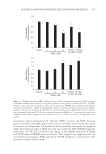
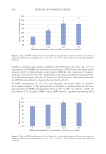
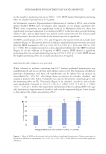
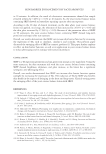
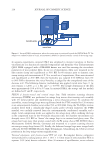
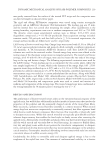
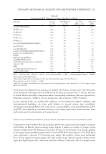
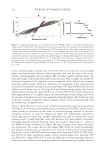
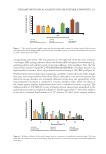
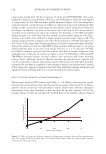
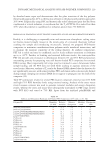
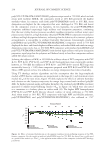
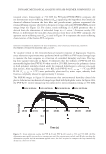
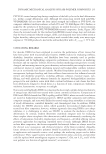
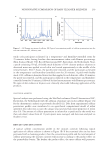
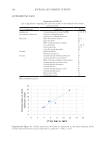
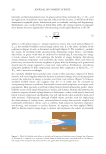
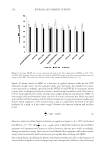
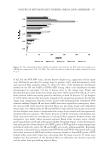
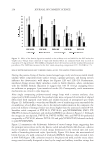
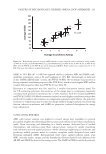
261 Failure of Mechanically Stressed Omega Loop Assemblies #AED at 50% RH (R2 = 0.98) but opposed trends in polymer MW and DHSA style- durability parameters, such as F1 and toughness at 50% RH. Interestingly, as indicated in the “DHSA-AED Results” section, the PVP K-30/PEG 400 treatment was perceived as having sensorial crunchiness properties like PVP K-60, which is much higher MW and has tougher film properties than neat PVP K-30 (see Table II). Resistance to compression was also rated by a smaller four-person sensory panel. For the VP-containing polymers, the resistance of the omega loop to compression negatively correlated with perceived crunchiness (R2 = 0.91) however, both the imidized p(IB/MA) and PVP K-30/PEG 400 blend treatments resulted in much higher crunchiness ratings than predicted by trends in the resistance-to-compression sensorial results. Hence, the perceived resistance to compression may be related to abrupt stiffness changes and perceived stick-slip friction, whereas crunchiness and #AED are properties evaluated throughout the omega loop compression. CONCLUDING REMARKS AED with texture analysis was applied to treated omega loop assemblies to provide perceptible insights into debonding pathways associated with structural failures in polymeric welds. Upon fracturing and debonding in a brittle manner, dislocated bits of cracked thermoplastic and polymer-coated fibers released elastic stresses by rapidly translating style remnants into new spatial positions—while vibrating neighboring air molecules and producing audible pressure waves. In contrast, compliant welds dissipated stress while liberating negligible #AED. Environmental water vapor, applied polymer solids, resin MW, cuticular surface energy, and the formulation delivery method each influenced the dB-SPL and #AED for discrete fracturing events. The #AED in DHSA correlated positively Figure 14. Relationship between average #AED and the average sensorial panel crunchiness rating results: A) PVP K-120 B) poly(VP/DMAPMA) C) poly(VP/MAPTAC) D) PVP K-90 E) PVP K-60 F) PVP K-30/ PEG 400 G) PVP K-15 H) PVP K-30 and I) imidized p(IB/MA). Panel studies were conducted at 48 ± 2% RH. The error bars indicate standard deviations.

262 JOURNAL OF COSMETIC SCIENCE with sensorial crunchiness ratings and negatively with performance indicators that would describe the polymer-treated omega loop as having superior resilience, pliability, toughness, and durability. ACKNOWLEDGMENTS Many thanks to Professor Steven Abbott for insightful discussions regarding Hansen solubility parameters and the principles of practical adhesion and to Dr. Janusz Jachowicz (1950-2022), thank you for paving the way. We would also like to recognize Chris Musto, T-bone Schiess, Larry Senak, Paul Suszczynski, Bill Thompson, and Fan Wu of Ashland Inc. Karen Winkowski of Innophos Neil Peart of Rush and Len Salvatore of GS Robotics, LLC for contributing their input and knowledge to the work. Cheers to Trefor, Sue, Brian, Emma, Spot, and J.P. for their sporadic patience and unending support. REFERENCES (1) J. P. McCrory, S. K. Al-Jumaili, D. Crivelli, M. R. Pearson, M. J. Eaton, C. A. Featherston, M. Guagliano, K. M. Holford, and R. Pullin, Damage classification in carbon fibre composites using acoustic emission: a comparison of three techniques, Compos. Part B-Eng., 68, 424–430 (2015). (2) A. W. Peng, F. T. Salles, B. Pan, and A. J. Ricci, Integrating the biophysical and molecular mechanisms of auditory hair cell mechanotransduction, Nat. Commun., 2, 523 (2011). (3) S. R. Alten, Cengage Advantage Books: Audio Basics (Cengage Learning, Boston, MA, 2011), pp. 15–27. (4) J. F. Eiche, Guide to Sound Systems for Worship (Hal Leonard Publishing Corporation, Milwaukee, WI, 1990), pp. 26–29. (5) M. H. Tunick, C. I. Onwulata, A. E. Thomas, J. G. Phillips, S. Mukhopadhyay, S. Sheen, C-K. Liu, N. Latona, M. R. Pimentel, and P. H. Cook, Critical evaluation of crispy and crunchy textures: a review, Int. J. Food Prop., 16, 949–963 (2013). (6) H. Luyten and T. van Vliet, Acoustic emission, fracture behavior and morphology of dry crispy foods: a discussion article, J. Texture Stud., 37, 221–240 (2006). (7) D. W. Rafferty, J. Zellia, D. Hasman, and J. Mullay, The mechanics of fixatives as explained by polymer composite principles, J. Cosmet. Sci., 60, 251–259 (2009). (8) J. Jachowicz and K. Yao, Dynamic hairspray analysis. I. Instrumentation and preliminary results, J. Cosmet. Sci., 47, 73–84 (1996). (9) J. Jachowicz and K. Yao, Dynamic hairspray analysis. II. Effect of polymer, hair type, and solvent composition, J. Cosmet. Sci., 52, 281–295 (2001). (10) J. Jachowicz, Dynamic hairspray analysis. III. Theoretical considerations, J. Cosmet. Sci., 53, 249–261 (2002). (11) J. Jachowicz and R. McMullen, Mechanical analysis of elasticity and flexibility of virgin and polymer- treated hair fiber assemblies, J. Cosmet. Sci., 53, 345–361 (2002). (12) R. McMullen, D. Laura, S. Chen, D. Koelmel, G. Zhang, and T. Gillece, Determination of physicochemical properties of delipidized hair, J. Cosmet. Sci., 64, 355–370 (2013). (13) N. E. Yin, R. H. Kissinger, W. S. Tolgyesi, and E. M. Cottington, The effect of fiber diameter on the cosmetic aspects of hair, J. Cosmet. Sci., 28, 139–150 (1977). (14)C . R. Robbins, Chemical and Physical Behavior of Human Hair, 4th ed. (Springer-Verlag, New York, 2002), pp. 360–435. (15) Acoustic Envelope Detection Manual A4, ver. 3 (Stable Micro Systems, Godalming, UK, 2008), pp. 3–17.
Purchased for the exclusive use of nofirst nolast (unknown)
From: SCC Media Library & Resource Center (library.scconline.org)