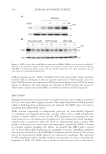
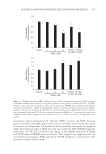
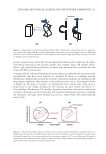
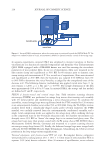
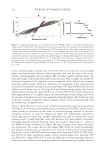
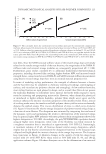
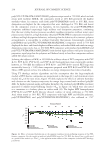
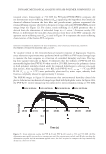
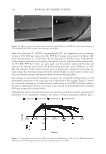
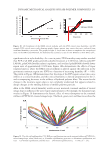
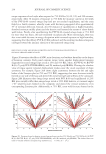
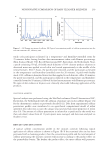
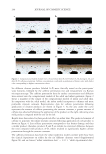
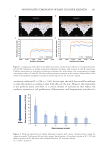
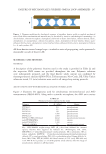
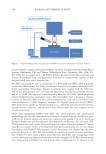
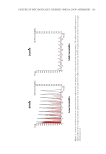
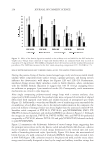
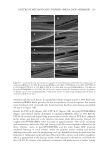
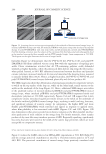
235 DYNAMIC MECHANICAL ANALYSIS OF HAIR-POLYMER COMPOSITES PVP K-90–treated omega loop during completion of the half cycles in the final deformation (i.e., within a single deformation step). Although the omega loop treated with poly(VCL/ VP/DMAEMA) did not show the same initial strength and stiffness as PVP K-90, the composite exhibited excellent resilience at both 25% and 75% RH (Figure 20C). Further, as judged by the symmetry of the Lissajous contours, no notable fractures or stress relaxation events occurred in the poly(VCL/VP/DMAEMA)-treated composites. Lastly, Figure 20D shows the torsional results for the imidized poly(IB/MA)-treated omega loop and indicates that the fixed composite behaved stronger, stiffer, and dissipated more stress when tested at higher humidity, where prior thermal analysis work revealed that steady state water vapor sorption at 75% RH produced a less brittle and leathery film with a T g, 75% RH = 53°C (12). CONCLUDING REMARKS For decades, DHSA has been employed to examine the performance of hair tresses that have been preset with macromolecular fixatives. DHSA indices for evaluating stiffness, durability, humidity resistance, and flexibility have been routinely used in product development and for highlighting comparative performance characteristics in marketing brochures and on corporate websites. However, modern marketing strategies have recently changed, and mounting interest in green chemistry and sustainable processing has increased commercial interest in rapidly developing natural and biodegradable synthetic polymers for use in eco-friendly hair fixative systems. Modified biopolymers possess intrinsic water management, hydrogen bonding, and chain-stiffness characteristics that influence hairstyle texture and durability properties, including adhesion, cohesion, moisture regain, tack, flaking, and weld plasticity whereas demands for improved biodegradability introduce prospects for new synthetic resins with labile covalent backbones or side chains that have been deliberately designed to break down as a function of time, temperature, hydrolysis, oxidation, fermentation, or exposure to sunlight. Our recent work highlights DMA for evaluating the deceivingly complex failure mechanisms of omega loops that had been treated with current commercial fixatives. Comparisons of DMA with DHSA showed that DMA capably parallels DHSA, where successful correlations are rooted in fundamental material properties. DHSA superbly categorizes style stiffness, composite strength, and seam weld failure for treated omega loop assemblies as a function of steady deformation, controlled humidity, and chronological time. In addition, DHSA includes the H10/H1 plasticity index, which quantifies stress-induced displacement of treated hair fiber composites however, without rigorously dissecting DHSA curve-shape subtleties, it is challenging to solely use H10/H1 to evaluate the mechanics of plastic deformation. In contrast, modern rheometers seamlessly integrate tools for evaluating these complex elasto-viscoplastic film characteristics while simultaneously considering the effects of temperature, humidity, displacement, and frequency—all while offering various geometric approaches for imposing controlled stress or strain. Although DHSA focuses on hair fiber composites, the factors responsible for hairstyle failure are always rooted in the thermal, water management, and rheological properties of the fixative polymer. Arguably, future advances in hair fixative polymers should be paralleled with comparable advances in applications and materials science—and, perhaps, the marketing jargon used to define performance. Then, vague business wishes to improvement stiffness, plasticity, and durability could be replaced with unambiguous requests to improve E’, G(t), tan δ, G’ L , and S of the neat polymer as a function of applied torsional γ or uniaxial ω.

236 JOURNAL OF COSMETIC SCIENCE ACKNOWLEDGMENTS The authors would like to acknowledge Drs. Fan Wu, Seher Ozkan, and Larry Senak of Ashland LLC Ironman Sue, Callie, Pippin, and Alfred and Alex Lifeson of Rush. Special thanks to Dr. David J. Moore for extraordinary patience, and for bringing the ARES-G2 rheometer to our Ashland Materials Science laboratory. REFERENCES (1) J. Jachowicz and K. Yao, Dynamic hairspray analysis. I. Instrumentation and preliminary results, J. Cosmet. Sci., 47, 73–84 (1996). (2) J. Jachowicz and K. Yao, Dynamic hairspray analysis. II. Effect of polymer, hair type, and solvent composition, J. Cosmet. Sci., 52, 281–295 (2001). (3) J. Jachowicz, Dynamic hairspray analysis. III. Theoretical considerations, J. Cosmet. Sci., 53, 249–261 (2002). (4) J. Jachowicz and R. McMullen, Mechanical analysis of elasticity and flexibility of virgin and polymer- treated hair fiber assemblies, J. Cosmet. Sci., 53, 345–361 (2002). (5) R. McMullen, D. Laura, S. Chen, D. Koelmel, G. Zhang, and T. Gillece, Determination of physicochemical properties of delipidized hair, J. Cosmet. Sci., 64, 355–370 (2013). (6) S. Ozkan, T.W. Gillece, L. Senak, and D.J. Moore, Characterization of yield stress and slip behaviour of skin/hair care gels using steady flow and LAOS measurements and their correlation with sensorial attributes, Int. J. Cosmet. Sci., 34, 193–201 (2012). (7) R.H. Ewoldt, A.E. Hosoi, and G.H. McKinley, New measures for characterizing nonlinear viscoelasticity in large amplitude oscillatory shear, J. Rheol., 52, 1427–1458 (2008). (8) R.H. Ewoldt, P. Winter, J. Maxey, and G.H. McKinley, Large amplitude oscillatory shear of pseudoplastic and elastoviscoplastic materials, Rheol. Acta, 49, 191–212 (2010). (9) T. Gillece, R.L. McMullen, H. Fares, L. Senak, and L. Foltis, Probing the textures of composite skin care formulations using large amplitude oscillatory shear, J. Cosmet. Sci., 67, 121–159 (2016). (10) M. Wilhelm, Fourier-transform rheology, Macromol. Mater. Eng., 287, 83–105 (2002). (11) R.J. Seyler, “Opening discussion,” in Assignment of the Glass Transition, S.J. Seyler Ed. (American Society for Testing and Materials, Philadelphia, PA, (1994), 13–16. (12) T.W. Gillece and R.L. McMullen, Eavesdropping on the failure of mechanically stressed omega loop assemblies. Manuscript submitted for publication (April 2021). (13) S. Abbott, Adhesion Science: Principles and Practice, DEStech Publications, Inc.: Lancaster, PA, 13–100 (2015). (14) B.C. Hancock and G. Zografi, The use of solution theories for predicting water vapor absorption by amorphous pharmaceutical solids: a test of the Flory–Huggins and Vrentas models, Pharm Res, 10, 1262– 1267 (1993). (15) E.S. Barabas, “N-Vinyl amide polymers,” in Encyclopedia of Polymer Science and Engineering, 2nd Ed., Vol. 17 (John Wiley & Sons, Hoboken, NJ, 1989), 198–257. (16) P. Hiemenz and T. Lodge, Polymer Chemistry, CRC Press: Boca Raton, FL, 247–508 (2007). (17) G. Wypych, “Effect of plasticizers on properties of plasticized materials,” in Handbook of Plasticizers, 3rd Ed. G. Wypych Ed. (ChemTec Publishing, Ontario, Canada, 2017), 209–332. (18) T.G. Fox, Influence of diluent and of copolymer composition on the glass temperature of a polymer system, Bull. Am. Phys. Soc., 1, 123 (1956). (19)C .R. Robbins, Chemical and Physical Behavior of Human Hair, 5th Ed. (Springer-Verlag, New York, (2012).
Purchased for the exclusive use of nofirst nolast (unknown)
From: SCC Media Library & Resource Center (library.scconline.org)