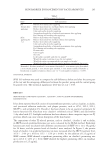
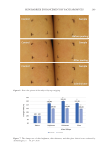
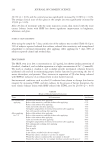
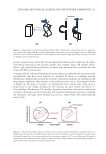
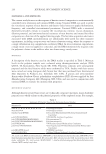
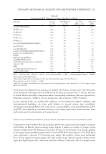
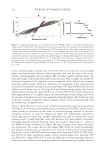
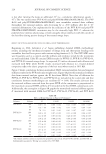
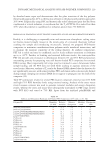
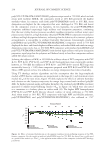
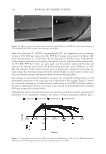
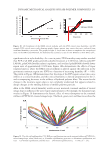
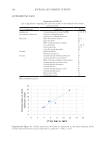
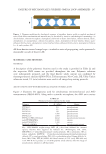
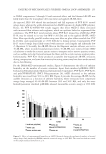
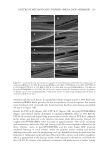
221 DYNAMIC MECHANICAL ANALYSIS OF HAIR-POLYMER COMPOSITES monitoring the applied force required to deform the fixative-treated tress (12). Similarly, more advanced techniques such as DMA may be used to measure the T g of neat fixatives or styled fixative-hair fiber composites while concurrently evaluating the time dependence, humidity resistance, stiffness, viscous dissipation, and resilience of the treatment. In the current work, we studied the influence of viscoelasticity, fixative dilution, and environmental humidity on seam weld failures in treated omega loop assemblies. Techniques including DHSA, stress relaxation, uniaxial DMA, rotational rheometry, DVS, and DSC were applied to correlate Lissajous curve-shape trajectories with outcomes from well understood enviromechanical measurements. EFFECT OF THE IMPOSED TORSIONAL ANGLE ON THE DURABILITY OF THE STYLED OMEGA LOOP Comparative visual analysis was the principal motive for using torsional testing to examine style failure in fixative-treated omega loops. Figure 6 shows an overlay of torque versus angular displacement (θ) Lissajous trajectories for the 30 incremental step strains applied to an omega loop assembly treated with 1% (w/w) PVP K-30 and tested at 50% RH. Each color represents a discrete ± θ twisting step, where the smallest strains were performed first. At low applied torsional angles, the slope of the torque response against displacement angle was high (Figure 6A), indicating that the stiffness of the style, which is proportional Table II Thermal and MW Properties of Various Hair Fixative Resins Polymer Dry Tg (±3°C) DVS Regaina (±3%) Tg, 90% RHb (±3°C) Relative MWc poly(VP/DMAPMA) 176 69 0 250 PVP K-120 182 59 0 190 PVP K-90 180 59 0 110 PVP K-60 178 47 0 25 PVP K-30 167 59 0 4 PVP K-15 131 59 0 1 poly(VP/DMAPMA/MAPLDMAC) 135 62 0 170 poly(VP/VA) 110 34 0 3 poly(VP/LM/AA) 150 27 19 30 poly(VCL/VP/DMAPMA/MAPLDMAC) 160 26 31 40 poly(VCL/VP/DMAEMA) 145 24 25 8 HPMC 165 24 33 20 Imidized poly(IB/MA) 149 11 76 5 poly(MA/MVE) diacid 143 33 3 100 poly(OAA/(meth)acrylates) copolymer 137 7 90 10 Sodium CMC 135 51 0 25 HEC 120 36 0 130 poly(MA/MVE) ethyl half ester 102 8 59 10 poly(VA/BMA/IBA) 77 5 52 9 HEC: hydroxyethyl cellulose OAA: tert-octylacrylamide CMC: carboxymethylcellulose HPMC: hydroxypropyl methylcellulose. a Maximum regain after predrying at 60°C and then equilibrating at 90% RH for 4. b Fox equation using Tg of water = 136 K. c Molecular weights determined by gel permeation chromatography and normalized to the weight-average MW of PVP K-15.

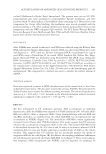
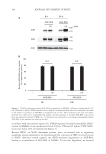
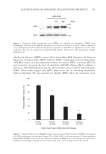
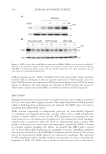
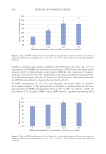
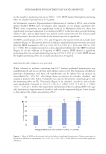
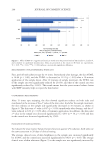
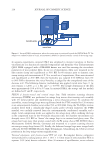
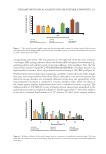
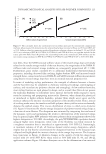
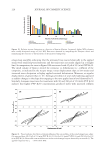
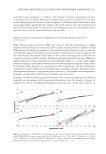
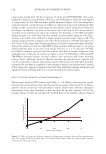
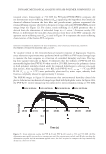
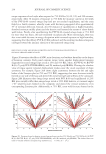
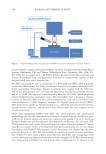
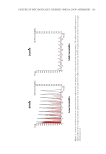
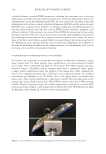
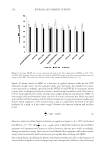
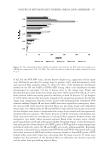
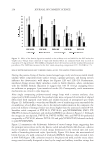
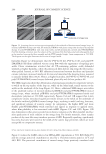
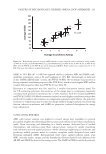
222 JOURNAL OF COSMETIC SCIENCE to the torsional storage modulus, was maximized. After 30 oscillations of increasingly higher step displacements, fixatives characteristically yield, and the slope of the torque response correspondingly decreased (Figure 6B). At higher applied torsional angles, the horizontal length of the produced Lissajous loops increased. Also, at higher step strains the mechanical response of the composite was not completely elastic. Instead, the treatment dissipated applied energy, which was indexed by the magnitude of the integrated area enclosed by the perimeter of single Lissajous loops (Figure 6C). Figure 6D plots the torsional stiffness at each strain step (i.e., the slope from each Lissajous loop) against the torsional displacement and shows the quasi-LVER for a 1% (w/w) PVP K-30–treated omega loop. After approximately 17° of applied torsion, fractures developed in the omega loop (*) and the strength of the fixative-treated tress gradually diminished (Figure 6E). Lastly, note that in dynamic torsional testing the imposed angular velocity increases proportionally with incremental steps in applied strain. Figure 7 charts the critical torsional angle of fixative-treated omega loops for tresses treated with 180 µL of 1% (w/w) aqueous polymer solution and tested at 50% RH. Critical torsional angles provide an indication of the extent of torsional twisting required to introduce precipitous decreases in torsional stiffness (see Figure 6E). Additionally, post-mortem visual inspection of omega loop interfiber debonding was used to correlate the critical torsional angle (*) with observable seam weld fractures. For glassy fixative treatments, debonding typically initiated along the top of the mounted omega loop (i.e., closest to the ARES-G2 torque transducer see Figure 2B), where warping of the omega loop shape was maximized. The results indicate that higher MW (Table II), chain entanglement, and inherent elastoplasticity are proportional to increases in the critical torsional angle. Specifically, trends in the PVP molecular weight series show that PVP K-90, PVP K-60, and PVP K-30 show significantly higher critical torsional angles than branched PVP and PVP K-15—where PVP K-15 is very low MW, and covalent branching alters the architecture of the film by decreasing the number of entanglements per polymer chain in Figure 6. Diagram of a Lissajous curve overlay for a 1% (w/w) PVP K-30 fixative-treated tress shaped into an omega loop (50% RH). Each color represents a discrete strain step, where the imposed torsional displacement includes twists to the left and right of 0° deformation. (A) The initial stiffness of the styled composite presented a steeper slope than the residual stiffness after 30 successively higher step strains (B). In the example, the energy dissipation of the composite at each strain step is represented by the integrated area of each Lissajous loop (C). For each loop, the torsional stiffness was graphed against the displacement angle (D, E) the torsional stiffness plateau (D) is the quasi-LVER for the 1% (w/w) PVP K-30 omega loop composite. Fractures (*) developed in the treated omega loop at approximately 17° displacement and diminished the tress stiffness (E). The maximum applied torsional deformation (loop B) was ca. ± 85°. The Lissajous curve was generated in ca. 100 s.
Purchased for the exclusive use of nofirst nolast (unknown)
From: SCC Media Library & Resource Center (library.scconline.org)