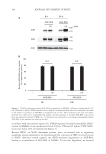
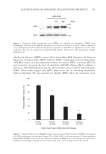
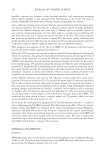
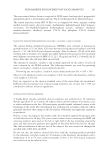
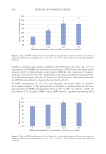
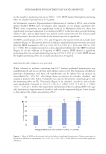
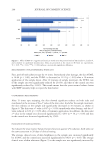
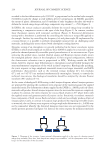
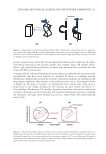
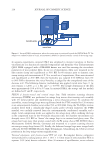
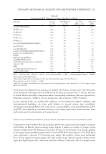
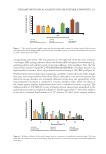
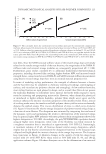
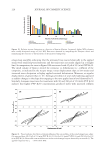
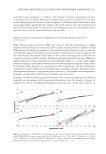
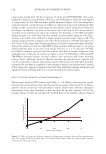
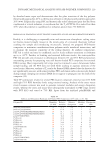
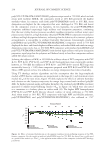
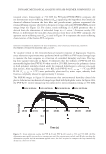
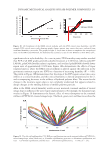
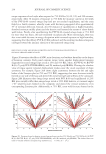
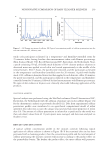
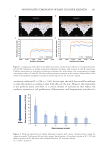
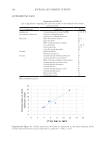
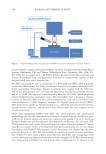
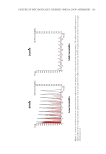
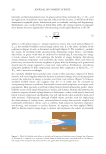
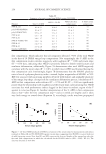
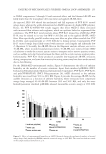
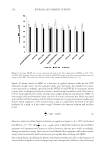
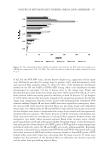
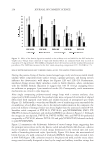
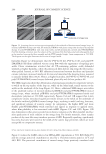
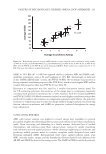
257 Failure of Mechanically Stressed Omega Loop Assemblies of AE. For the PVP MW series, discrete fixative droplets (e.g., application of hair spray) were deliberately introduced to omega loops to produce styles with discontinuous welds and untreated fiber segments. Figure 11 shows the effect of the formulation distribution method on the SR and #AED in DHSA-AED testing, where each distribution method disseminated an equivalent 2.33 mg of fixative mass to the omega loop. Virgin and bleached European dark brown hair omega loops were either treated with 186 µL of 1.25% (w/w) solution, which was evenly spread on the fibers, or with 20 discrete 2.33 µL droplets of 5.00% (w/w) solution that was evenly mapped on the omega loop perimeter. For the first omega loop compression, bleached tresses treated with homogeneously distributed PVP solutions exhibited higher SR and more #AED than their virgin fiber counterparts, where the increased SR trend noted for bleached fibers was previously found with delipidated omega loops (12). Additionally, the SR and #AED for virgin and bleached loops treated with discrete droplets were lower in magnitude than omega loops treated with homogeneously distributed fixative solutions. The relative decrease in AE for treatments with droplets was likely associated with the introduction of uncoated fiber segments between brittle and elastoplastic spot welds, where uncoated segments flexed under excessive strain, thereby protecting inelastic welds and reducing perceptible debonding. Figure 11 also demonstrates that styles produced from droplets of all MW grades of PVP applied to virgin omega loops performed identically, where the SR and #AED were nearly indistinguishable. Regarding treatments to bleached fibers, droplets from PVP K-90 and PVP K-120 formed styles with directional increases in #AED and stiffness however, droplets of lower MW grades of PVP formed stiffer styles with virgin hair, advocating that the lower-viscosity 5% (w/w) resin droplets wet the perimeter of the bleached fibers too efficiently and instead coated the cuticles rather than spot-welding adjacent fibers. Figure 10. The relationship between #AED and polymer dry solids for the PVP molecular weight series (DHSA first compression 24˚C 35% RH). The error bars indicate trends in the sample standard deviation (n ≥ 5).

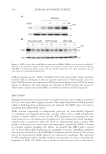
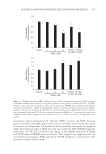
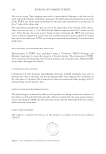
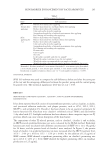
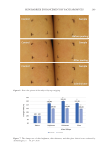
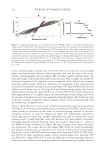
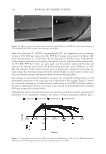
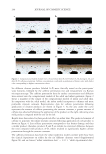
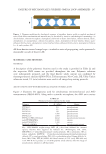
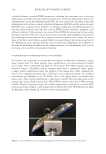
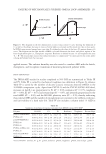
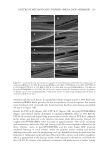
258 JOURNAL OF COSMETIC SCIENCE SEM OF ENVIROMECHANICALLY STRESSED OMEGA LOOPS: VISUALIZING WELD FAILURES During the passive drying of fixative-treated omega loops, tacky and viscous welds slowly solidify, where components from surface tension, capillary pressures, and drying stresses influence the characteristic weld shapes (see Figures 12D and 12F) (19). Furthermore, interfacial drying stresses likely introduce cracks to brittle fixatives, where calculations with the Griffith formula (Equation 2) suggest that 0.01 N (1.02 g) unzipping forces are sufficient to propagate 1 µm interfacial cracks (20). Consequently, crack termination mechanisms are critical to style longevity. After singly compressing polymer-treated omega loops with a texture analyzer, close inspection by SEM revealed that the residual styles were composed of networks of aligned fibers fixed with ruptured seam welds and smaller fractions of interspersed spot welds (Figure 12). Additionally, a very thin and flexible coat of reinforcing resin surrounded the circumference of each fiber hence, due to the myriad reinforcements in the composite, the perceived stiffness of damaged styles was always higher than the untreated control (8–10). Interfiber welds composed of PVP K-15, PVP K-90, poly(VP/DMAPMA) (INCI: VP/ DMAPA Acrylates Copolymer), and imidized p(IB/MA) are shown in Figure 12. Although the images are not depicted, PVP K-30, PVP K-30/PEG 400, and PVP K-60 performed comparably to PVP K-90, whereas PVP K-120 and poly(VP/MAPTAC) behaved similarly to poly(VP/DMAPMA). Figure 12 summarizes the dichotomic behavior of treated omega loops, suggesting that the principal stress release in the dry fixative welds included brittle film fracture, whereas elastic-viscoplastic dissipation of crack energy dominated in the stressed spot and seam welds of humidity-plasticized styles. Specifically, Figure 12A shows the near-interfacial brittle fracture of a weld composed of imidized p(IB/MA) however, when strained 4 mm at 90% RH (Figure 12B), cavitation ensued in the plasticized weld, and the excess elastic energy was frictionally dissipated as heat by the tough and rubbery interfiber strings that Figure 11. Effect of the fixative deposition method on the stiffness ratio and #AED for the PVP molecular weight series. Omega loops composed of virgin and bleached fibers are compared. Each loop received an equivalent 2.33 mg of fixative. The #AEDs are displayed above the error bars with the standard deviations in parentheses. The #AED was measured in the first 4-mm omega loop compression (24˚C 35% RH) (n ≥ 5).
Purchased for the exclusive use of nofirst nolast (unknown)
From: SCC Media Library & Resource Center (library.scconline.org)