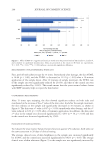
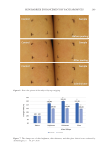
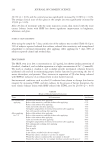
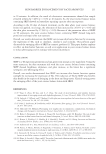
219 DYNAMIC MECHANICAL ANALYSIS OF HAIR-POLYMER COMPOSITES was gently removed from the surface of the treated PET strips and the composites were air-dried overnight on silicone release paper. The rigid and oblong PET-fixative composites were tested using torsion rectangular geometry and an ARES-G2 rheometer (TA Instruments). The loading gap was 25 mm, and the normal force was zeroed after mounting the sample. After equilibration at the testing humidity, experiments were run at ambient temperature and 10% or 75% RH. The dynamic strain sweep experimental settings were as follows: 0.05–2.50% strain (logarithmic sweep) and ω = 0.1 Hz (20 pts/decade). Data acquisition settings included: transient mode 256 pts/cycle and four half cycles (n ≥ 3). In torsional experiments, the storage and loss moduli are defined as G’ and G”, respectively. LAOS testing of fixative-treated omega loops. Omega loops were treated with 45, 90, or 180 µL of 1% (w/w) aqueous polymer solutions and passively dried overnight at ambient temperature and humidity. A TA Instruments ARES-G2 rheometer with Trios LAOS FT analysis software was used for the torsional studies. Treated omega loop tresses were affixed to the testing stage of the rheometer using torsion rectangular geometry. The wrench and fixture settings, anvil #3 with 60 cN·m of torque, were used to mount the two ends of the omega loop to the top and bottom clamps. The following experimental constraints were used for the LAOS testing: 77-mm loading gap (to accommodate the two acrylic plates, where the true sample length was 15–16 mm, which is the diameter of the omega loop) 0.05–2.50% apparent strain (loop oscillated up to ± 90°) and ω = 0.1, 1.0, or 4.0 Hz. Experiments were performed at ambient temperature (23–26°C). For the humidity-controlled experiments, the measurement stage was sealed in a custom polyethylene film enclosure. Along with Model 5482 humidification and Model 5461 dehumidification systems (Electro-Tech Systems, Perkasie, PA, USA), respectively, an Electro-Tech Systems Model 5100 RH microcontroller and Model 556 humidity and temperature probe were used to control and monitor the isohume and temperature of the testing stage. The treated omega loops were conditioned at the testing humidity for 30 minutes prior to starting the test (n ≥ 3). RESULTS AND DISCUSSION The performance of fixative-treated tresses relies on the enviromechanical response of the applied resin, but weld failure additionally includes interfacial interactions that involve the properties of the polymer and the anionically charged cuticles of the treated hair fibers. More succinctly, a polymer-treated hair fiber assembly is a composite material. When treated omega loop hair tresses are compressively or torsionally strained, hair fiber segments bend while fixative welds between contiguous fibers fracture, flow reversibly, or plastically yield to dissipate excess stress. Welds that stretch reversibly are typically quite flexible and have inherent shape memory that enables the fixed styles to slowly recover after removing the applied stress. Alternatively, very flexible and plastic films may have limited shape memory, and the welds stretch and viscously flow to avoid fracturing. In contrast to flexible films, very dry and glassy seam welds do not possess the viscoelastic componentry to dissipate stress, and instead develop microcracks that may inconveniently propagate to the polymer- cuticle interface. Catastrophic interfacial debonding involves irretrievable style loss and the concurrent release of audible acoustic energy (12). Undoubtedly, the ability to reversibly yield and dissipate applied energy is key to the toughness of the styled hair tress. One measure of conformational mobility in a fixative

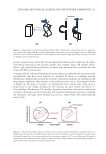
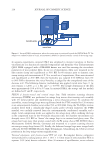
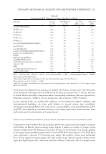
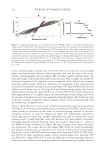
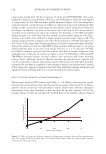
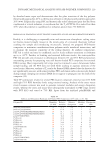
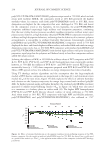
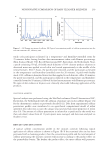
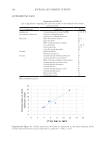
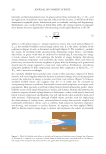
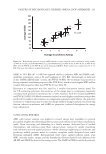
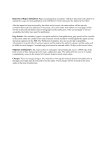
220 JOURNAL OF COSMETIC SCIENCE film is the T g , where the T g is typically measured by thermal analysis techniques, including DSC, DMA, and rotational rheology. Glass transitions are not discrete thermal transitions but are instead singular values that are used to represent the temperature range over which the T g takes place (11). Figure 5 is a model thermogram showing a typical glass transition for a fixative with a T g of approximately 110°C. Prior to the onset of the T g inflection (ca. 102°C), the polymer film is an amorphous and brittle glass (glassy plateau). During the thermal transition, increased free volume and segmental motion of the backbone intensify the toughness of the film (leathery phase). After completion of the heat flow inflection (ca. 119°C), the polymer is rendered soft and rubbery and capable of plastic and limited translational flow (rubbery plateau). Polymeric compositional factors, including MW, polydispersity (PDI), chain flexibility, bulkiness of monomeric pendant groups, secondary bonding interactions (i.e., hydrogen and van der Waals bonding), and the degree of crosslinking influence the magnitude of the T g (11). The T g reported in most marketing brochures and research articles, including our current work (Table II), is the dry T g and refers to increases in the cooperative wiggling of adjacent monomer units in the dry polymer backbone as a function of increasing temperature. The magnitude of the dry T g alone is practically irrelevant as a hair fixative performance indicator since most styling resins are formulated with plasticizers or are hygroscopic, where the segmental mobility of the backbone is increased as water vapor increasingly adsorbs to the polymer chains. Eventually, with prolonged exposure to higher ambient humidity, absorbed water lubricates entanglements in the polymer chains and interferes with weaker physical interactions, including polymeric hydrogen and van der Waals bonding, and lowers the energy barrier for augmented plastic flow. Although the T g derived from DSC heat flow measurements is extensively used as an indicator for predicting the intrinsic flexibility of styling fixatives, results from thermomechanical testing likewise discern the T g while simultaneously describing mechanical transitions in the styled fixative-hair fiber composite, including brittle weld failure and changes in style elasticity. For example, by isothermally sweeping the humidity and/or temperature in a viscoelastically reversible DHSA experiment and monitoring changes in sample stiffness, the critical isohume (T g at a chosen isotherm) may be measured while synchronously 102 °C T g = 110 °C 119 °C 80 90 100 110 120 130 140 Temperature (°C) Glassy Rubbery Leathery Figure 5. Model DSC thermogram for a thermoplastic styling resin showing the effects of increasing kinetic energy as it is heated through its glass transition. By convention, the Tg for poly(VP/VA) is designated as 110°C (midpoint of the thermal transition), although the polymer physically transitions from a glass to a soft rubber over a 17°C temperature range. Heat Flow (J/g)
Purchased for the exclusive use of nofirst nolast (unknown)
From: SCC Media Library & Resource Center (library.scconline.org)