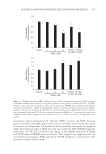
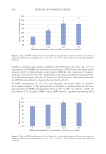
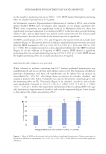
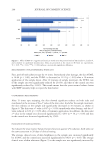
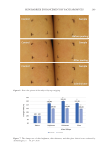
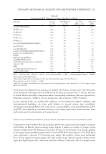
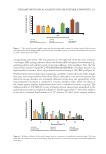
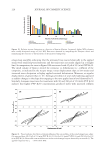
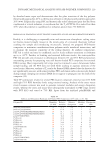
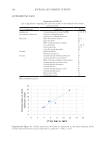
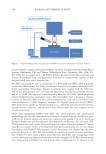
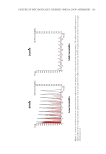
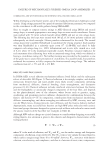
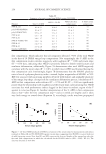
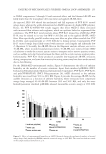
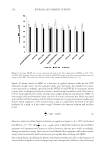
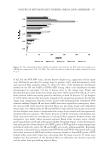
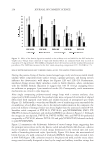
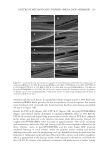
251 Failure of Mechanically Stressed Omega Loop Assemblies CORRELATING AED WITH SENSORIAL CRUNCHINESS USING TREATED OMEGA LOOPS When developing a new fixative system, one of the standard performance challenges is style crunch. Using ratings generated by a panel of untrained laboratory personnel, we compared tactile crunchiness to AE results gathered using DHSA-AED. Since we sought to compare sensory ratings to AED liberated using DHSA and treated omega loops, it seemed appropriate to use omega loops to assess tactile crunchiness. Tresses were washed with 3% (w/w) sodium laureth sulfate (SLES) and wet set into omega loops. The following day the loops were treated with 186 µL of 2% (w/w) polymer solution and subsequently air-dried overnight. Fifteen panelists volunteered for the study. The treated omega loops were scrambled beforehand to randomize the testing sequence. Each panelist was then blindfolded in a relatively quiet room (37–42 dB-SPL) and asked to fully compress each omega loop (i.e., 100% deformation) and to rate style crunch on a scale of 0–10, where 10 is the maximum reportable crunch. Panelists evaluated triplicates for each treatment after calibrating force with an untreated omega loop, which was defined as having a crunchiness rating of 0. No further training was provided to the panelists as one of the goals was to assess their perception of crunchiness. In a parallel study, four panelists evaluated the resistance to fully compress the fixative-treated omega loops. The ambient conditions were 22 ± 3°C and 48 ± 2% RH. RESULTS AND DISCUSSION In DHSA-AED, several adhesion mechanisms influence bond failure and the subsequent release of detectible AE (Figure 1). Practical adhesion is deceivingly complex, and durable interactions between hair and water-soluble resins likely involve components stemming from mechanical, diffusive, chemical bonding, chain entanglement, and dissipative processes (13,16). Chemical adhesion includes interfacial attractions between the fixative and the hydrophobic or anionically charged components of the hair fiber, and depends on the physiochemical state of the substrate, where factors such as genetics, aging, weathering, and grooming practices influence chemoselective conformations between the fixative and keratin (9–13). In comparison, contributions from mechanical interlocking, diffusive intermingling, and chain entangling are influenced by MW, viscosity, ionic and van der Waals forces, drying protocols, resin diffusion, and the fixative delivery method. Appropriately, many successful hair fixatives are high MW polar molecules with cationic functional groups that were designed to optimize style stiffness and molecular contact with the anionic moieties of the hair fiber (see examples in Table II). Although MW and net charge are critical elements to consider when designing a successful styling fixative, less attention is given to the cohesive and dissipative characteristics of the styling polymer: W W W SE diss = + (1) where W is the work of adhesion, and W SE and W diss are the surface energy and dissipative components of adhesion, respectively (16). The W SE term is very similar for most fixatives, where surface energies range from 40 to 60 mJ/m2 however, W diss associates with fixative cohesion, viscoelasticity, and compliance, and thus is a function of stress, time, temperature,

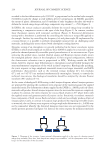
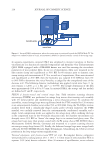
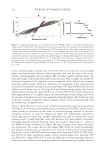
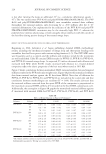
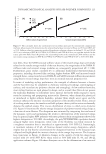
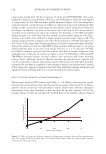
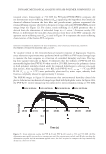
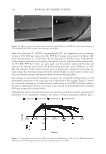
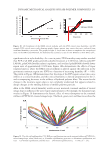
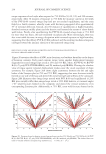
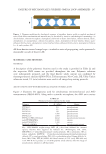
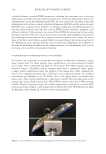
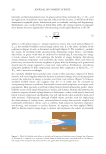
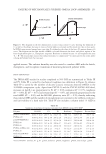
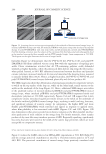
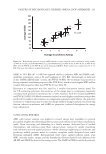
252 JOURNAL OF COSMETIC SCIENCE humidity, and formulated plasticizers. In glassy polymer films and welds, W SE W diss , and the application of inordinate stress typically induces brittle fracture, in which brittle films demonstrate negligible plastic deformation prior to randomly cracking and fragmenting. Furthermore, once cracks develop in brittle film welds, the energy required to propagate these fissures decreases significantly with increasing crack length (Equation 2) (16–18): σ πa f s,p G E = (2) where σ f is the failure stress (i.e., energy required to create a new crack surface) (Figure 5) G s,p is the modified Griffith’s critical energy release rate E is the elastic modulus of the polymer (see Figure 6) and a is the initial crack length (Figure 5). The variable G s,p includes the energy for breaking bonds and plastically dissipating energy. Hence, catastrophic film failure in glassy welds may be mediated by maximizing E, increasing the energy to break cohesive bonds, and exploiting the benefits of energy damping. Introducing energy-damping components, such as flexible side chains, nanofillers, fibers, and chemical plasticizers, increases the fracture toughness of glassy films by blunting crack growth and maximizing the energy required to create new crack surfaces. Furthermore, introducing dissipative pathways to film compositions increases film compliance, in which W diss W SE , and σ f increases accordingly. In a nutshell, Griffith theory predicts that cracks in fiber junctions composed of brittle fixatives will easily lengthen when the decrease in potential energy after crack propagation exceeds the reduction in energy to produce two fresh crack surfaces (Figure 5) however, modified Griffith theory also suggests that the σ f of welds may be increased by incorporating fixatives or additives that would increase weld compliance to mitigate crack propagation. More precisely, a textbook styling fixative should demonstrate perfect elastic behavior across a wide range of frequencies, strains, and climates. Realistically, however, the climactic response of most styling fixatives is dichotomic—where welds may be hard and brittle at lower temperature and humidity, but soft and ductile when warmed or plasticized with moisture. Unfortunately, although Griffith theory provides tools for implicating the shortcomings of styling resins, enviromechanical testing data provides tangible and marketable performance claims, such as stiffness, hold, plasticity, humidity endurance, anti-frizzing, and resistance to surface abrasion. In response, we have applied DHSA- AED to fixative-treated omega loops to observe and enumerate the release of externally Fiber 1 Fiber 2 a Seam weld fracture (two new surfaces) Figure 5. Model of Griffith crack failure in a brittle weld junction of a fixative-treated omega loop (Equation 2). For shorter a, sufficient σf is required to break chemical bonds and create two fresh surfaces. At longer a, the energy of the composite decreases and the crack grows with minimally applied strain.
Purchased for the exclusive use of nofirst nolast (unknown)
From: SCC Media Library & Resource Center (library.scconline.org)