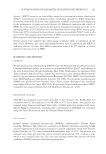
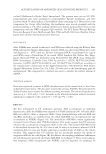
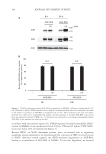
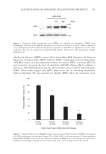
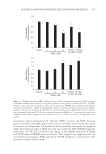
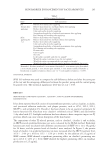
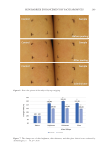
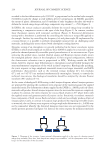
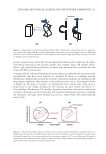
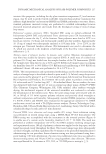
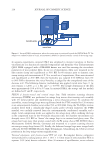
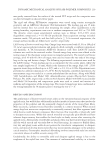
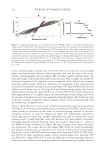
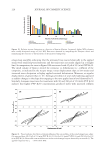
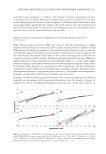
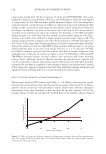
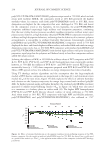
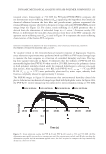
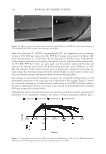
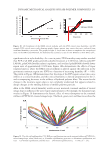
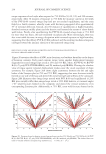
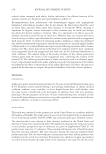
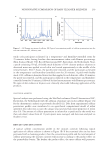
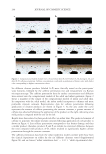
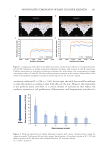
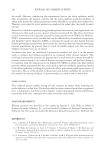
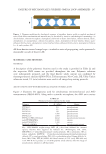
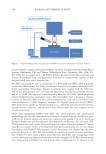
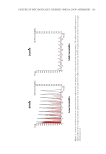
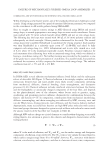
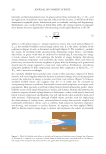
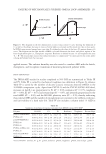
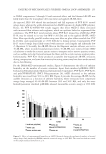
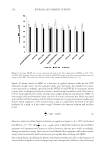
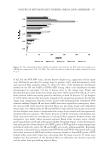
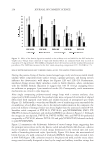
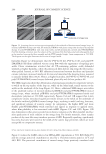
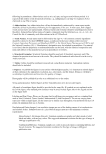
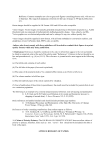
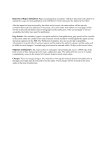
215 DYNAMIC MECHANICAL ANALYSIS OF HAIR-POLYMER COMPOSITES produces distorted waveforms that include additional harmonics that complicate the shapes and physical meaning of the Lissajous profiles. For example, Figure 3B exhibits perfect plastic- and strain-stiffening behaviors in which large deformations irreversibly alter the original LVER microstructure. Consequently, the contours of rheological Lissajous plots pictorially describe microstructural perturbations that have been imposed on materials by linear or nonlinear external deformation. Additionally, beneath the triviality of Lissajous diagrams are mathematically meaningful complexities. For example, in the model stress (σ) versus γ Lissajous plot shown in Figure 3A, the slope of σ against γ is proportional to G’, and the area of the curve is proportional to the energy dissipated by the material per unit volume and, hence, G” (loss modulus). Furthermore, FT rheology algorithms have been conceived to analyze the contours of Lissajous patterns and produce new nonlinear rheological parameters, including the minimum and large strain moduli (G’ M and G’ L , respectively), and strain-stiffening ratio (S) (10). θ 40° 0° (A) (B) Transducer Figure 2. Application of torsional deformation (θ) in LAOS testing, where: (A) torsional strain is applied to a rectangular specimen and (B) torsional displacement is imposed on a treated omega loop tress. Although the entire tress is treated with fixative, the red ellipse on the torqued omega loop shows the typical location of introduced seam weld fractures. γ Viscous Viscoelasg415c Elasg415c (S S) (LAOS) Deformag415on (A) (B) Perfect plasg415c Nonlinear Figure 3. (A) Ideal sinusoidal response of elastic, viscous, and viscoelastic materials to sinusoidal strains, as described by the contours of model Lissajous plots. For elastic materials, the stress response is in phase with the applied strain (line). In viscous materials, the stress wave response is 90° out of phase with the applied strain (circle). Viscoelastic materials appear as distorted ellipses (B) nonlinear, strain-stiffening response to applied deformation produces distorted Lissajous loops. Stress Reσsponse (σ)

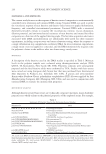
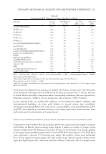
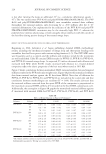
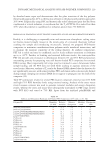
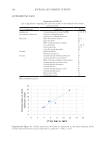
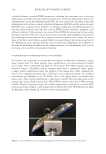
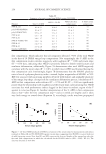
216 JOURNAL OF COSMETIC SCIENCE MATERIALS AND METHODS The current study focuses on the response of fixative-treated composites to environmentally controlled stress relaxation and torsional DMA testing. Uniaxial DMA was used to probe the viscoelastic response of neat fixatives and fixative-styled tresses to applied deformation, frequency, and controlled environmental parameters. Torsional DMA with a rotational rheometer provided a means to visualize the viscoelasticity, intrinsic viscous dissipation, dilution potential, and enviromechanical resistance of neat fixatives and treated hair fiber composites as a function of the applied twisting angle. The fast data acquisition electronics associated with DMA instrumentation are additionally well suited for other transient experiments, including creep-recovery and stress relaxation testing, where the response to a single deformation step complements oscillatory DMA. In stress relaxation experiments, a single strain event was applied to a material, and the DMA monitored the requisite time for polymeric chains in the welds to relax into lower energy steady states. MATERIALS A description of the fixatives used in the DMA studies is specified in Table I. Moisture levels in the polymer samples were evaluated using thermogravimetric analysis (TGA Q5000, TA Instruments, New Castle, DE, USA). Polymeric solutions were subsequently prepared and the final fixative solids were confirmed by TGA. Studies with hair tresses were carried out using European dark brown hair that was purchased from International Hair Importers & Products, Inc. (Glendale, NY, USA). A porous and semicrystalline Kunin white Rainbow Classic polyethylene terephthalate (PET) felt was supplied by Foss Manufacturing Company, LLC (Hampton, NH, USA), and was used in conjunction with torsional DMA to estimate the intrinsic film properties. METHODS OF ANALYSIS Although fixative-treated hair tresses are technically composite materials, many durability properties are wholly reliant on the physical properties of the employed resins. For example, Table I Summary of Fixatives Used in the Enviromechanical Studies Polymer ID INCI PVP K-15, K-30, K-60, K-90, K-120 Polyvinylpyrrolidone Branched PVP Polyvinylpyrrolidone Imidized poly(IB/MA) Isobutylene/Ethylmaleimide/Hydroxyethylmaleimide Copolymer poly(VP/DMAPMA) VP/DMAPA Acrylates Copolymer poly(VP/DMAPMA/MAPLDMAC) Polyquaternium-55 poly(VCL/VP/DMAPMA/MAPLDMAC) Polyquaternium-69 poly(VP/LM/AA) VP/Acrylates/Lauryl Methacrylate Copolymer poly(VCL/VP/DMAEMA) Vinyl Caprolactam/VP/Dimethylaminoethyl Methacrylate Copolymer poly(MA/MVE) diacid PVM/MA Copolymer poly(VA/BMA/IBA) VA/Butyl Maleate/Isobornyl Acrylate Copolymer AA: acrylic acid BMA: monobutylmaleate DMAEMA: 2-(dimethylamino)ethyl methacrylate DMAPMA N-(3- (dimethylamino)propyl)methacrylamide IB: isobutylene IBA: isobornyl acrylate LM: lauryl methacrylate MA: maleic anhydride VA: vinyl acetate MAPLDMAC: 3-(methacryloylamino)propyllauryldimethylammonium chloride MVE: methyl vinyl ether.
Purchased for the exclusive use of nofirst nolast (unknown)
From: SCC Media Library & Resource Center (library.scconline.org)