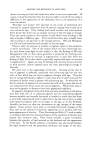
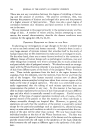
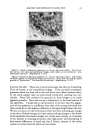
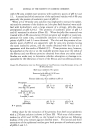
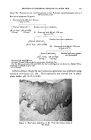
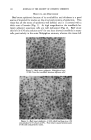
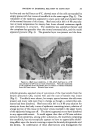
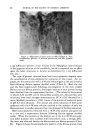
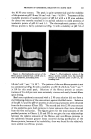
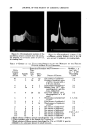
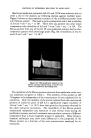
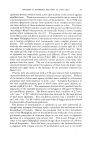
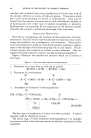
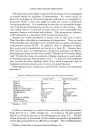
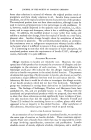
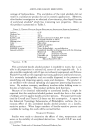
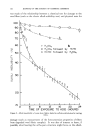
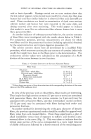
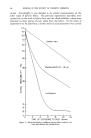
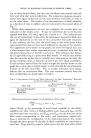
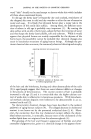
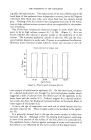
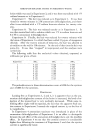
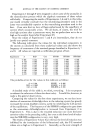
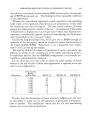
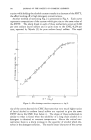
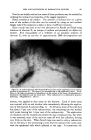
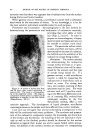
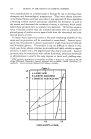
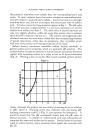
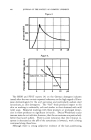
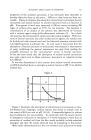
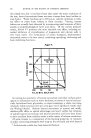
SODIUM LAURYL SULFATE-LAURYL ALCOHOL-WATER SYSTEMS 397 beyond the CMC indicates that the slopes are characteristic of a particular value of the transition temperature. Z = moles of alcohol moles of alcohol q- (moles detergent -- moles of der. at the CMC) Consequentlywe have defined the quantity as the"apparent miceliar mole fraction" which represents the concentration of alcohol in miceliar deter- gent only. The experimental FDTT's are then plotted in Fig. 5 against log Z for all concentrations of detergent above the CMC. The value 0.226 per cent sodium lauryl sulfate is taken from the break in Fig. 4 as repre- senting the CMC for the calculation of Z. The various curves of Fig. 2 except those for concentrations below the CMC, have been reduced in this plot to a single curve. The implications of this plot are the following: 1. Above the CMC, the miceliar composition (mole fraction of alcohol in the micelie) determines the value of'the FDTT which is independent of the number of micelies, i.e., FDTT depends only on the composition of the micelie. 2. Increasing Z results in an increase of the FDTT up to a limiting tem- perature of about 34øC. From consideration of phase data (1'), it appears probable that the intersection of the two branches of the curve in Fig. 5 represents the upper temperature limit for the solution of lauryl alcohol in the micelies and that further addition of lauryl alcohol gives rise to a two-phase system. This calculation neglects the slight correction that should be made for the alcohol which is associated with non-micellar detergent and is not dissolved in the micelies. However, this is essentially of theoretical in- terest and not too significant for this discussion. We have presented a theory of FDTT which is essentially based on the "buffering" action of the micelies and therefore should be confined to the concentrations where micelles are present. INTERMOLECULAR COMPOUNDS Two intermolecular compounds or adducts have been isolated as crystal- line precipitates from the sodium lauryl sulfate--lauryl alcohol--water system. Several of the solubility diagrams have been previously pub- lished (1). These adducts have the following compositions: 1 mole sodium lauryl sulfate: 1 mole lauryl alcohol 2 moles sodium lauryl sulfate: 1 mole lauryl alcohol It is believed that the phenomenon of slow draining films is probably due to the existence of rigid surfaces on the films. The requirement for the formation of high viscosity surfaces is that there'must be present on the sur- face a long chain polar compound which can interact with the detergent

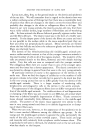
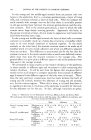
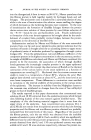
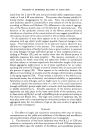
•398 JOURNAL OF THE SOCIETY OF COSMETIC CHEMISTS molecules with considerable energy. Brown, Thuman, and McBain (4) have shown that the surface viscosity of the system discussed here can be ex- traordinarily high. The transition from slow to fast draining is probably akin to a melting phenomenon in two dimensions, the surfaces changing from rigid or semirigid ones to freely flowing ones. In the case of the slow draining films, the rigid surfaces of the film may act like the walls of a plate viscometer in which liquid held between two solid plates can be made to drain very slowly. When the surfaces become mobile, then we have the fast draining case, the bulk liquid descending rapidly along with the sur- faces. The existence of intermolecular compounds in this system is quite con- clusive evidence that there are strong interactions between lauryl alcohol and sodium lauryl sulfate in the bulk and that these are probably respons- ible for the existence of surfaces of .high viscosity. The forces that lead to interaction between these molecules are of the ion-dipole type at the polar ends, and van der Waals interactions between chains. It has been found that the formation of slow draining films is favored by straight chain de- tergents and additives (2), which is in accord with our interpretation since the van der Waals forces increase very rapidly with closeness of approach. Widely different chain lengths of additive and detergent are in general unfavorable, as is branching on either substance. CONCLUSIONS The formulatot of shampoos can use the film drainage technique as a useful method for determining whether a given material will be useful as an additive for enhancing foam characteristics. In addition a study of the concentration relationships for detergent and additive which give slow draining films is useful for choosing that ratio of additive to detergent which will give the highest FDTT at use concentrations. dcknowledgment: The author wishes to acknowledge the active par- ticipation and helpful criticisms in this work of G. D. Miles, J. Ross and M. B. Epstein. REFERENCES (1) Epstein, M. B., Wilson, A., J akob, C. W., Conroy, L. E., and Ross, J., y. Ph)s. Chem., 58, 860 (1954). (2) Miles, G. D., Ross, J., and Shedlovsky, L., y. din. Oil Chemists' Soc., 27, 268 (1950). (3) Williams, R. J., Phillips, J. N., and Mysels, K. J., Trans. Faraday Soc., in press. (4) Brown, A. G., Thuman, W. G., and McBain, J. W., 5 t. Colloid Sci., 8, 491 (1953).
Purchased for the exclusive use of nofirst nolast (unknown)
From: SCC Media Library & Resource Center (library.scconline.org)