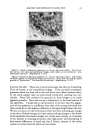
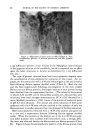
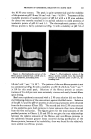
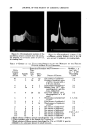
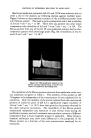
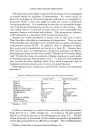
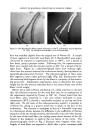
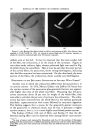
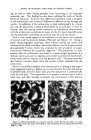
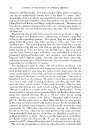
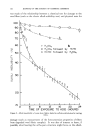
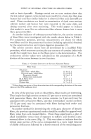
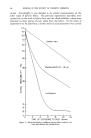
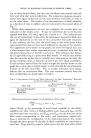
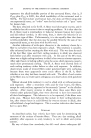
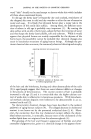
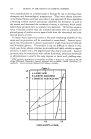
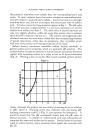
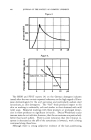
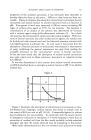
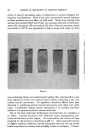
372 JOURNAL OF THE SOCIETY OF COSMETIC CHEMISTS It is now some years since it was found by Miles and Ross that it is possi- ble to classify foams and films produced with the common surface-active agents into two groups, fast and slow draining respectively. When allowed to drain freely the fast draining foams thin rapidly with the appearance in a short time, generally less than a minute, of the typical interference colors associated with soap bubbles, followed by the disappearance of the colors as the so-called "black films" develop. With slow draining foams the same process is relatively long drawn out, being several times longer. The validity of this separation into two definite categories was estab- lished by the prediction and observation of sharp temperature transitions in films between slow and fast draining conditions. Slow draining foams and films were observed with certain narrow classes of surface-active agents. It was also found that their occurrence required the presence of at least two surface-active components of differing proper- ties. Not all combinations gave rise to slow draining foams and fairly strict limitations upon the molecular structures of both components were postulated (1). In the first experiments, many of the basic techniques, useful in the study of foam and film drainage, were developed. These studies were also coordinated with certain fundamental problems related to minima in sur- face and interfacial tension and to selective fractionation through foaming or emulsification. This whole development has important implications for the cosmetic industry by providing a scientific understanding of certain of its materials. Subsequent work has been concerned with extending the systems known to show slow drainage and with improvements in experi- mental technique. There has also been an appreciation of the foam drainage (or film drainage) transition temperature as being a definite physico-chemi- cal property which may be studied as a function of concentration variables and phase changes, much as ordinary melting points may be studied (2). Some years ago at the laboratories of the Colgate Palmolive Co. (3), the writer carried out some experiments on tall columns of wet foam under varying conditions of temperature and liquid content. It will be interest- ing to reconsider certain aspects of this work. If a manometer is placed at the bottom of such a column, the measured pressure is due to the amount of liquid held in the foam and is a measure of the foam density. This simple principle offers an approach to the study of drainage characteristics by the use of columns of foam through which a flow of detergent solution is maintained. One of several convenient arrangements of a drainage apparatus is shown in Fig. 1. This apparatus consists of a jacketed column having an upper section approximately 15 cm. long by 2.2. cm. internal diameter and a lower section 34 cm. long by 0.9 cm. internal diameter. The outlet, D, of the column is 64 cm. below the solution inlet, z/. A thermocouple, B,

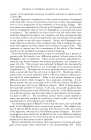
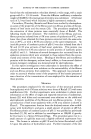
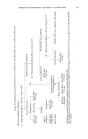
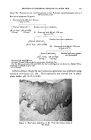
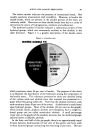
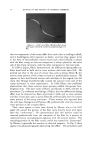
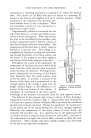
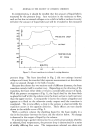
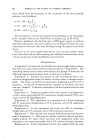
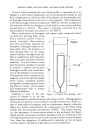
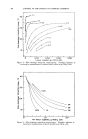
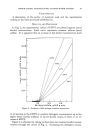
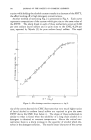
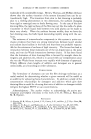
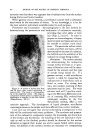
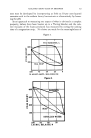
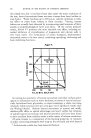
FOAM TRANSITIONS AND FOAM PERSISTENCE 373 connected to a recording instrument is situated 8 cm. below the solution inlet. The column can be filled with foam by means of a spinneret, F, located at the bottom and supplied with air at constant pressure. Under conditions of the experiment the spinneret pro- duces bubbles about 1.5 mm. in diameter. These are remarkably constant in size and permit re- generation of a given •am. A Experimentally, solution is introduced into the top of the column at a steady rate which is main- tained without interruption. When the solution has risen to the level fixed by the overflow tube, C, foam is generated until it fills the column to the inlet level with uniformly sized bubbles. The 8 temperature of the foam then is slowly raised or lowered at a constant rate. This change is ac- complished by heating or cooling the water flow- ing through the jackets of the foam column and the jacket of the preheater and flow regulator (not shown) which feeds solution to the inlet. c- ' -- c' Throughout the course of the experiment the temperature of the foam, the rate at which liquid issues from the outlet and the drop in pressure D • across the foam are observed. The drop in pres- sure is indicated by the lowering of the liquid- F foam boundary from the initial solution level set by the outlet. It provides a measure of the density of the foam and is proportional to the average density if the average is taken over the height without respect to the difference in di- Figure 1.--Foam drainage apparatus: Column of vary- ameter of the two sections of the column. A ing diameter. calculation of total liquid in the foam requires knowledge of the diameter and pressure drop for each separate section. The behavior of the pressure drop across a column of foam showing a temperature transition is given in Fig. 2. These results were obtained for a 0.25 per cent aqueous solution of Duponol ME from which the unsulfated alcohols had not been extracted. During the experiment the temperature of the jacket and of the liquid flowing into the foam changed together. Effectively the temperature of the entire column of foam slowly and uniformly fell and then rose. It is apparent that as the temperature fell an abrupt increase in pressure drop occurred at about 40øC., and that as the temperature rose again the reverse effect occurred at about the same temperature. These changes take place rapidly enough to be observable by the eye as the experiment progresses.
Purchased for the exclusive use of nofirst nolast (unknown)
From: SCC Media Library & Resource Center (library.scconline.org)